
Before the Name Meant Anything: A Portrait of Anthony Bourdain as a Young Disaster
There's a quote that opens Tony, pulled from Anthony Bourdain's own words, that sets the terms of everything to follow:
"I was, to be frank, a spoiled, miserable, narcissistic, self-destructive and thoughtless young lout, and badly in need of a good ass-kicking."
It's the kind of opening declaration that immediately tells you what kind of biopic this will be, which is to say, not the kind that typically gets made.
Matt Johnson, along with writers Todd Bartels, Lou Howe, and Matthew Miller are not here to sanctify a man whose death has calcified him into sainthood in the public imagination. They are here to show us the shithead, and in doing so, to remind us that the most beloved people were often, at nineteen, completely unbearable.
That is not a criticism of Bourdain. That is the most honest tribute anyone could pay him.
Johnson, who has proven himself across wildly different registers with BlackBerry and the gloriously unhinged Nirvanna the Band the Show the Movie, brings a genuinely unusual intelligence to the biopic form. Rather than attempting to compress a full, extraordinary life into two hours of tastefully lit highlights, he zeros in on a single summer: 1975, Provincetown, a nineteen-year-old Tony Bourdain following a girl, lying about a writing fellowship, and accidentally stumbling into a kitchen that will change everything.
It is the origin story approach, and in Johnson's hands it feels less like a structural choice and more like an act of grace. Because when you love someone the way the world came to love Bourdain, the last thing you should do is flatten them into a monument. The braver move is to show them being spectacularly, recognizably human.
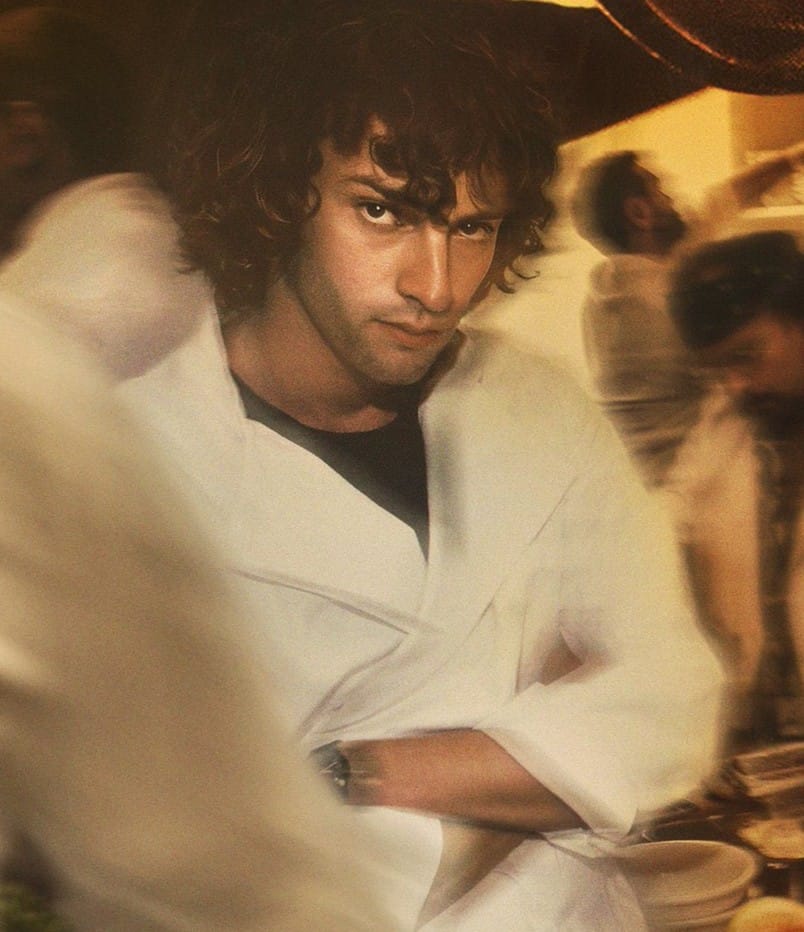
Dominic Sessa, building on the promise he showed in The Holdovers, gives a performance of real charisma and real nerve. His Tony is leather-jacketed, nunchuck-wielding, insufferably pretentious, and genuinely difficult to dislike despite all of that, which is exactly the balance the film requires. He is a nineteen-year-old who keeps using words he does not fully understand and dreaming of a literary greatness he has not yet done the work to deserve.
The screenplay, written by Johnson alongside Todd Bartels, Lou Howe, and Matthew Miller, is smart enough to let him be wrong about nearly everything without making him contemptible. There is a line of thought in the film about how Bourdain desperately wanted to be Holden Caulfield while apparently forgetting that Holden Caulfield was defined by the very wandering, truth-hungry restlessness that Bourdain himself would eventually make famous. The irony is both funny and quietly moving.
Antonio Banderas, as the chef known only as Ciro, gives what is probably the film's finest performance. He brings a stoic, complicated authority to the role, a man who has already made his peace with his regrets and now simply does the work with a quiet intensity that Tony cannot yet comprehend. Banderas plays him with enormous restraint, letting his character's warmth and melancholy sit just beneath the surface of every scene rather than announcing themselves.
It is the kind of performance that teaches you something about acting by refusing to explain itself.
Leo Woodall as Sal, Tony's drugged-out, charismatic, catastrophically bad-influence coworker, is a scene-stealer of the first order: all brash New York energy and a barely suppressed grief behind his eyes. There is a scene between Woodall and Banderas in the kitchen where things boil over that is among the most affecting in the film.
Emilia Jones brings genuine warmth and specificity to Nancy, and Stavros Halkias, playing what is reportedly the only character actually named in Kitchen Confidential, provides comedic relief that earns its laughs rather than simply announcing them.
The production design by Ryan Warren Smith and his team deserves its own paragraph, because it's doing extraordinary work throughout. Smith previously conjured the 1970s with tremendous conviction in The Holdovers, and he brings that same period authenticity to Provincetown here: the texture of the kitchen, the feel of the restaurants, the particular quality of a summer evening on Cape Cod in 1975. It is the kind of production design that never calls attention to itself because it is too busy being completely convincing, and it gives the film a physical groundedness that makes every other element more believable. The cinematography by Michael Bauman complements this with clever blocking and shot composition that is largely unfussy and unshowy, a deliberate departure from Johnson's usual handheld aesthetic, allowing the setting to become a genuine character rather than just a backdrop.
What makes Tony feel genuinely special, beyond its craft, is its tonal intelligence. Johnson and the writers manage to hold comedy, sadness, warmth, embarrassment, and real human ugliness in the same frame without any of them canceling the others out. There are stretches of the film that feel like Linklater, loose and sun-soaked and invested in the texture of hanging out. There are moments that are almost painful to watch in their specificity about what it feels like to be young and convinced of your own future greatness while doing nothing to earn it. And there is a consistent undertow of something more melancholy, a film quietly aware of where this particular life is eventually going to lead, without ever allowing that awareness to tip into sentimentality or prophecy.
The film is admirably restrained about its connection to the Bourdain legend. The Easter eggs are present and meaningful for those who know Kitchen Confidential and No Reservations and Parts Unknown, but they never feel like obligation. More importantly, Sessa's Tony is never written as a figure clearly destined for greatness. He is written as someone who is, right now, making a mess of most things and occasionally catching a glimpse, in the middle of a frantic kitchen service or a quiet conversation with Ciro, of something that feels like himself.
The screenplay understands that you do not need to show someone becoming who they are going to be. You only need to show the first moment they stop performing and start paying attention.
The final moment of the film, Tony saying his full name out loud, lands with the particular weight that comes from knowing exactly what that name is going to mean. It is the best kind of biopic ending—one that earns its emotion not through music swells or title cards listing achievements, but through the simple accumulation of everything you have just watched. By the time it arrives, you feel it.
I loved Bourdain. Parts Unknown is one of the greatest things ever made for television, and his death hit me with a surprising force. A bad biopic about him would have felt like a betrayal. Tony is the opposite of that. It is the most honest tribute available: showing us the man before the myth, loving him through his mess, and trusting that the mess is where the real story lives.
*Feature image: Tony (2026)