
Popcorn Summer
It was 2002, my sister Ann was 20 and had decided she was going to Europe to find herself. She’d saved up, lived at home during college, only filled her gas tank halfway to keep from driving too much, and endured a year of free, home-cooked meals. She planned for over a year to go to Denedin, Carbsdale, Munich, Paris, Zurich, Venice, Corfu, and Barcelona. Her room became a paper nest of maps and travel guides from the library, every inch of wall turned into evidence of escape.
It had been unbearable to live with her that last year. I had no mental bandwidth to care whatsoever about her upcoming journey. To my credit, I was a senior in high school, holding my GPA together by sheer will so I could get a scholarship and leave, too. Because if I didn’t go to college, I’d be homeless and die—or worse, stay home.
But we were sisters. She’s older, therefore I always had to listen to her dreams. Older sisters simply possess such power. For example, we only had one Ken doll, and he always had to fall in love with Ann’s Barbie. Of course, Ken always turned evil. Once, when Ann’s Barbie refused to marry him, he raped her and threw her off a bridge. (We didn’t know what rape was, only that it was on the news). Barbie luckily made it to the hospital, where she was revived—then Ken crept into her room and stabbed her seventeen times around the heart! Ann wanted her stabbed in the heart, but I begged her not to. I was convinced Barbie would die and playtime would be over.
At twenty, Ann was still chasing the same story: pain, peril, and a resurrection. A young woman dying to get away from home, aching for adventure.
About two months before Ann’s flight, it hit my mom that it was actually going to happen. In spite of the reigning fears of airplanes and terrorism cells post 9/11, her baby was leaving. An ocean away.
Dinners at our house could erupt into arguments at any moment. In my middle school years, the target was always peas. Canned peas haunted my childhood from day care to day care, and just the memory made me gag. So, my mom and stepfather found it hilarious to serve them and insist I eat them. I begged, negotiated, and performed my flair for the dramatic—throwing peas, yelling “be free!”—earning my place in the household with humor. Each time I lost, I shoved them down, chased with water like horse pills, eyes watering, until the night I puked two glasses of water and three shriveled peas across the kitchen table. That was the bar set for ending a family fight.
The night my sister announced she’d bought her plane ticket to Europe, the dinner spread was burnt canned corn, undercooked biscuits (Ann’s favorite), and fish sticks. My mother, hiccuping through sporadic gasps, asked Ann:
“But you aren’t really going, are you?”
My jaw dropped. How could she not know? Has she been in her room lately? Her passport arrived in the mail? And didn’t Ann ask for a hiking backpack from REI for Christmas, AND MY MOM BOUGHT IT FOR HER?
I watched my mother process this; the pupils in her big, blue eyes constricting in abject horror. My sister and I had grown into our fleeing-the-house age right under her nose—and no one ever thought to ask her for permission to do so.
I had little sympathy for these feelings at eighteen, but I write this now, as a woman in her forties, listening to my children slam their doors and stomp in the hall and scream expletives during their gaming sessions—such annoying sounds I could never live without—knowing their escape is inevitable. Would I know it’s happening, but not truly know deep down the era is ending? That those doors would soon reasonably be shut or remain closed soon enough?
I watched my mother process this ... long and hard. Her belly shook the table with each dumbfounded hiccup. We sat at a plastic patio table with a beveled glass top, which our dogs would sit underneath and lick at our plates. My parents had always said they’d move it to the backyard once we found a nice dining table, but other things in our lives took precedence, and instead rooted itself as a permanent fixture, each of us unable to picture another table in its place.
“How long are you going for? <HICCUP> A week or two?” My mom’s eyes shone in panic, trying to hold another hiccup back.
“Three months,” Ann replied.
My mom’s fish stick went down wrong. She coughed it out. My Stepfather glared at Ann like she had said something inappropriate. My Stepfather is a permanent softie when it comes to animals. When they go to the Italian restaurant down the street, they bring back extra breadsticks for the dogs. But, when it comes to humans, my Stepfather possesses “The Look.” I was afraid of him on size alone. He was 6’ 2” and bigger than anyone I had ever seen. And one time when I was eight, I was being obnoxious and stupid, and he grabbed my jaw to stop me from being loud—no injury, just a clamping of my mouth SHUT. But “The Look” was like those massive fingers around my face. Us both knowing that he could end me, all of us, really, if he wanted to.
Once I saw “The Look,” I shoveled in the corn as fast as I could; Ann looked to me for support. But, earlier in the month, it had been me in the hot seat, informing my parents I wouldn’t be going to Arizona State University (ten minutes away) like my sister had. I got accepted to a state school up north, two hours away, and had acquired enough graduation money from shaking down distant relatives, and I thought I could pull it off. This college was out of the desert—the only landscape I had ever truly known. It had trees. Big beautiful sap sticky pine trees—like out of a fairy tale.
But, the unspoken plan for me to stay in my childhood bedroom, still with bunk beds, and fish stickers on the wall—the room next to my parents—for another four years. It had not been my plan; I may not have had the maps to prove it like my sister, but the escape contagion pumped through my veins as well. And in that time when I was being interrogated, Ann had gotten up to look up more hostels on her computer and left me to the wolves. So now it was her turn to be eaten alive.
I left, letting the kitchen table rage without me.
As the designated bad child of my household, a fight without me was a rare treat. Not only was I not in trouble for loading the dishwasher wrong, not cleaning my room, wasting the hot water, going to a friend’s house and not calling, or inviting members of my group project over late, when my mom was already in her nightgown, but I took a momentarily delicious moment to enjoy Ann’s screams and yells through my bedroom walls and hearing the replying disdain from my parents that was ordinarily reserved for me.
My perfect sister, with her 3.9 GPA, getting a dual degree in English AND Biology, had blundered over the tripwire of our mother’s long list of do’s and don’ts that had never been exactly shared with us. My mom’s children were leaving her—going miles away to different schools, different continents … and though it had been slow and plodding in some ways, in others, we had gone from her babies to indoor cats bolting for a cracked open front door in the blink of an eye.
After my sister slammed her door, signaling a ceasefire in the fight, I became resigned to my sisterly duties to go to her room when her tears subsided a bit. Together, we would sit and damn both of them for crushing our beautiful, young dreams. I knew I owed this to her as a sister to do this, but I didn’t necessarily like it. She always liked to end her rants by saying the parents liked her more than they liked me. And then she’d be upset on my behalf that they liked her more, earnest tears on her cheeks.
I walked into her room. She was hugging her dog, and her face was all red, making her freckles nearly invisible.
“So, what’s up?” I asked, closing the bedroom door behind me. “You going?”
The maps had taken over—she was putting pushpins in all her destinations on one. A mandolin from Nickel Creek was sounding off in the CD player—all the moodiness we could muster, being young, middle-class women, drowning in American suburbia at the turn of the century.
Ann tried to tell me, her breath as stifled as our mother’s hiccups: “They’re coming with me. They’re coming to Europe with me.”
Through my gaping expression, I sputtered out: “How can they?!”
I honestly could not fathom how that would be possible. My sister was leaving in eight weeks. She had spent years planning. How would my parents get passports, buy tickets, get a Eurorail pass, do all the things that she had spent all this time doing, telling me all about?! And … Why the hell would they?
But all I managed to say was: “You’re staying at youth hostels. They’re too old for youth hostels.”
“They’re booking nearby hotels and want me to check in with them every day.” She began to cry again.
“But they don’t want to go to Europe! They go to Alpena when they want to vacation! They love Alpena!” Alpena, Michigan, is where my Stepfather’s mother lives. On our last vacation there, we spent painting the apartments my Stepfather owns. Family labor is always the cheapest. Why would they randomly spend all that money … on Europe?!
Ann cried harder. I tried to think of some way to console her.
“But they can’t go!” I insisted, still fishing around in my mind, why this was such an absurd, impossible idea. I mean, my parents were really going to stalk my sister country to country? And then, the calm answer swept over me. Something I knew in my heart would stick. Would be true.
“They won’t go because they’d never leave me here in the house alone. Remember? I’m the irresponsible one!”
Ann cried harder and harder.
“That’s why they’re making you go, too.”
My sister and I were both adults. But, we were both not completely untied from our parents, despite our synchronized urge to flee. I was still finishing high school, Ann still had two years left of college and living at home. Like many young people this age, we were kind of hoping not to be homeless and die. But if Ann went without them, there would be no place for her here when she came back. A deep mirthless irony. And, if I didn’t go, she couldn’t go.
Oh. Another thing. I had to pay my own way. My own ticket. My own bookings. Passport.
Numbly, I sat in my sister’s room. All of the money I had been saving up was to go to college two hours away. Gone. One of our dreams had to die for the other's to survive.
I looked at those pins on her map: Denedin, Carbsdale, Munich, Paris, Zurich, Venice, Corfu, Barcelona.
This was the moment I became an adult as I realized the world wasn’t an inherently good or fair place. It wasn’t anything, except merely somewhere I existed.
Sure, I had been on the precipice of adulthood. I had just gotten my first tattoo (yet another strike for me as the designated bad child). I had been to smoky Indian casinos, giggled my way through sex shops, and after-hours at Hamburger Mary’s. I had a job backstocking men’s underwear in a department store and was already sustaining my first unreported knee injury because I had been too lazy to grab a ladder. I put together a freaking literary magazine when the editor, my ex-boyfriend, had been too busy to roll up his sleeves and do the work. It would take me till my 20s to acknowledge I was queer. It would take until then, too, for the people I knew in school to start to die. Some by suicide, others by Leukemia and cancer. But on that day, the ball started rolling.
We cut to the airport, eight weeks later in this story. It’s moments after my mother’s hyperventilation in the Super Shuttle. No one is a safe driver ever, except her, because she got into an accident almost 10 years ago in a puke-colored Gremlin with vinyl seats. I take us to the baggage check, freshly post 9/11, where everyone is suspicious (i.e., the not caucasian people). Ahead of us, people are getting nervous because these Middle Eastern guys are taking so long, and their baggage is too heavy. They’re taking out clothes from side pouches and slipping them on, but it’s still too heavy.
What could be so heavy?
My mom must have thought it was a bomb because she put her shoulder in front of me to shield me, like we were in the car, and she was about to throw out her arm to stop the impact of a real or imagined stop.
The clerk, fearful, opened the bag and revealed more microwavable popcorn than I had ever seen in my life. Orville Redenbacher’s. And the Middle Eastern guy’s pulling out his socks and some undershirts, more and more. It didn’t matter what he had to let go of; he would not give up his popcorn. Not something he’s wanted so much. I can’t stop laughing as they turn to me, search my backpack, and pull out my toiletries and sleep sheets.
I didn’t need a trip to find myself like my sister. I just needed to see this man love popcorn. At that moment, I knew that I was still leaving when I got back. Even if it took three jobs and selling my soul.
Perhaps I’d be home for Christmas time for a few turkey leftover meals and the annual one hundred dollars my bio dad gives me (which he neglects to mention each year is mostly from my Great Aunt Pat).
And then, I will once again drive away, hearing the door lock behind me and the porch light flicker out.
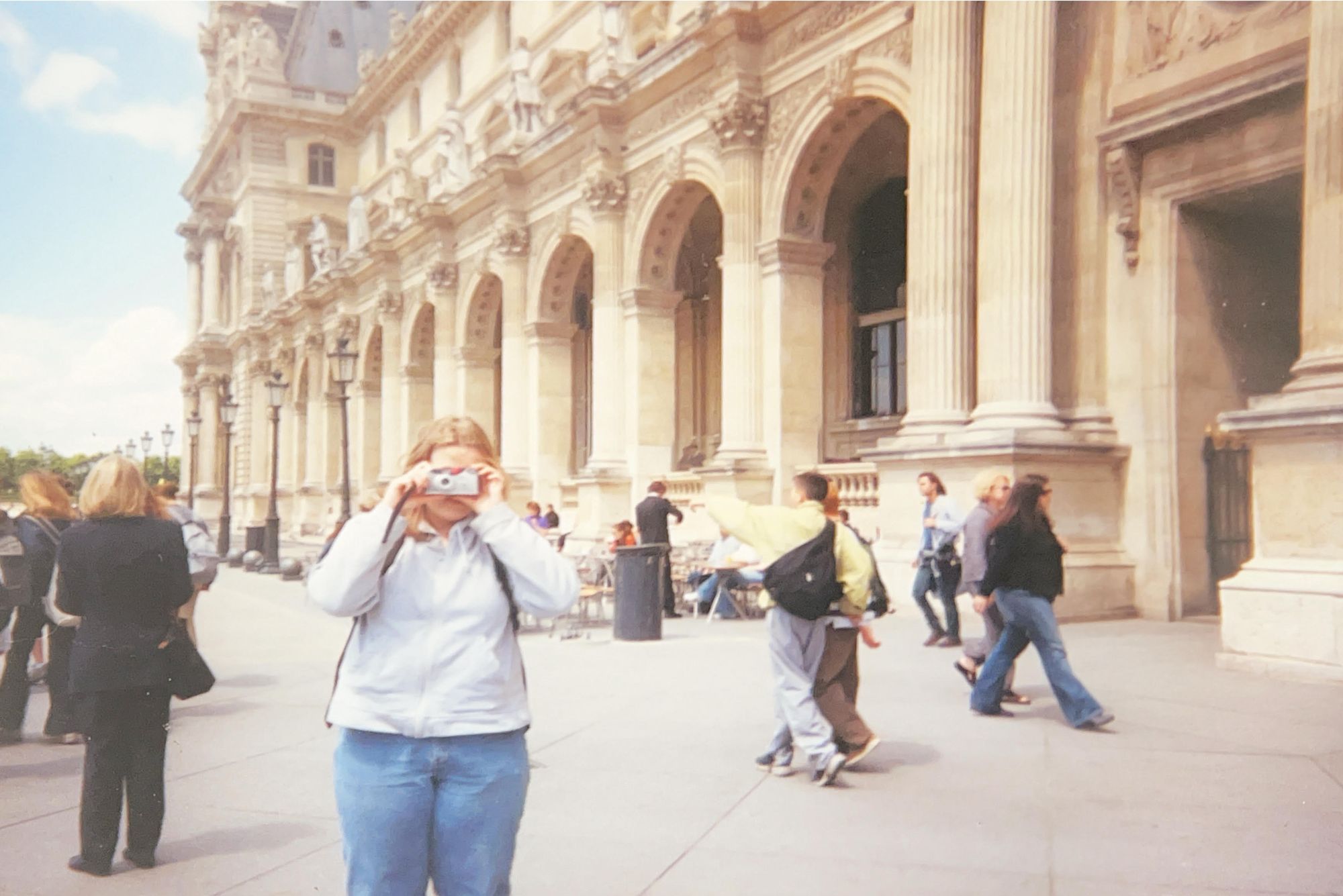
*Feature photo 'Ann Takes a Photo' by Kay Tuxford