Show, Don't Tell
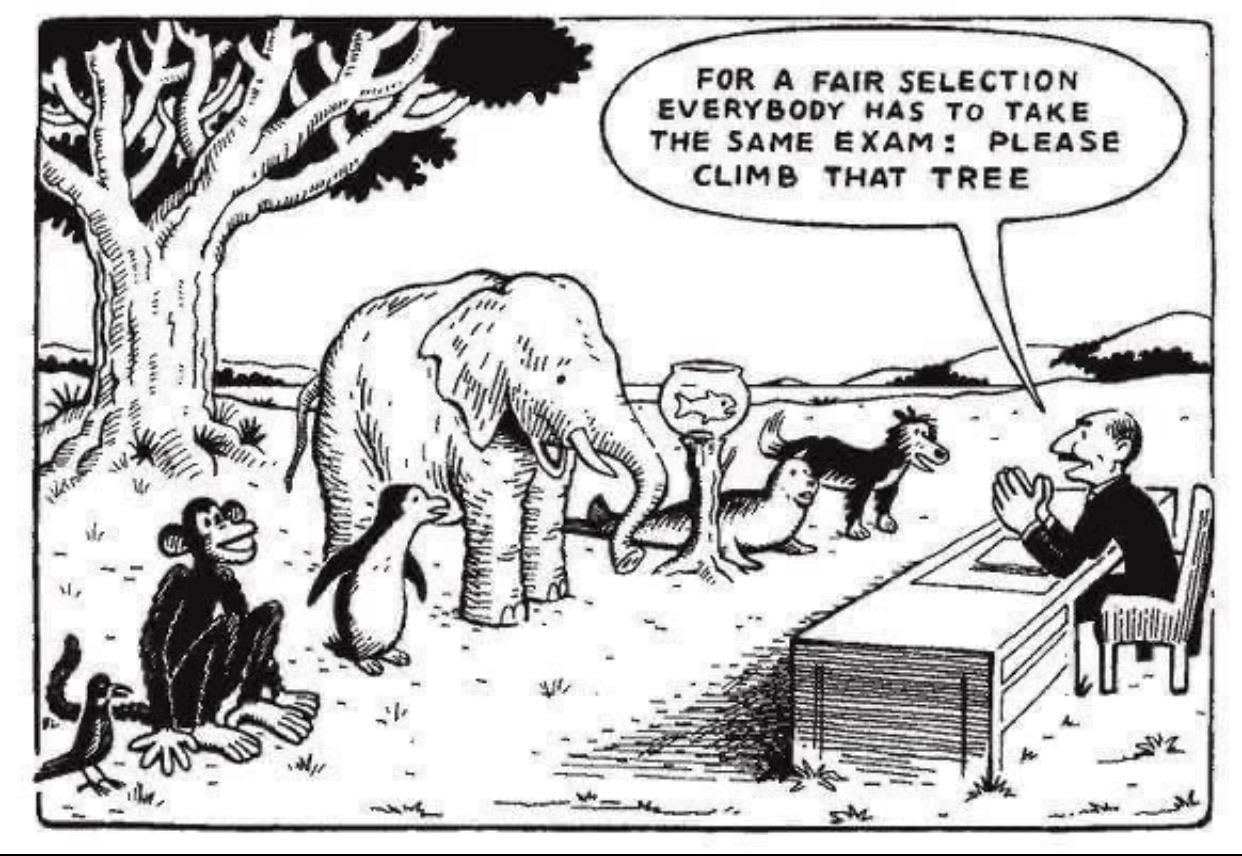
Y’all know that meme that’s been floating around where a man asks an elephant to climb a tree? In case you haven’t seen it, here’s what I’m referencing.
The idea is that what’s easy for some (aka, asking a monkey to climb a tree) is not doable for others (like an elephant, fish, or a penguin). Part of being a good teacher is recognizing your student’s strengths and weaknesses and adjusting accordingly.
This is exactly the situation I found myself in recently, working with a new writing client. He simply was not understanding the core concept that I was trying to convey, and it was leading to a lot of frustration on both ends.
“You need to show, not tell,” I said, for about the fifth time, “Telling the reader information is never as impactful as showing it to them.”
“But I feel like I am doing that!” He repeated, as he emphatically pointed to a line in his screenplay.
I shook my head. “This isn’t actually telling. What you’re really doing here is …” I’ll skip the exact wording, but I tried to explain the idea in another way.
Long story short: it still didn’t make sense to him.
This session was going nowhere fast. I was at a crossroads.
But then … something hit me. I realized I wasn’t taking my own advice.
I was trying to tell my client about “show, don’t tell.” What I needed to do was show him.
So, I opened up Youtube and started looking up scenes. We were going to watch classic moments from great films, and I’d use those to illustrate my point. And my god, did it work. Everything clicked after this.
Some people are conceptual learners; they can grasp complex topics just by talking and thinking about them. But this guy was a visual learner. He needed to see an example in order to comprehend it.
And that made me wonder … How many of you out there are also visual learners? I’m betting a ton. So, today, we’re going to have a little lesson on “show, don’t tell.” Using the exact same examples I showed my client.
But before we get into all that, let’s set a baseline …
WHY IS “SHOW, DON’T TELL” IMPORTANT?
“Show, don’t tell” is a foundational principle across all forms of storytelling because readers and audiences connect most deeply to experiences they can observe rather than information they’re simply handed. When a writer tells us what something means, or what a character feels, why a moment matters, how we should interpret it, etc, the reader stays at a distance, receiving conclusions instead of forming them.
Showing, on the other hand, uses concrete details, actions, choices, and consequences to let meaning emerge naturally. A clenched jaw, a delayed reply, an empty chair at the table can communicate far more than a sentence explaining sadness or anger. This approach turns the reader into an active participant, piecing together emotion and intent on their own. In screenwriting especially, it engages your eyes, ears, and brain simultaneously. Which makes the experience much more fulfilling to the audience.
When you show the reader or audience information, it makes them engage more deeply in the story. Because they are figuring things out for themselves. When you just tell it to them, it more often than not comes across as flat and uninteresting.
Let’s look specifically at an example that tells, rather than shows.
This is a long clip … DON’T WATCH THE WHOLE THING. But start at 01:45 (we queued it up for you) and stick with this as long as you can (until around 05:00, if you make it that far) ...
Neil Breen's Double Down:
This is from a Neil Breen movie. A filmmaker who is famous for making movies that are so bad, they’re good. Do you see how … lame that opening was? Sure, we saw him typing on a laptop, etc., but at the same time …
He told us he was a fighter pilot …
He told us he used to be in love …
He told us he was a James Bond-esque super spy …
Did any of that really land with you? I didn’t with me. It all felt pretty weak.
Telling the reader information is never as powerful as showing it. To get the most out of your writing, you want to craft scenes and moments where the audience knows what’s going on inside a character’s head without the need to tell it to us. That’s part of excellent storytelling.
With that out of the way, let’s get into the examples, and we’ll start with one of my favorite movies ever …
A FEW GOOD MEN - THE COURTROOM CLIMAX
This movie is all about Tom Cruise’s character (Dan Kaffee) investigating an incident with a dead cadet on a military base. Through his research, Kaffee knows that the “official” story being provided about how the victim died is bullshit, but the only way he can prove that is to get Jack Nicholson (Col. Nathan Jessup) to mess up and admit that in court. This will not be an easy task. Screwing this up will have severe ramifications to Kaffee’s career.
Kaffee calls Jessup to the stand and peppers him with questions. Jessup deftly dodges them. And then this happens (watch from the beginning of the clip to around 1:00) ...
When this clip opens, Kaffee has a decision to make. Thus far, he has gotten nowhere with this witness. And pressing further serves to risk his own career. Kaffee makes the decision to press on, demanding Jessup sit down when he tries to leave.
The beauty of this scene happens at 00:58. Kaffee goes to drink a glass of water, and as he brings it to his mouth, his hand trembles and shakes.
The character doesn’t walk over to his colleagues and say, “Guys, I’m going to press this round of questioning, but I’m really scared.” He doesn’t say, “I know what I’m about to do is dangerous and extremely risky.”
Instead, Sorkin shows us that Kaffee is terrified of what he’s about to do. But he’s going to do it anyway. We know what Kaffee is thinking and feeling without needing any words to describe it.
You liked that example? Cool, I’ve got more. This time we’re watching:
CHILDREN OF MEN - THE BABY IS BORN
Another classic, but in case you’re unfamiliar …
This semi-apocalyptic tale takes place in a world where women have all become infertile. Governments have collapsed and global politics have shifted for the worse because of this.
The protagonist (Theo) has spent all movie protecting a pregnant woman from harm. The first pregnant woman this universe has seen in YEARS. He’s sheltered her, guided her, and right before this, he ran into an active war zone to make sure she faced no harm.
And then this happens …
Mere minutes before this, bombs were exploding and guns were firing … But then everything suddenly stops once the baby is revealed. Every character in this universe is in awe of the child. Everyone stops what they’re doing to look upon it.
Again, people don’t walk into frame and go “wow, this is a huge moment. Holy crap, we’re saved! Maybe the world isn’t doomed!” That’s telling information. Instead, without using words, this scene showcases how important this is for the people of this story. Frankly, their silence communicates more than dialogue ever could.
I got one more for you, and we’re changing mediums now. Let’s look at an example from TV.
BREAKING BAD - THE DISCARDED PLATE
This is early in season one. Walter White is in the beginning stages of his descent to Pablo Escobar status. And in this episode (103) he’s got a thug chained up in his basement, and he’s trying to decide what to do.
His soul wants to let him go. But his brain knows it’s safer to kill him. But can he do that? Is he that type of man? Will the thug keep his word and not seek retribution? Many questions run through Walt’s mind …
Walter spends most of the episode talking to the thug. He learns his name. Gets to know him, and decides “yeah, I can’t kill you. I’ll let you go.” But earlier in the episode, it’s critical to know that Walter brought him food, and accidentally shattered the ceramic plate the sandwich was on.
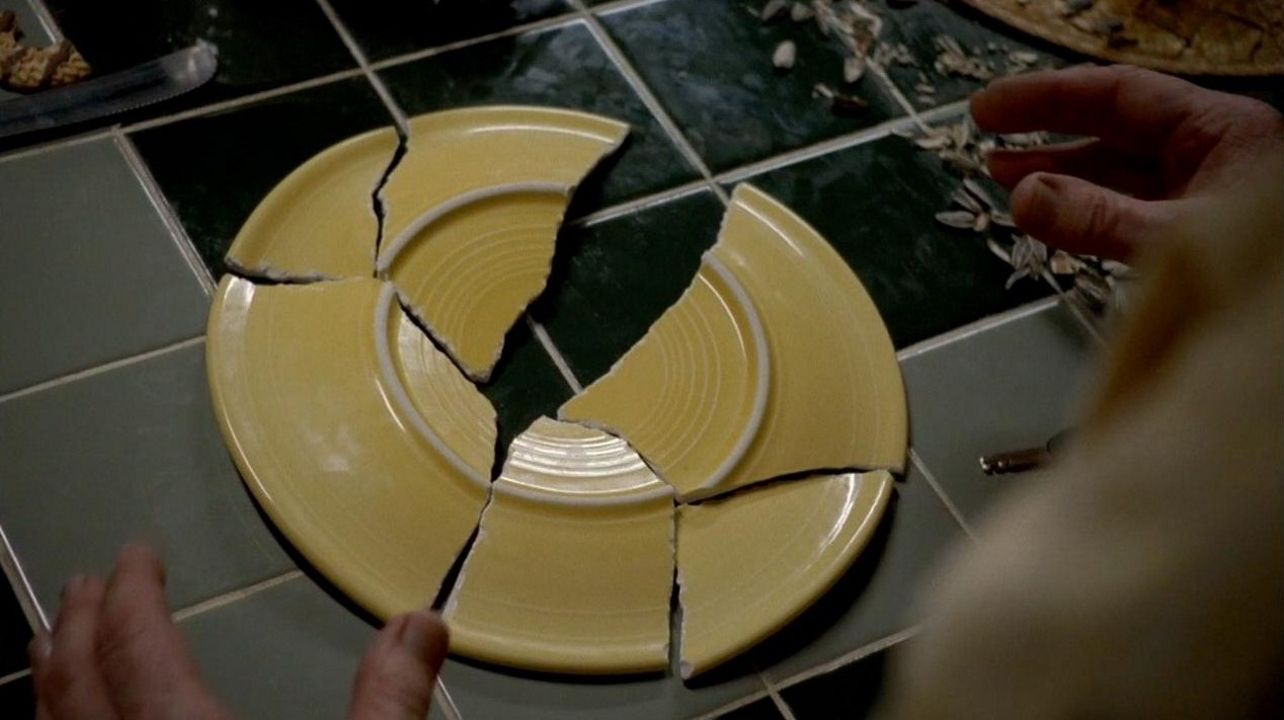
And then he discovers this …
Right as he’s about to let the thug go, Walt has a thought. He takes the pieces of the discarded plate and puts them back together like a puzzle. And he comes to the terrible realization that one of them is missing.
The thug has it. And it’s clear he’s planning to kill Walter with it the moment he’s released.
Again, the writing here elevates this scene. Because we don’t need to be told what Walt is thinking to understand it. We’re shown the relevant information and allowed to figure things out for ourselves. The writers trust that we (the audience) are smart enough to piece things together if they give us the proper clues along the way.
At its core, “show, don’t tell” is about trust. Trusting that your audience is paying attention. Trusting that they can connect dots. Trusting that meaning doesn’t have to be explained to be understood.
When you show, you invite the reader into the story as a participant instead of treating them like a passive observer. And once a reader feels involved—once they feel like they’re discovering something instead of being lectured—that’s when storytelling stops being informational and starts being memorable.
Godspeed y’all, and happy writing.
*Feature photo: "Breaking Bad" episode 103