
The End of Oak Street
Where Goes the Neighborhood, and Where Goes the Script
David Robert Mitchell is a filmmaker I have enormous goodwill toward. It Follows is one of the most genuinely unsettling and formally distinctive horror films of the last decade, a movie that weaponized suburban geography and a deceptively simple premise into something deeply, persistently creepy. Under the Silver Lake was messy and divisive, and I loved it for exactly those reasons, a film that committed to its own labyrinthine logic with the conviction of someone who truly did not care whether you kept up.
So when The End of Oak Street was announced, a mysterious cosmic event relocating an entire suburban neighborhood to somewhere unknown, I was ready. Mitchell doing Spielberg-inflected family science fiction with dinosaurs? Hand it over. Unfortunately, what arrives is a film that gestures toward its inspirations without capturing what made them work, and that gestures toward its emotional core without earning it.
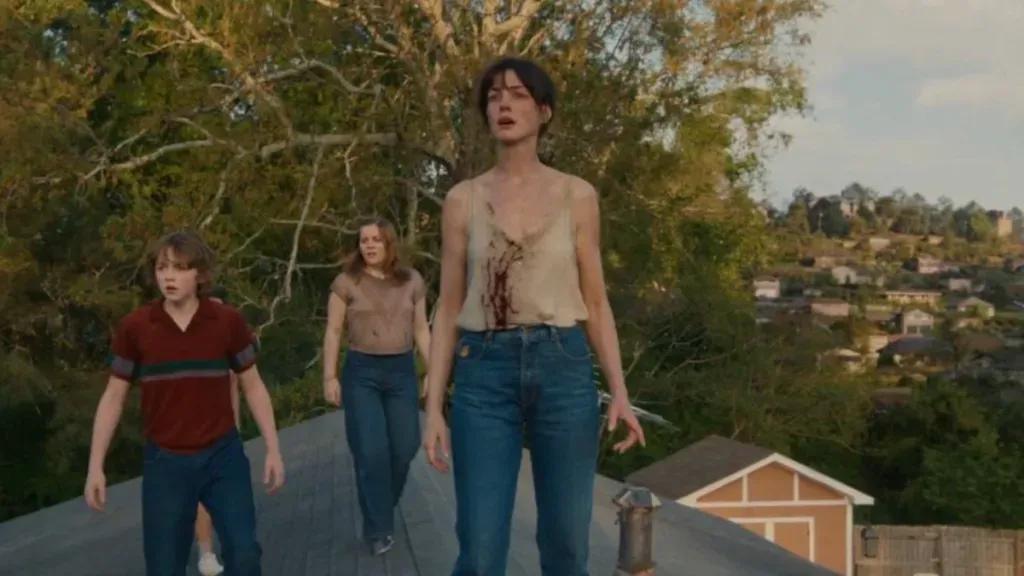
The setup is genuinely promising. The Platt family, living on Oak Street in the kind of meticulously ordinary suburb that Mitchell has always understood as fertile genre territory, find their neighborhood wrenched out of time and space by an unexplained cosmic event. Dinosaurs appear. Survival becomes necessary. Family bonds are tested.
On paper, this is the skeleton of something with real potential, a domestic drama operating under existential pressure, the kind of premise that lets character reveal itself through impossible circumstance.
What the film does with that skeleton is the disappointment.
Anne Hathaway carries the film almost entirely on her own, and the disproportion between her effort and the material she has been given is one of the more frustrating things about the experience. She plays the stakes as real and urgent and internalizes the chaos with a commitment the film does not always deserve. Hers is a performance working overtime to generate emotional stakes that the screenplay has not established through character or relationship.
Ewan McGregor, playing her husband, seems to have made a different calculation about the material entirely, and the result is a performance of notable vacancy. The children are written as types rather than people, and the film's attempts to generate family drama feel less like organic tension and more like scheduled interruptions to the survival plot.
The survival sequences themselves are competent but rarely tense. Mitchell is clearly drawing from Jurassic Park in the way the film stages its dinosaur encounters, but what made Spielberg's film terrifying was the combination of practical weight, spatial clarity, and genuine investment in the characters being chased. The End of Oak Street struggles on all three counts.
The threat rarely feels immediate, partly because the film keeps pausing its own momentum for emotional conversations that the characters have not earned the right to have yet, and partly because the spatial logic of the neighborhood as a setting is never established clearly enough for the geography to generate dread.
The dialogue is the film's most consistent problem. Scene after scene consists of characters explaining to each other exactly what has happened, what it might mean, and what they plan to do about it, as though the film does not trust the audience to draw any inference without being walked through it explicitly.
This kind of expository scaffolding is the enemy of immersion, and it is doubly damaging in a genre film where immersion is the entire product.
When your characters are processing information out loud in the middle of a dinosaur encounter, the dinosaurs stop feeling dangerous and start feeling like props. The film occasionally tips into unintentional comedy as a result, and not the kind that feels like a directorial choice.
What is strangest about The End of Oak Street is how much it resembles other films without capturing what made those films work. It feels more Spielberg than Spielberg's own recent work, which sounds like a compliment but is not quite meant as one, because it is Spielberg surface without Spielberg substance: the John Williams-adjacent score that announces every minor event, the suburban family under cosmic pressure, the children navigating adult-scale danger.
The M. Night Shyamalan DNA is also present in the film's rhythm, the way revelations are staged and characters process them, but without the tonal control that makes Shyamalan's best work so effective even when it is absurd.
The references are all legible. The synthesis never quite arrives.
The film's third act makes choices that undercut character development established earlier, and the resolution has a tidy quality that does not feel earned by anything that precedes it. There is a moment involving a family photo montage that signals the happy ending so explicitly that it reads almost as parody, though I do not believe that was the intention.
Mitchell has shown real formal ambition in his previous work, and there are isolated sequences here where that ambition briefly surfaces, a moment of genuine surprise, a visual choice that lands with the kind of giddy absurdity his best work delivers. Those moments make the rest more frustrating by contrast.
The production has genuine visual qualities, and the film is never less than watchable. There is craft in the cinematography even when the split-diopter shots, used with a frequency that starts feeling like a signature that has not yet earned its own status, begin to grate.
The score does its job of matching the film's tonal ambitions even when those ambitions are not quite realized in the writing or direction. And Hathaway, always Hathaway, keeps you watching even when the film gives you reasons to disengage.
Mitchell remains a filmmaker worth watching, and I would not trade It Follows or Under the Silver Lake for anything. But The End of Oak Street suggests a director temporarily more interested in the idea of making a certain kind of movie than in the harder work of making it actually function.
The neighborhood got transported somewhere strange. So did the screenplay.
*Featured image: The End of Oak Street (Warner Bros.)