

The Most Undervalued Screenwriting Skill
POP QUIZ TIME!!
Hey, stop! You can’t click away! It’s against the rules. By opening this article you unknowingly signed the Pipeline Artists terms of service and are now contractually obligated to take this test.
Yes, I’m serious. Don’t make me call a lawyer.
Anyway, fear not, because the test is easy: you only have to answer a single question …
What is the most undervalued screenwriting skill?
Don’t worry, this isn’t a timed test. Go on, take all the time you need to think about it. I’ll wait.
("JEOPARDY!" MUSIC PLAYS … RIP MY MAN ALEX TREBEK)
Did you answer plotting? If you did, that’s wrong. I would hazard to say that’s overvalued, actually.
What’s your next guess? Crafting great characters? Thematic implementation? Both wrong. Which actually pains me to say, because I love a good theme.
No, I’d reckon that the most under-appreciated skill a screenwriter can have is space management. Which will probably surprise all of you, given that I literally never hear anyone talk about this.
Any creative endeavor needs to be cognizant about time. People’s lives are busier than ever, and our attention spans are constantly strained. Things that require less commitment are often viewed as easier asks. And this applies doubly as much when working in a medium with a hard page count (like screenwriting). You can’t go over 120 pages in a document (caveat—sure, technically you can, but technically you can also go outside right now and eat a clump of dirt for dinner. Both are things I wouldn’t recommend).
The point is, being efficient with your page count is a very good thing. Because the first thing every single reader does is check how long a PDF is. And the shorter your script is, the faster it’s getting read. Period.
What makes this hard, though, is script format. Frankly, this thing sucks for writers. The blank spaces, the margins, the indents … A simple scene with just two characters talking can easily become 10+ pages if you aren’t careful. And in a 100-page script, that’s 10% of your total runtime! Egads!
This is why I want you all to become a master. Not just of storytelling, but of script format. You need to learn how this darn thing works to make it work for you … not against you. And today, I’m going to share a few tricks I’ve found that can really make an impact by the time you write FIN.
Let’s start off with a basic sin I see writers make all the time …
KILL YOUR WIDOWS
In writing, a widow is a single word that hangs over the edge of a sentence creating a whole new line. In practice, they look something like this:
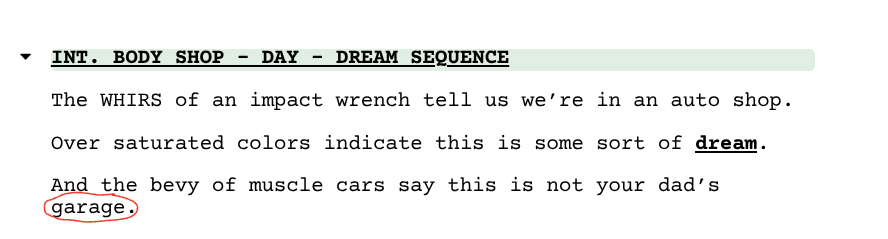
You see that? That stupid little word I circled in red?
Yeah, we hate that loser. He’s awful. The literal worst. Why? Because he blocks us from using all of this beautiful space (see below)!
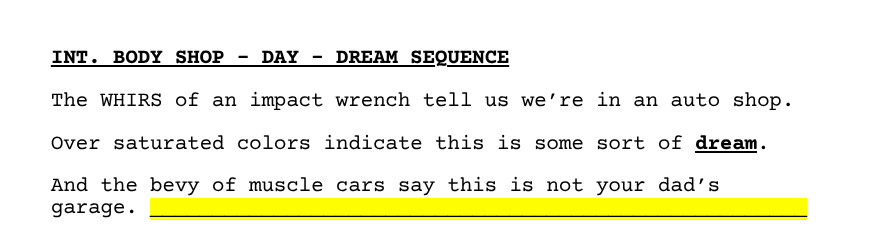
You know what this area I’ve highlighted in yellow is? A waste. You’re losing almost an entire line that you could be filling with words and instead putting nothing there. That’s hella inefficient.
So, we’re gonna fix that. How? It’s easy, just look at this…
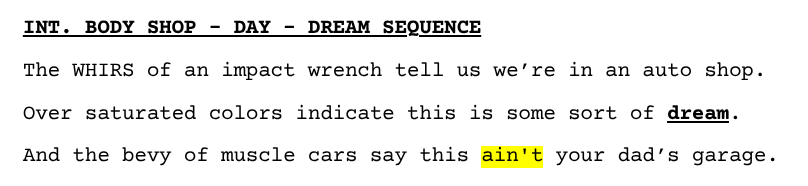
Look! We killed the widow! Hooray!
But … How did that happen? Take another look to confirm.
We cut a single character from the sentence.
Not an entire word. Heck, we didn’t change the meaning of the sentence at all.
We cut one single measly keystroke. And in return, we got a whole line of text back to work with.
That’s … a crazy good trade. Almost as good as the Yankees getting Babe Ruth for $100,000.
We took “is not” (6 keystrokes, when counting the space bar) and instead wrote “ain’t” (5 keystrokes) and got a whole line back.
“But Spike!” you cry, “Ain’t ain’t a word!”
… And? Your point is … what, exactly? It serves the exact same purpose in the story, and would you like to guess how many scripts I have passed on in my life because they used the word “ain’t?”
Exactly zero. None. Zilch.
Trust me, it’s fine.
Anyway, let’s move on to another little tip I absolutely love implementing …
YOU CAN (SPARINGLY) BEND THE RULES WITH PUNCTUATION
I almost intentionally mis-punctuated that sentence, but I’m sure my editors will have none of that.
But, no, seriously. You can do the same thing with periods, too. Take this bad boy as an example:

We have the same problem as last time. There’s an ugly old widow falling under our beautiful sentence. But this time, there’s no easy character to cut. We don’t have a word to contract or switch around to buy us that necessary space.
… Or do we? Because I can actually fix this whole thing by just doing this …

How’d I do that? The wordage of the sentence is exactly the same, but somehow, I still killed the widow?
Have you noticed it yet?
I took off the period at the end of the sentence.
GASP!! But you can’t do that!! That’s … that’s … UNGRAMMATICAL!!!!!!!!!
Why not? I just did. And it saved me a whole line. And again, I’ll repeat myself … You wanna guess how many scripts in my life (15 years of reading for agencies, production companies, networks, and contests) I’ve passed on a screenplay because it skipped a period?
Zero. None. Zilch.
At the end of the day, getting that line back is more valuable than one measly period. So, go ahead and kill it off! I give you permission. You can really do it.
There are a few caveats to mention with this:
1) You can only do this when a line is ended at the edge of a page and nothing comes after it. If you need to have a clear sentence with something else following it, then yeah, you’ll need a period.
2) You don’t ever want to reduce clarity in exchange for page count. I’m not saying never use periods, especially in larger paragraphs. I’m saying if you don’t need a period to understand “okay this is clearly a stand-alone sentence” then it might make sense to cut it.
Anyway, moving on … The next one is short, but it’s often overlooked (and don’t worry … this is totally within the rules):
USE DOUBLE DIALOGUE WHEN OVERLAP IS REAL
Technically double dialogue is only supposed to be used when two characters are talking over each other. Yes, you don’t want to use this too much.
But I also read tons of scripts that COULD use this function and very rarely do. If you’re unfamiliar, double dialogue looks like this:
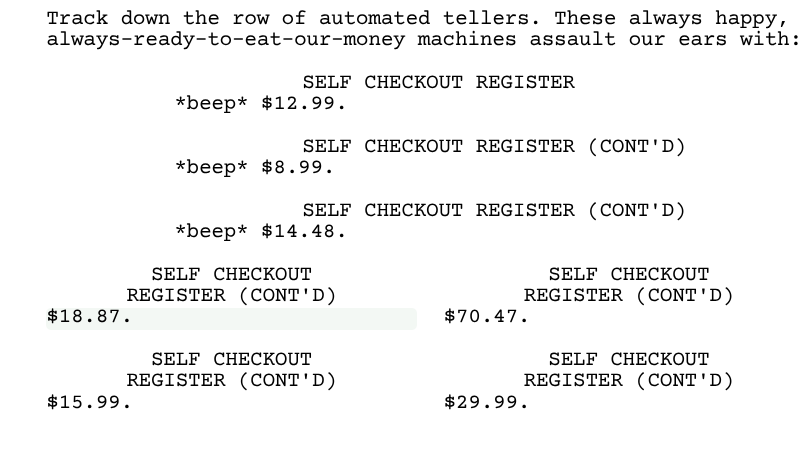
In this script I wrote a few years ago, I wanted the sound of the self-checkout registers to be overwhelming. To come in quick succession and bombard the reader for thematic impact.
I also wanted to be space efficient, because horror movies in particular are best when they’re short—I saved at least four lines by double-dialoguing them at the end of this scene. It achieved both goals, and I was very happy with the result.
Again, this is not a trick I would overload your script with. You don’t want to do this too much.
But if you have a scene where characters are fighting and they legit would be talking over each other, why not gain some all-important space back at the same time? In my mind, it’s worth it.
I’ve got one final topic to cover, and this is a biggie. Honestly one of my personal pet-peeves:
AVOID BIG DEAD ZONES IN YOUR WRITING
This almost always occurs at the end of a page, when a scene heading starts off the next one. This is, sadly, just the way scene headings work.
Script format is NOT user friendly. There are a ton of very annoying aspects to it. And in many, many instances, it fights with you. Just like it’s doing here:
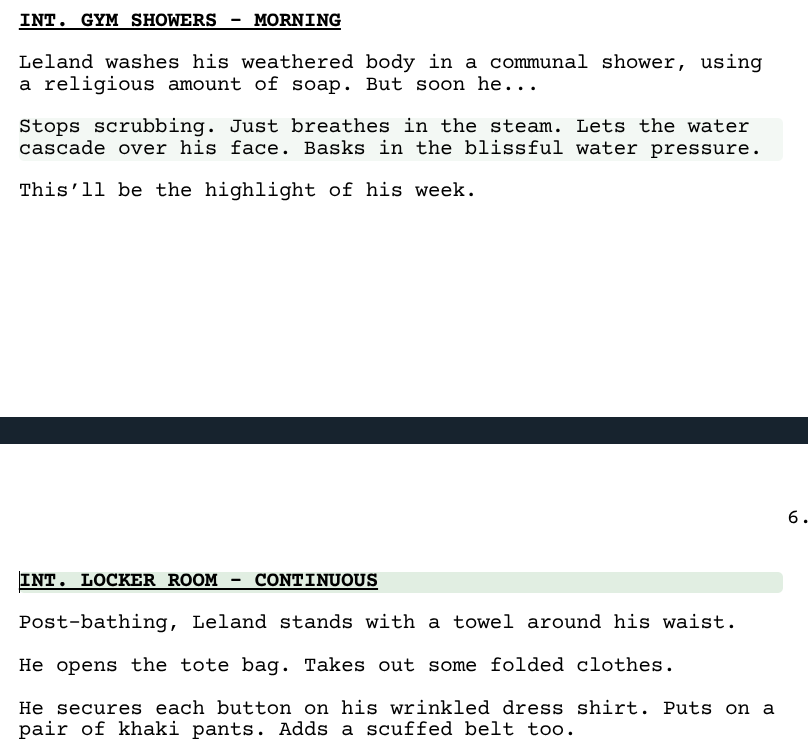
This image captures the bottom of one page and the top of another. And because of the way it’s currently written, a scene heading falls on the top of a new page.
Because of the way margins work in script format, new scene headings take up the most room. They need a ridiculous amount of space to fit in when compared to action description. Which can lead to massive blocks of space at the end of a page not getting used.
But, if you manipulate your writing a little bit, you can solve this. By just doing this …
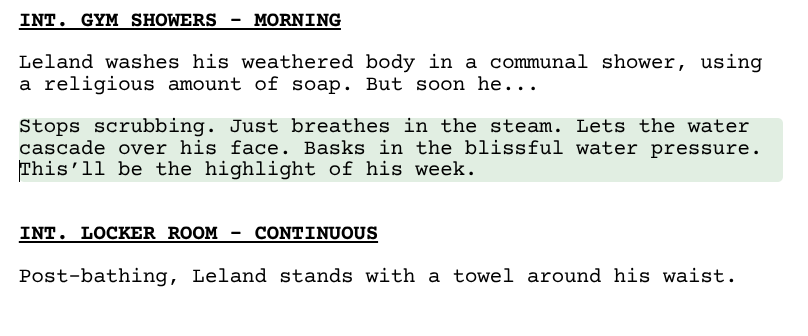
You make a killer trade. You just took away one line from the top page, which moved the scene heading up. And in return, you got at least 2 lines back (though it’s more like 2.5 lines with how scene headings are formatted.
That’s a crazy good deal. In baseball terms, that’s called “receiving extreme surplus value.”
And you know what? This is not even the most egregious case I’ve seen. I have seen scripts where it was clear if the writer reworked their writing a smidge, they would get 3 … 4 … maybe even 5 lines back! That’s like sending a bunch of scrubs in exchange for Luka Doncic (shots fired)!!
So please, I beg all of you … Don’t be merely “a writer.” Become a master of screenplay format. Learn how it works. Learn the flaws of the system.
And then learn how to exploit them to your advantage.
Godspeed y’all, and happy writing.
*Feature image by fran_kie (Adobe)