
Why 'Spider-Man: Brand New Day' is a Mammoth Hit
🚨SPOILERS AHEAD!🚨
Spider-Man: Brand New Day opened in theaters worldwide this past weekend and made $927 million at the box office. Almost a billion dollars in a mere three days.
And they say the theatrical experience for moviegoers is dead. Ha!
If you create works that intrigue people, speak to them, and connect with them, the paying customers will come. It happened this year with Obsession, Backrooms, The Devil Wears Prada 2, Toy Story 5, and The Odyssey. More on those hits later, but what do all these films have in common?
Why did they ring the bell when so many do not?
Well, some of it comes down to distribution, timing, and the effectiveness of a good PR campaign, but more often than not, it boils down to one key factor—what is at stake in the story, and is it compelling enough to get people to want to watch the main character wrestle with his or her problems and overcome whatever the conflict might be.
Stakes.
What’s at stake? It is perhaps the single most important question when writing a story, be it a novel, screenplay, or newspaper article. What is at stake in the story? Life, death, money, prestige, survival—what? And if the stakes are viable enough, palpable enough … the audience will relate and be enthralled.
Some call it the hook. I call it the heart.
The lack of genuine stakes is one of the reasons that audiences have soured on superhero movies these past few years. Sure, the market for them is oversaturated, and a badly-thought-through dud doesn’t help, but more and more the stakes in superhero films are getting very flimsy.
We know caped wonders have to survive; they are franchise players. And if we know they’re going to make it to the end of the story, no matter what, the stakes are immediately lowered. Think about it: in almost every instance, from Batman Begins to Avengers: Endgame, superheroes win. Thus, it’s exceedingly difficult to present a story in such a world where we feel that the hero’s butt is truly on the line, that they’re truly risking it all, or even fearful that they might screw up big time.
And too often, because they are superheroes, they have an advantage over palpable stakes that renders worry obsolete. I mean, if a superhero can turn back the clock, time-travel to fix the past or future, or, for that matter, take all of the kind of punishment, from fists to bullets, that would kill most mortals, what is really at stake?
So, what are the stakes in most superhero films? The fate of the world?
Trust me, the world isn’t going to blow up, nor will cities fall, and America isn’t going to even stop being a superpower. Very unlikely in real life or at the cinema. And even with the histrionics of worldwide death as exhibited in the aforementioned Avengers: Infinity War, with all those people being wiped out by Thanos, the follow-up Endgame saw all those lost in the previous film return to the land of the living. Hale. Hearty. Completely back to normal.
The films made for a great one-two punch, but time-travel is more than a bit of a cop-out when it comes to storytelling. It doesn’t exist and is therefore irritating and irrelevant when used to guarantee a happy ending. And if superheroes can stop time, or erase it, what can’t be fixed in such a way? Are there really any stakes in that?
Still, there is one superhero franchise where the stakes are almost always heavier than any other one, and, as a matter of fact, it’s the one where its hero just experienced a record-setting, boffo box office weekend.
So, what is it about Spider-Man that makes his stories so continually enthralling and the stakes so wholly viable?
Well, for starters, in Peter Parker’s world, he’s younger and inexperienced. No seasoned adult is he. That underdog status makes him far more likable and relatable.
You’ll remember that in the big film franchise that started with Spider-Man in 2002, starring Tobey Maguire, a teenage Peter Parker was bitten by a radioactive spider that gave him overwhelming superhero powers. He struggled to learn to use his powers, control them, and adapt to being on call for a fraught New York citizenry. His immaturity in dealing with his new strength kept him from taking care of his Uncle Ben, being wholly there for his love interest Mary Jane, and saving his mentor Norman Osborne from succumbing to the enhanced powers that turned him into the murderous Green Goblin.
And throughout the subsequent decades, whether it was Maguire playing him, or Andrew Garfield or Tom Holland, Peter has still struggled to mature, from teen to adult, from vigilante to avenger, from nemesis to hero. His stakes hang over his head daily like the sword of Damocles, and it has endeared audiences to him. And it’s made his superhero franchise endure better than the others. Endearing and enduring.
Throughout the live-action films, as well as the big-screen animated one in the Spider-verse, Spider-Man has made oodles of mistakes, watched good people die, and paid a heavy price. Stakes. Stakes. And more stakes.
Andrew Garfield’s two movies playing The Amazing Spider-Man, didn’t give Peter any kind of a break. His Peter watched Gwen Stacey die in a horrible fall. He lost friends, jobs, and the goodwill of the public, too. And wherever he went, no matter how many years he had donned the disguise, trouble followed. A lot of trouble; a lot of stakes.
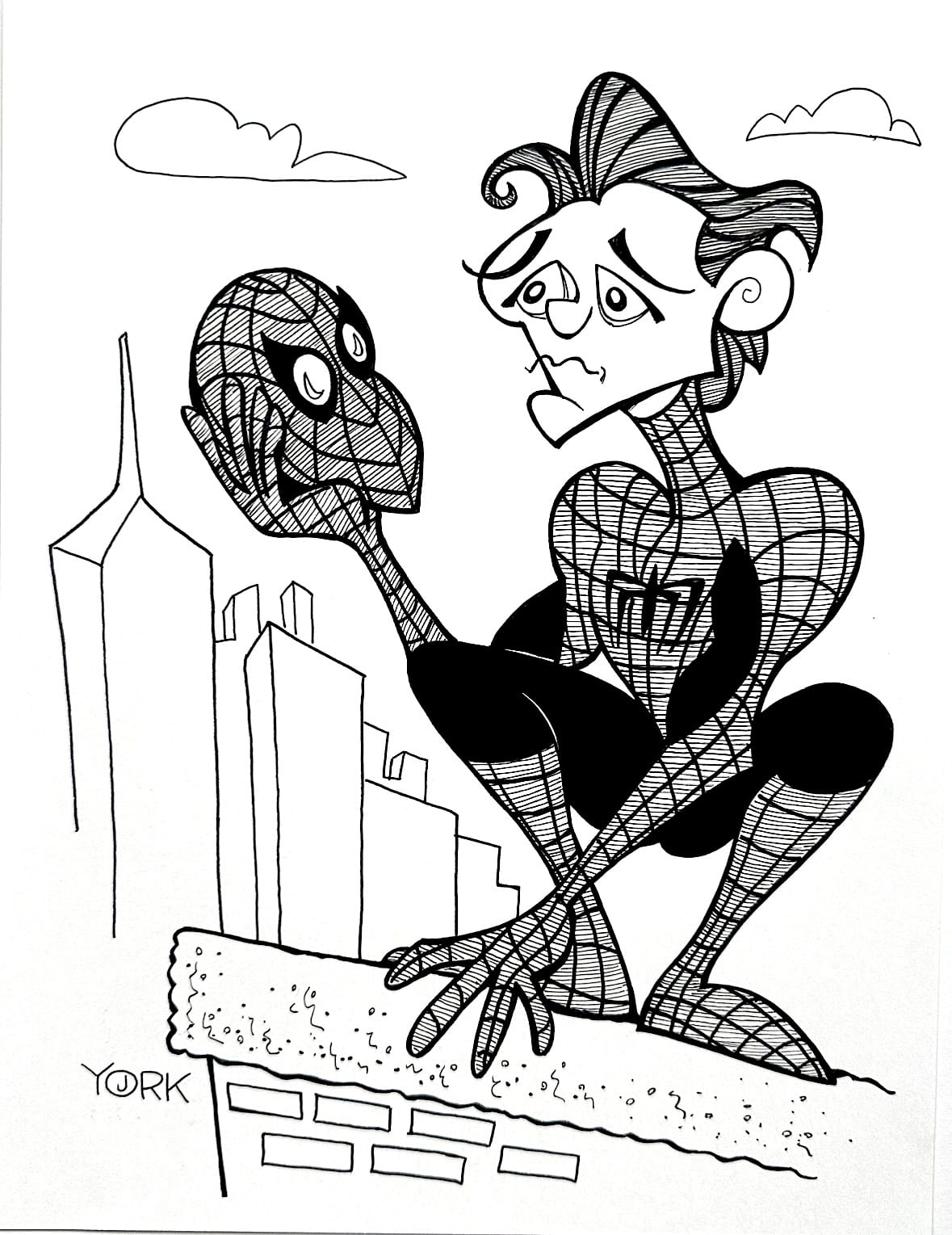
When Holland rebooted the live-action franchise for the third time in a decade, he brought even more youthfulness to the enterprise, not to mention some existential angst worthy of Hamlet.
Holland’s Parker wore his vulnerability on his sleeve, whether it was tweed or fireproof rayon. He experienced the loss of friends and trust with a grief that bordered on depression. And the more he tried to do right, he’d often screw things up irrevocably.
Why, in his previous film Spider-Man: No Way Home, Peter’s true identity was exposed to the world, and he had to beg Doctor Strange to use his mumbo-jumbo to erase that memory from the minds of the collective world. Comparatively, Batman’s antisocial prissiness driven by a thug killing his parents when he was a child almost feels one-note.
Spider-Man also keeps the stakes so compelling because, outside of his superpowers, he’s a bit of an everyday Joe. In contrast, Tony Stark/Iron-Man is a billionaire and inventor. Same with Bruce Wayne/Batman. Thor is a God from another planet. Superman? The same. Hawkeye and Black Widow are more down-to-earth, sure, but they were trained assassins by their country’s governments.
Peter Parker had to learn to fight, fly, and swing without any owner’s manual. He’s more like us, and we can relate to his narrative and all that’s at stake in his basic survival.
Now, in Spider-Man: Brand New Day, Peter has settled into a groove as a superhero, but the world has gotten even more erratic, and his nemesis Jean Grey is another mutant who has had it with the world holding her back. It’s all of the same drama Peter has gone through for years, only now he’s on the side of those who’ve often held him back. And he’s alone, friendless, and still pining for MJ.
It’s the perfect entertainment for a time when we’re all fractured, uncertain of where the world stands, and wondering if we can get back to some sense of normalcy. The right and left used to get along, but like Peter and Jean, they can’t find much common ground even though they have more in common than not. We pity Peter because his world is our world, one that is post-COVID, post-kindness, post-truth.
Similar themes of a world lacking trust and human empathy can be found in those other hit films I mentioned earlier as well. And the stakes there are palpable and infinitely relatable, too. We would all like to find romantic love but worry that it’s impossible in a brutal, upside-down, Tinder world (Obsession). What was once familiar, be it work or our environment, often feels like a spiraling nightmare in modern times (Backrooms). And we feel left behind by the society and economic changes that have eliminated our livelihoods, professions, and skills (The Devil Wears Prada 2). Modern gadgetry—I’m looking at you, A.I.—has given everyone a nagging uncertainty about our worth and a feeling of obsolescence (Toy Story 5). And even feeling at home in our communities, let alone the world, is an endless journey to find a safe space (The Odyssey).
Spider-Man remains viable because his stakes have never been more recognizable.
Hopefully, that will mean something to the C-suites at both Marvel and DC, let alone other studios large or small.
A film filled with empathy, relatability, and authenticity means one with genuine stakes, and that will draw audiences like a siren song. It’s the hero’s journey, the oldest plot in the book, rendered effective every time by a character like Spider-Man who is still learning, still yearning, and still trying to get through the day without losing more than he gains.
To do that is to be a superhero in today’s time. No capes or mutations needed.