

A Step in a Direction: A Conversation with ‘Late Fame’ and ‘Coyote vs. Acme’ Writer Samy Burch
Samy Burch on the casting background that shaped her voice, writing between registers across Late Fame and Coyote vs. Acme, and why confidence has to last you a long time.

There is a particular kind of screenwriter whose range defies easy summary, not because they are inconsistent, but because they have found something deeper than genre or tone to organize their work around. Samy Burch is that kind of writer.
In the space of a few years, she wrote May December, a psychological thriller about performance and exploitation that earned her an Academy Award nomination, Late Fame, a quiet, melancholy adaptation of an Arthur Schnitzler novella about an aging poet rediscovered by a young creative class, and Coyote vs. Acme, a live-action and animation hybrid, legal comedy built on a cartoon coyote suing the corporation that kept selling him products that did not work. On paper, those three films have almost nothing in common. In practice, they share a writer who is deeply preoccupied with the gap between who people are and who they think they are, or who they are allowed to be.
Late Fame, directed by Kent Jones and starring Willem Dafoe and Greta Lee, is a film I found myself thinking about long after watching it. It is gentle in its observations and devastating in its implications, a story about what recognition does to a person who spent decades making art in the absence of any.
Dafoe delivers one of the finest performances of his career: interior, economical, and quietly breaking. Greta Lee blazes around him as Gloria, an actress who performs her own life at full volume. That contrast, one person holding everything inward and another projecting everything outward, is one of Burch's great subjects.
Coyote vs. Acme is something else entirely, and something considerably more political than it might appear. A film about a lone consumer taking on a corporation that has profited from his suffering for decades, made by filmmakers who watched a major studio try to shelve their movie for a tax write-off, arrives with a resonance no marketing campaign could have manufactured. Burch's screenplay is among the smartest pieces of work I have encountered in this space in years.
I spoke with Samy about the path from casting assistant to Oscar nominee, the craft of writing characters who carry everything beneath the surface, the art of adaptation, and what it actually takes to keep going for eleven years before anything breaks your way.
This interview has been edited for flow and clarity.
Rahul Menon: Before the screenwriting, before May December landed on the Black List and before the Oscar nomination, you spent years working in casting. How did all those years in casting shape the writer you became, and is there something you can see on the page now that you would never have noticed if you had come up through a more traditional screenwriting route?
Samy Burch: I found myself working in casting, mainly as an assistant, because I grew up in a casting office. My mom was a casting director of some incredible films in L.A. and later on in North Carolina and Georgia, where I would fly down and work as her assistant and then go back up to New York and temp and keep writing. I think the goal for me, probably because of this background, has been to write roles that actors want to play. And I think from a practical standpoint, I try to be very thoughtful about every character on the page, that they're there for a reason, even a one-line part, because I saw so many times actors get cut from movies because no one realized, until after they shot, that the role didn't need to be there and that can be so painful.
RM: May December operates in a register that is genuinely rare: funny, deeply uncomfortable, almost Sirkian in the way it uses surface glamour to expose something rotting underneath. Late Fame trades that discomfort for something gentler, by turns funny and melancholy. Do you think of tonal control as a single muscle you are always exercising in different registers, or are dark comedy and melancholy actually two very different disciplines for you as a writer?
SB: That's a really interesting question, I'm not sure I know the answer. I think tone is maybe a natural consequence of the voice of a writer and the voice of the characters intersecting? On the page anyway. And then getting to work with the caliber of director that I've gotten to, you see how the tone is further built and calibrated. Kent Jones, who before Late Fame made a beautiful film that I love called Diane, has such a way of capturing this feeling of melancholy that feels very specific to him.
RM: The scene in May December where Charles Melton's Joe finally breaks, where everything he has been quietly carrying for decades just falls out of him, is one of the most extraordinary things I saw on screen that year. And the butterflies. I am still thinking about those butterflies. Willem Dafoe's Saxberger in Late Fame carries something similarly interior, a lifetime of unspoken longing that surfaces only in small, quiet moments rather than one eruption. How do you approach writing characters who hold that much beneath the surface, and does a slow release like Saxberger's require a fundamentally different kind of restraint on the page than a single, explosive breaking point like Joe's?
SB: Well, it's extremely lucky in both cases when these characters are being played by actors as extraordinary as Willem Dafoe and Charles Melton. I think it just completely depends on the story. In May December there's this sense of tension because no one is being honest, no one is saying out loud the truth as you in the audience want to hear it, and you're almost jumping out of your skin begging for it to be said, so that calls for some kind of release. Every choice is really going to come from the character, what is honest in their story.
That answer, every choice comes from the character, sounds like a simple thing to say. But in Burch's work it is clearly a practice rather than a slogan. What makes Saxberger so quietly devastating in Late Fame is that you never feel Dafoe performing repression. You feel the weight of a man who simply never found the right occasion to say what he needed to say, and who has perhaps stopped believing the occasion will ever arrive. That is a very different thing to write, and a very different thing to watch.
RM: Late Fame is an adaptation of an Arthur Schnitzler novella published in the 1890s, about an aging poet whose forgotten work suddenly finds a young audience. That premise maps onto the present moment with an almost uncanny precision. When you read the novella and immediately connected with it, what specifically were you seeing? And how did you decide which parts of Schnitzler's story to stay loyal to and which to make entirely your own?
SB: I tried to be intuitive about it. The novella just read so extremely relevant to today, there's a timeless quality to it, because ego and insecurity are also timeless.
RM: You have described your approach to the Schnitzler adaptation as trying to capture what it feels like to read the book, while also going deeper into any character that interested you. For writers who are trying to understand the difference between faithful adaptation and genuinely creative adaptation, where does one end and the other begin for you?
SB: This is my first time adapting a book, so I'm definitely still working it out myself. I think my instinct is to look to the writers who have done both ways the best. I'm a big fan of Ruth Prawer Jhabvala's work, and what Emma Thompson did with Sense and Sensibility. Or something like The Silence of the Lambs adapted by Ted Tally, that's an incredibly faithful adaptation that's done so perfectly. But there are examples too of great movies that use the book as scraps for parts, it really is so specific to the situation.
RM: Late Fame is, among other things, a film about the difference between genuine artistic passion and the performance of artistic identity: the real artists and the ones who bask in their glow. Writing that distinction without it becoming condescending requires a writer who genuinely loves both kinds of people. How do you hold that without judgment, and how does the writing find warmth even for the pretenders?
SB: I think there is judgement, but it's easy also to feel for people who have a lot of want. I find it harder to not feel for almost everyone.
RM: Greta Lee's Gloria performs her own life at full volume at all times, while Willem Dafoe's Saxberger holds his at the opposite end of the register. They are operating in completely different modes and yet the film holds them together without one overwhelming the other. How do you write a scene between two characters who are so fundamentally different in how they exist in the world, and how do you know on the page when the contrast is working?
SB: Scenes like that are really fun to write because both voices are so different, so you start to find a rhythm. I think that's just something you have to feel as you go.
Burch's answers about Late Fame have a quality that mirrors the film itself: they are quietly precise without ever announcing their precision. I find it harder to not feel for almost everyone is, in four words, the entire emotional philosophy of the film. The young writers who mythologize Saxberger are not villains. They are people who want something badly enough to reach for it, and the film holds that reaching with genuine tenderness even while understanding exactly what it costs the person being reached for.
RM: You have now written May December, Late Fame, and Coyote vs. Acme in fairly quick succession, three films that could not be more different from each other tonally, formally, and in terms of intended audience. What does stretching between those registers do for you as a writer, and do you think it is important for writers to resist being classified?
SB: I've been really lucky with how things have worked out. I was hired on Coyote from the May December script when it was just a sample before anyone was attached. So I ended up working on drafts of both back and forth for a couple of years. And prior to that, I never had any sense that I would be working on something for kids, it was a big surprise to me that Dave Green felt I was the right person for it and that was such a gift. Not just because it was a great job, but because it allowed me to take a step in a direction that I assumed was a blocked off wall. And then once you're open to that, you can look in other directions, too.
RM: Coyote vs. Acme is a film with a genuinely unusual origin story: a studio shelved it, a public outcry followed, and now it has finally arrived. As the writer of the film, what was that experience like, and what do you want audiences to know about what is actually in it?
SB: It was a roller coaster. It was upsetting, mainly because of how many hundreds of peoples' work was almost not seen. I'm just so relieved that Ketchup saved the movie and people will be able to see it and that's forever.
RM: The entire premise of Coyote vs. Acme begins with Ian Frazier's 1990 New Yorker piece, which is essentially a fake legal brief written as a comedy bit. That is an extraordinarily unlikely place to find the foundation of a feature film. When you started thinking about an adaptation, what did you see in it beyond the joke? What was the story inside the legal document that made you feel there was a full film here?
SB: Dave Green had signed on to be the director and then went looking for a writer, so the vision always started with him. I think his feeling was that the way to expand the brilliant Frazier humor piece into a film was to use the language of movie legal thrillers as an extension of the straight-faced joke, and I loved that from the start. I think for my part, I tried to think of it as there being a solid foundation, both of character and the structure of the case and conspiracy, that held water on its own, so that the comedy and the Looney Tunes gags could be held within it. Really thinking about who Wile E. Coyote is, and who his human counterpart should be, that was a lot of the early thinking.
RM: What your screenplay does so impressively is reframe Wile E. Coyote without diminishing him. He has always carried real pathos underneath the comedy, but your screenplay takes that quality seriously in a way that makes him genuinely moving. How do you write a character whose entire existence is defined by catastrophic failure in a way that makes the audience feel for him rather than simply laugh at him?
SB: Thank you, that's really nice. It's definitely a balance, and one that was really collaborative, obviously with Dave, but also all the incredible animators, many of whom were on basically from the beginning, so I would write a scene and then see rough sketches of visual gags, and they would go back into the script. I just tried to keep him really alive on the page without him being able to have dialogue.
RM: Coyote vs. Acme exists in a hybrid world where animation and live action share the same physical reality. Are you writing those animated set pieces in full detail as part of the script, or do they get designed later through collaboration? And given there is an enormous library of classic Acme and Coyote set pieces across decades of Looney Tunes, how do you decide what to draw from and what to invent entirely?
SB: It was definitely a mix of a lot of the above. We tried to take any opportunity we could to infuse even the smallest Looney Tunes detail, for the die-hards. They've been through a lot, and they've earned it.
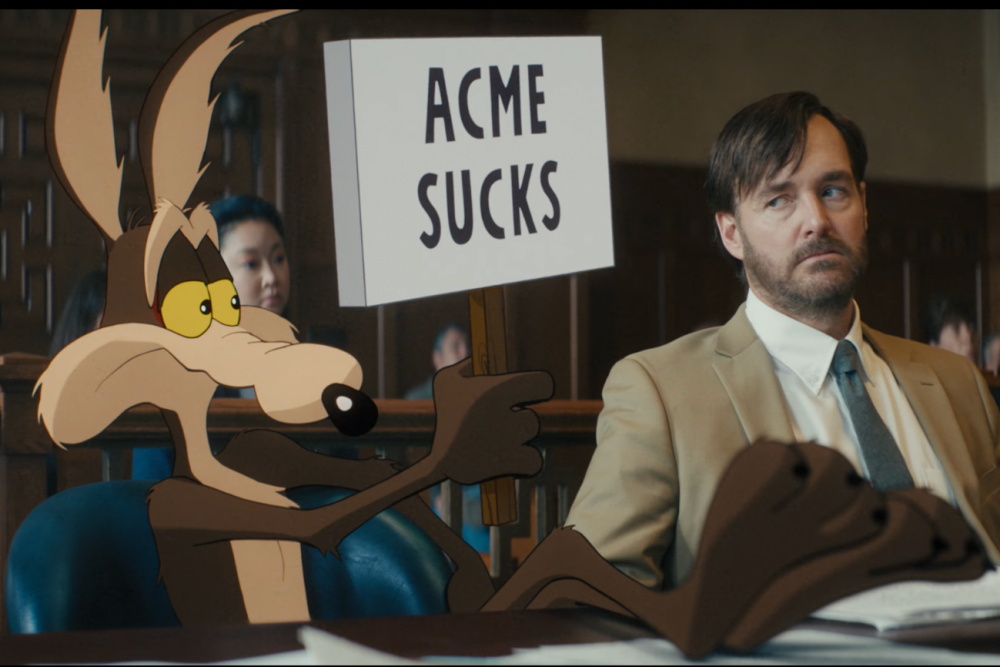
RM: The film has a corporate satire running underneath all the laughs that has genuine teeth. The argument at the center of the lawsuit, that a company profiting from a loyal consumer owes him a product that actually works, is both absurd and completely serious. How do you calibrate satire so that the comedy and the argument exist in equal measure, where the laughs make the point land harder rather than defuse it?
SB: This is also a very nice compliment, thank you. I think there's a nice cyclical kind of thing that happens in the tone of this movie where the more serious it gets you can find yourself getting sucked into it dramatically, and that's great on its own, but then you fall out of it and remember the absurdity of what you're watching, and it's funny again. I think ideally both elements are working in a nice tandem.
There is something almost perfectly appropriate about a film that nearly got buried by corporate indifference being, at its core, a film about corporate indifference. Burch did not plan that resonance. Nobody could have. But it is there, and it gives Coyote vs. Acme a peculiar additional dimension: something between a very good joke and a genuine act of defiance. When it finally screened for audiences, the response was exactly what it deserved. People were rooting for the coyote. They earned that, too.
RM: You have talked about always trying to write from a place of purity rather than trying to sell something, and always returning to character, voice, and tone as the foundation of any project. What does that actually mean in practice when you sit down to start something new, and how do you protect that purity when the project gets complicated or the notes start coming in?
SB: Well, I think for me it means waiting for the right idea, or not pursuing jobs that come by that may seem big if I don't feel a click. It's really easy to convince yourself that you could like something if you're about to be paid for it, but I try to think of everything I say yes to as a stepping stone and avoid the ones that are heading in the wrong direction. Ultimately impossible, but I try.
RM: Your work is consistently interested in the relationship between public image and private self, whether it is Elizabeth researching Gracie in May December, young writers mythologizing an old poet in Late Fame, or a cartoon character taking on a corporation in Coyote vs. Acme. Is that a conscious preoccupation, or is it something you only notice in retrospect?
SB: That's interesting. I think the gap between who someone is and who they think they are, or who they're seen as, may be central to the moment we have always been in.
RM: For writers who are still finding their way in, still working on their first or fifth or tenth script and wondering if any of it is going anywhere: what is the most honest thing you can say about what this work actually asks of you, and what kept you going before any of it was recognized?
SB: You have to store up your confidence like you're setting off on the Oregon trail, and parcel it out very carefully. I graduated college, where I studied screenwriting, with a lot of confidence, and it ended up having to last me eleven years before I was signed by representation or had a single good thing happen to me. That felt like a really long time, and I was also extremely lucky where the dominos fell really fast. It could be a lot longer. So I would also say to set up wins for yourself. For me that was strict, self-imposed deadlines, finishing a draft of a script by x date and not being a minute late on it. For some people maybe it's more like writing a certain number of hours or pages a day, but if you have a discipline, I think it's easier to trust yourself, trust that you mean what you say.
Eleven years. That is the number Samy Burch gives when she describes the distance between graduating with a screenwriting degree full of confidence and the moment anything broke her way. Eleven years of keeping the confidence rationed and the deadlines self-imposed and the scripts finished on time for an audience of ... nobody.
It is a number that lands differently when you have just spent an hour in conversation with someone whose work is as distinctive and quietly ambitious as hers. The question is not how she got through those years. The question is what kind of writer those years made.
What they made, based on the evidence of May December, Late Fame, and Coyote vs. Acme, is someone who understands the gap between who people are and who they think they are, or who the world decides they get to be, with unusual precision and unusual warmth.
That gap is the engine of all three films.
It runs through Elizabeth's obsessive research of Gracie's past, through the young writers who mythologize Saxberger into a version of artistic purity they themselves cannot embody, through Wile E. Coyote standing in a courtroom arguing that a company profiting from his loyalty owes him a product that actually works. These are all versions of the same story, about what happens when the distance between the ideal and the reality becomes impossible to ignore.
What makes Burch unusual is not just the range across those three projects, it is the consistency of care beneath the range.
The casting background means every character is there for a reason. The eleven years in the wilderness mean she knows not to say yes to the stepping stones heading in the wrong direction. The intuitive approach to tone means she trusts the intersection of her voice and the character's voice to find the register rather than imposing it.
She once assumed working on something for kids was a blocked-off wall. Then she walked through it. I suspect the next wall she is not supposed to be able to open will go the same way.
*Featured photo: Samy Burch