
Chloe Zhao’s Hamnet: Adapting The ‘All Knowing Narrator’ and Shooting Spiritually
Chloe Zhao’s adaptation of Hamnet shattered records during its awards run, earning a groundbreaking eleven BAFTA nominations, eight Oscar nominations, winning Best Motion Picture, Drama at the Golden Globes and Best Actress for Jessie Buckley at the Academy Awards to name a few.
It’s a dazzling run for any film, but particularly for one that grapples with mortality and grief in such a raw, unflinching way. Zhao’s capacity to hold space for big emotions as a filmmaker is influenced by her somatic practice (she even led the crowd at TIFF in a breathing exercise before the film’s premiere in 2025). This, combined with her collaboration with cinematographer Lukasz Zal, allowed for a visual language that incorporated spirituality into every frame of the film.
For those that haven’t seen it (you should, but stock up on tissues first!), spoilers ahead.
Hamnet, based on the book of the same name by Maggie O’Farrell, follows William Shakespeare and his herbalist wife, Agnes, through the depths of grief after their eleven-year-old son, the titular Hamnet, dies of bubonic plague. This loss then inspired the writing of Shakespeare’s play, Hamlet (the names were apparently used interchangeably in the late 16th/early 17th Century).
Hamnet the book is written in a present-tense third person narrative style, also known as an all-knowing or omniscient narrator. Colloquially, this type of narration is also called the ‘God’s eye point-of-view.’ Zhao and Zal masterfully interpreted this omniscient literary narration into an all-seeing camera that gives the film the sense that something bigger than us is always watching.
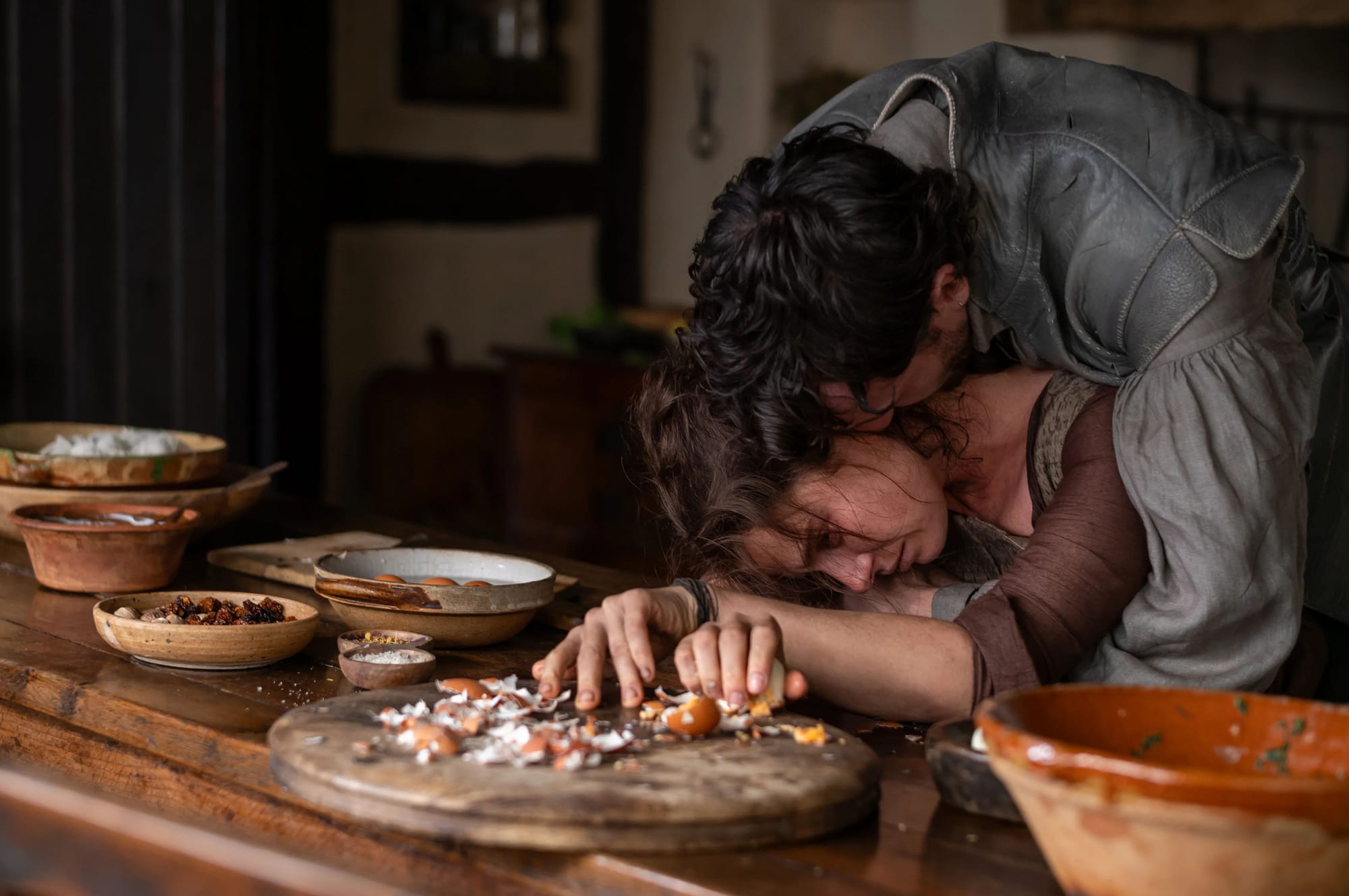
“We had a few different cameras on set,” said Zal. “One camera is immersed in the present moment—when they look at each other, fall in love, argue. For those scenes, we stayed close and handheld, intimate. Then there’s an all-knowing camera, almost like CCTV in the corner of a room. God’s point of view—or maybe death’s. A ghost camera, drifting and observing, scanning the scene without judgment. Then there’s the camera that knows everything, knows the ending. Also, a camera of tableaux that creates a mosaic of still images,” he elaborated. This was a way to allow for audiences to both engage deeply with the characters but also to make it seem like “somebody is watching our human struggle.”
For Zhao, stories are non-linear and circular, much like life, with the ending always connecting back to the beginning.
Hamnet begins with roving shots of the trees and reveals Jessie Buckley’s Agnes curled as if in a womb in the roots of a tree, a giant dark hole in the ground beside her. That same void appears towards the end of the film as part of the set design at the Globe Theatre through which Agnes and Will reconnect after the death of their son.
In this way, Hamnet’s visual language is decidedly spiritual.
Zhao and Zal used a CCTV-style camera to adapt the novel’s omniscient narrator and support the circular nature of the script by visually representing the interconnectedness of all life. In doing so, Hamnet’s visual language contextualizes death, and grief, as parts of the natural cycle of all living beings.
*Feature image, Hamnet (Focus Features)