
How 'The Invite' Nails Storytelling with Only Four People
The Invite, written by Will McCormack and Rashida Jones, is the latest movie in a year of A24 hits to garner rave reviews and a surprisingly decent limited opening at the box office.
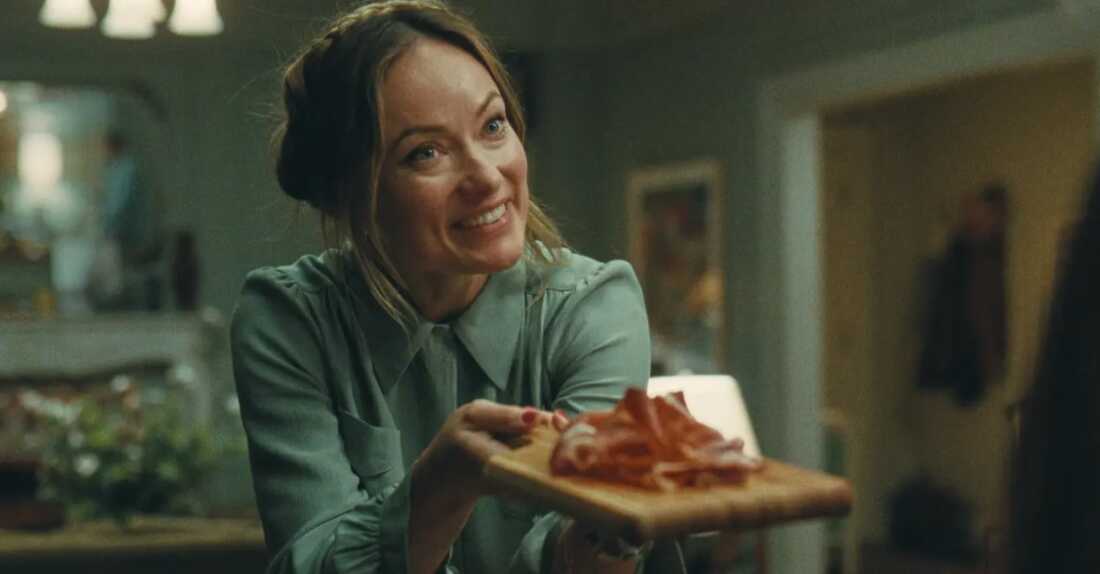
While we hear of a daughter we never see, and briefly witness a handful of music conservatory students for about two minutes, the majority of The Invite—and when I say majority, I mean 99.2% of the film—is taken up by four roles: Joe (Seth Rogen), Angela (Olivia Wilde, who also directs the film), Pína (Penelope Cruz), and Hawk (Edward Norton). (More on his name choice later.)
Now, a small caveat: the film is based on and/or inspired by the 2020 film The People Upstairs (or Sentimental in Spanish), written and directed by Cesc Gay and based on his own play. In fact, it’s been remade a few times in international markets—in South Korea under the same title, in Switzerland as The Neighbours from Upstairs, in Italy as 2022’s Neighbors, and in France as 2024’s Maybe More. Clearly, the premise rings true on a global scale.
Perhaps it’s because the premise is deceptively simple: a married couple on the rocks invite their easygoing, hot neighbors for wine and cheese. Chaos ensues. Very Virginia Woolf.
What makes The Invite such an engaging watch isn’t just the stellar performances or the beautifully decorated set. It’s that the writing specifically takes such a simple premise and makes it explode into a hilarious and heartfelt examination not just of marriages, relationships, and sex, but of grieving the person you did not become.
WARNING: spoilers coming up, so beware if you have not seen the film yet!
Let’s break down how this film so deftly makes sure we’re never bored with such a small cast:
Develop nuanced, complicated characters.
These four are recognizable in our own lives, but fleshed out to be distinctive. Angela is a neurotic mess, desperately trying to appear cool and collected while salvaging the sinking ship that is her marriage with interior decorating. Joe, on the other hand, is in a creative rut and totally miserable that this is his lot in life, perceiving himself to be a giant failure. Both simmer and boil over with years of unaddressed resentments.
Meanwhile, Pína and Hawk could just be one-note, but they’re not. The pair are easygoing and cool—a perfect foil for Joe and Angela’s anxiety and misery—but reveal themselves to be as fucked up as Joe and Angela. By having these people grounded in an archetype (e.g., Angela = neurotic, Pína = sexy), then slowly adding to those archetypes (Angela is neurotic because she badly wants to impress people, Pína is sexy because she’s extremely self-assured and comfortable in her own skin), we end up with characters we could watch for hours.
Make those nuanced, complicated characters have one weapon.
No, I don’t mean a literal weapon. This isn’t Clue (another great one-location film!). Rather, each character has an emotional weapon they wield at specific points.
For Joe, it’s a caustic sarcasm that shines through, amplified by Rogen’s ability to deliver incredible one-liners. For Angela, it’s subtly digging at Joe’s insecurities. Pína knows her therapeutic background gives her the upper hand, while Hawk utilizes his weird blend of New Age charm and “ick” to rile up the others.
These “weapons” are detonated with meticulous precision at just the right moments to ramp up the tension even further.
Give everyone a goal to move towards.
Angela has one goal at the top of the film—to have the neighbors over. However, the subtext is that it has to be an amazing evening. Her reaction when she learns Joe did not pick up wine is almost akin to stabbing her with a tiny knife. Joe, on the other hand, has one goal at the top of the film—ruin this evening so he can smoke a joint and go to bed.
Both have the same need: express their honest opinions and feelings about their relationship. They need the neighbors to be there long enough to not only drive the story, but push them both into a place where they can finally admit that things aren’t working as they should be.
Reveal every 5 to 10 minutes.
The pacing of the film is a credit to McCormack and Jones’ script, which rightfully gives every revelation a moment of breath, some discussion, and what appears to be a resolution before something new happens.
For instance, once Pína and Hawk admit they’re swingers, it seems as if Joe and Angela are a united front again in learning more about how that works. However, once Hawk reveals that Angela has been walking naked by the window—which he’s taken as a semi-subtle hint that Angela wants him to see her naked—all bets are off for Joe.
Keep everything (more or less) in one location.
Again, apart from a few minutes at the very beginning where we see some exterior shots of San Francisco, the rest of the film takes place in Joe and Angela’s apartment. Doing so doesn’t just make the production budget heaven to a producer’s ears; it also forces inventive ways to place these four in compromising situations.
Go with what’s funniest.
There’s an unspoken rule in our society that if you see or hear a couple fighting, do not interfere, as it’s not your business. When Pína and Hawk enter, they immediately comment on hearing Joe and Angela fighting, which Joe promptly admits is what was happening.
It’s unexpected, it’s honest (the thing that Joe needs most!), and it’s the funniest outcome that sets the tone for an emotional rollercoaster of an evening.
Break up the dialogue with different types of dialogue.
The Invite excels at conversation in many forms. Whether it’s the four of them bantering, two of them breaking off to discuss the others, or a monologue in which Edward Norton explains the origins of his self-proclaimed nickname, part of what keeps up the pace is that you never just have people talking. Despite being based on a play, we’re not watching a play—it’s a film!
Constant talking needs constant movement!
The Invite goes beyond the alchemical mix of the actors and direction because of its surgical storytelling. It’s a finely constructed world of a protagonist and partner who go from their ordinary, yet sad, lives to the underworld, deconstructing their lives, and reborn through a resurrection that leaves them in pain but living in their truth.
In other words, it’s the hero’s journey, except in a prewar apartment with flan. What’s not to love?
*Feature photo The Invite (A24)