
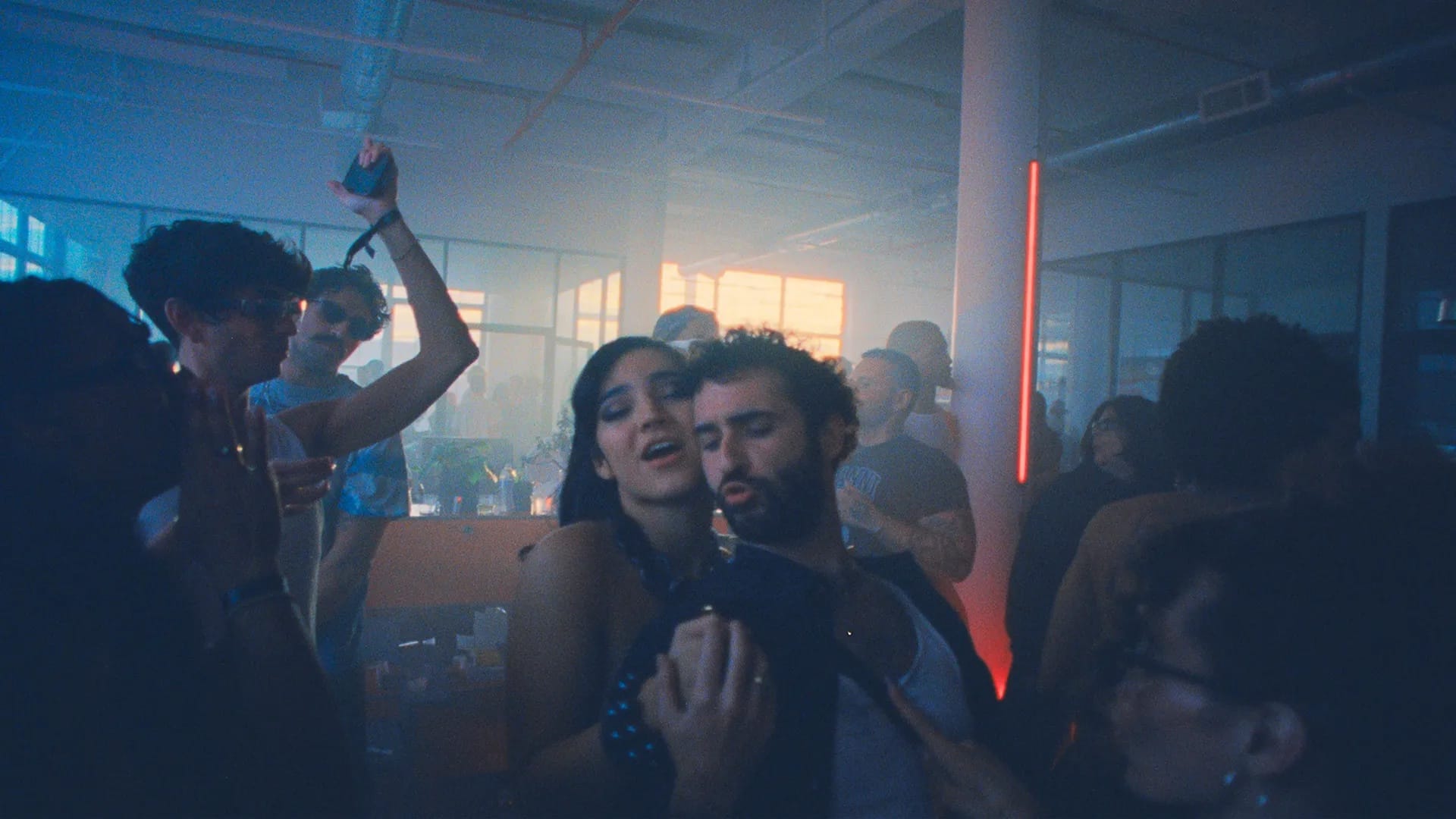
'Club Kid': Growing Up is Optional, Until it Isn't
Jordan Firstman's Debut Is One of the Year's Most Lovable Surprises
There is a specific kind of film that arrives at a festival, generates the kind of word-of-mouth that makes you rearrange your schedule to see it, and then actually delivers on every whispered promise.
Club Kid is that film.
Jordan Firstman's feature directorial debut is funny, tender, specific, and moving in ways that accumulate so quietly and so precisely that by the time the final twenty minutes arrive you are not quite sure when the tears started, only that they are very much happening. This is a genuine crowd-pleaser in the original sense of that phrase: a film that earns its emotional beats through honesty rather than manipulation, and trusts its audience to meet it without being condescended to.
The premise is deceptively familiar. Peter, a hard-partying New York City club promoter who has spent the better part of a decade avoiding anything resembling adulthood, discovers he has a ten-year-old son he never knew about. The boy, Arlo, arrives at his door, and the film is what follows.
On paper this sounds like a film you have seen before in some form or another, and to be fair, Club Kid does not pretend otherwise. What Firstman understands is that a familiar structure is only a limitation if you have nothing new to put inside it, and he has something genuinely new: a queer New York club scene rendered with a specificity and a love that transforms the generic premise into something that feels entirely its own.
Firstman writes, directs and stars, which is the kind of combination that makes a certain kind of film critic nervous, and which here turns out to be one of the film's greatest assets. He plays Peter with a disarming openness, moving through every stage of the character's evolution without vanity or protection. You are genuinely annoyed by him early on, which is the correct response and clearly the intention.
He is exhausting and chaotic and completely consumed by a lifestyle that has functioned as a way of never having to become anything. The film's gradual shift in your relationship to him, from exhaustion to pity to sympathy to something approaching genuine affection, is accomplished with more subtlety than the premise suggests, and Firstman earns every step of it.
Reggie Absolom as Arlo is wonderful, and his chemistry with Firstman is what gives the film its emotional core. The father-son dynamic here is not your prototypical maudlin Hollywood version of the relationship: it is funny and awkward and specific in exactly the way real relationships are, built from small moments of recognition rather than orchestrated scenes of revelation.
There is a conversation between Peter and Arlo about sadness and loss that is the film's best scene, simple and direct and quietly devastating in the way that the best character moments in the best films always are.
Diego Calva, as Arlo's social worker, brings his considerable charisma to a role that the film uses wisely, and Eldar Isgandarov nearly steals the entire picture as an aspiring queer philosopher from Azerbaijan who mostly plays Xbox and bullies teenagers online. Kirby Howell-Baptiste arrives in a single extended scene and delivers a masterclass in controlled comic chaos, setting up the rest of the film while clearly preoccupied with scoring drugs and getting to a party. It is a genuinely hilarious piece of performance work.
What Firstman gets most right is his treatment of the queer club scene as Peter's community and chosen family rather than as a lifestyle he must escape in order to grow up. This is not a film about a gay man who needs to straighten out his life. It is a film about a man whose community has real value and whose growth does not require abandoning it.
That distinction matters enormously, and in a cultural moment that feels increasingly hostile to queer stories told on their own terms, there is something quietly radical about a film this openly loving and this genuinely non-judgmental about the lives it portrays.
The music supervision deserves its own mention. The needle drops throughout are exceptional, and the film saves its most significant one for exactly the right moment with the precision of a filmmaker who understands that the relationship between a scene and a song is one of the most powerful tools available. Hearing a particular track arrive at a particular moment in a particular emotional context is one of those pure cinema experiences that is almost impossible to describe to someone who has not felt it.
This film has several of those moments, and they are not accidental.
Firstman's visual choices are equally considered. Shooting on 35mm gives the film a textural warmth that suits both the sweaty intoxicating energy of the club scenes and the quieter daytime intimacy of the father-son material. The cinematography puts the film in conversation with a certain tradition of New York filmmaking, from Cassavetes to Scorsese, that understood the city as a living participant in the stories being told there.
The editing is playful and smart, particularly in the way it handles the jump from Peter's early life to the present, creating a transition that feels like a comedown, the perfect formal equivalent of what the narrative is doing.
The film is not without minor issues. Arlo is perhaps slightly too perfect for too long, and a storyline involving a neighbor that exists primarily for comedy feels less organically connected to the rest of the film than everything around it. There is also a question about how fully the film interrogates what Peter feels he needs to shed versus what he should actually keep, and whether the resolution earns its emotional confidence entirely.
But these are small complaints against something that achieves something rare: a film that is completely clear-eyed about the self-destruction and the sex and the drugs while also loving its community without apology or condescension.
It does not soften these characters to make them palatable. It trusts them enough to show them whole.
Coming-of-age does not happen on a schedule. Some people miss the conventional windows entirely. Club Kid loves all of them, and it made me love them, too. What a debut.
*Feature photo: Club Kid (A24)