
'Coyote vs. Acme': The Movie Acme Didn't Want You to See, and the One We All Fought to Watch
There is something almost mythically appropriate about the fact that Coyote vs. Acme nearly never existed. A film about perseverance in the face of an indifferent, profit-driven corporation almost got buried by an indifferent, profit-driven corporation.
The Sisyphus reference in the film itself lands differently when you know that context, and believe me, the filmmakers know exactly what they are doing with it. That the film not only survived but arrived this good, this funny, and this genuinely moving is the kind of ending Wile E. Coyote himself rarely gets.
We earned this one together.
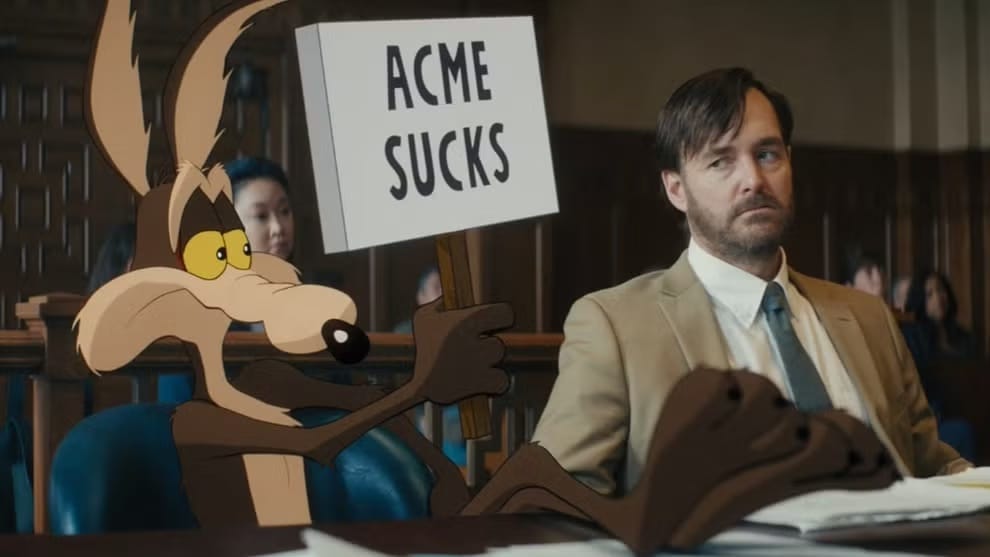
The premise, drawn from Ian Frazier's brilliantly absurdist 1990 New Yorker piece, is simple and perfect: after a lifetime of Acme products failing him in his pursuit of the Roadrunner, Wile E. Coyote hires a billboard lawyer and sues the Acme Corporation. That is the whole setup.
What screenwriter Samy Burch does with it is something considerably more impressive: she builds a legal comedy that is genuinely smart about the law, genuinely funny about the Looney Tunes, and genuinely heartfelt about what it means to keep getting up after every catastrophic fall.
The courtroom premise is not a gimmick. It is the ideal frame for a character whose entire existence has been defined by the gap between ambition and outcome, between desire and the anvil that lands on your head every single time.
What makes Burch's screenplay so impressive is how it reframes Wile E. Coyote without diminishing him. He has always been, at some level, a figure of pathos as much as comedy, the one character in the Looney Tunes universe who wants something so badly and fails so completely and keeps going anyway.
Burch takes that quality seriously.
She finds in him a kind of embodiment of perseverance against institutional indifference, a lone consumer up against a corporation that has been profiting from his suffering for decades and never once asked whether the product worked. It is both a very funny joke and a surprisingly resonant argument, and the film holds both registers simultaneously without straining at either.
Will Forte is perfectly cast as the billboard lawyer who takes Coyote's case, bringing the specific brand of enthusiastic, slightly overwhelmed sincerity that the role demands. There is a quality to Forte's comic timing that suits this material exactly: he is funny precisely because he is completely genuine, never winking at the audience about how absurd his situation is, just living inside it with total commitment.
John Cena, on the other side of the courtroom, is equally well deployed, and the film finds real comedic mileage in the contrast between Cena's physical presence and the corporate bureaucratic energy he is asked to embody. The casting across the board suggests a production that understood its tone completely and built accordingly.
The live-action and animation hybrid is handled with genuine craft and affection. Director Dave Green and his team clearly love this material, and that love shows in how carefully the animated characters are integrated into the live-action world.
The film captures the same spirit that made Who Framed Roger Rabbit so memorable, that sense of two realities coexisting with their own internal logic rather than one simply being a special effect layered over the other. Wile E. Coyote exists in this world fully, and the film never condescends to its animated characters or uses them as props for the human story. They are the story.
The slapstick sequences are genuinely inventive, carrying the anarchic energy of classic Looney Tunes while finding new formal possibilities in the live-action context. There is a deep generosity in how the film handles the cartoon cameos and references, never making them feel like obligation or fan service, but rather like the natural consequence of a world where these characters have always existed alongside us. For anyone who grew up with Looney Tunes, there will be moments of genuine joy in recognizing something beloved being treated with exactly the respect it deserves.
What I did not entirely anticipate was how much the film has to say beneath all the laughs. The corporate satire has genuine teeth.
The argument at the center of the case, that a company which has profited enormously from a customer's loyalty owes that customer a product that actually works, is both comedically absurd and completely serious. You find yourself genuinely outraged on Coyote's behalf, which is not a sentence I expected to write, but here we are.
The film understands that you can pack a powerful message about corporatism and consumer exploitation into a story about a cartoon coyote chasing a bird, and that the comedy makes the message land harder rather than softer.
Satire at its most effective works exactly this way.
The film also, unexpectedly, functions as its own meta-commentary. A movie about a lone figure taking on a massive corporation that kept shelving his grievances, made by filmmakers who watched a massive corporation nearly shelve their movie, has a resonance that goes beyond anything the production could have planned for. That layering gives Coyote vs. Acme a peculiar additional dimension, something between a joke and a genuine act of defiance, and it makes the experience of watching it feel like more than just a good time at the movies.
Samy Burch's screenplay is among the smartest pieces of work I have encountered in this space in years, and I say that as someone who had the pleasure of speaking with her about her writing. She has a gift for finding the emotional truth inside absurd premises, for locating genuine feeling in the places you least expect it, and Coyote vs. Acme is the fullest expression of that gift yet.
By the time the credits roll, you will find yourself applauding, possibly literally. I did.
We fought to get this film released. It was worth every moment of the fight.
*Featured image: Coyote vs Acme (Ketchup Entertainment)