
'Fjord': Where the Ice is Thinnest
Cristian Mungiu turns the mirror on progressive certainty, and nobody comes out clean.
Somewhere in the first half hour of Fjord, I realized I was being asked to do something cinema rarely asks of us anymore: sit with people whose beliefs I do not share and take their suffering seriously anyway.
Cristian Mungiu has always been a filmmaker who pokes at the places where decency and dogma overlap. From 4 Months, 3 Weeks and 2 Days to R.M.N., he has made cold, patient, morally knotted dramas that refuse to hand the audience a verdict.
His latest may be the most deliberately uncomfortable of them all. I suspect it will be called both woke and conservative propaganda, which is usually the sign of a film doing something right.
The setup is deceptively simple. After the deaths of his parents, Romanian software engineer Mihai Gheorghiu, played by Sebastian Stan, moves his wife Lisbet and their five children from Bucharest to a remote village in Norway, near the fjord where Lisbet grew up. Her family is nearby, the schools are excellent, and the neighbors are warm.
The Gheorghius are devout, strict, and traditional in ways that sit awkwardly beside the relaxed, secular liberalism of their new community. For a while the two worlds coexist through gentle smiles and polite avoidance. Then their eldest daughter Elia arrives at school covered in bruises, and the fragile peace begins to come apart.
What follows is one of the most quietly harrowing portraits of institutional machinery I have seen in years. Mungiu knows that the cruelest systems rarely announce themselves as cruel. They arrive in soft voices, wearing the language of care and the best interests of the child.
There is a sequence in the family home, filmed with the restraint of a man who understands that spectacle would only cheapen it, that left me genuinely sick to my stomach. No one raises a voice. No one needs to. The scene works because every person in the room believes they are doing the right thing, and that belief is exactly what makes it terrifying.
This is where Fjord earns its place among the most interesting films of the year. It asks us to empathize with people holding convictions many of us find difficult, including views on faith, discipline, and family that will make plenty of viewers recoil.
It does not ask us to agree with them. It asks whether a society that prides itself on tolerance can truly extend that tolerance to those it finds intolerable, or whether progressivism, handled without humility, can turn into a weapon of its own prejudice.
The film is not interested in giving the Gheorghius a halo. Mihai is a controlling man who struggles to separate love from authority, and Mungiu never lets us forget it. But he is equally unwilling to let the system off the hook, and the tension between those two truths is the engine of the entire film.
Sebastian Stan and Renate Reinsve are extraordinary here, and part of what makes them so is how little they are given to show off with. Neither gets an Oscar moment, no thunderous monologue, no tearful breakdown engineered for an FYC awards reel. Stan plays Mihai as a man gripping his own certainty like a railing in a storm, while Reinsve, whose performance has the quality of a willow shaken by wind, lets Lisbet's loyalties tug visibly in several directions at once.
I found my sympathies shifting scene by scene, sometimes within a single exchange, which is a rare and valuable kind of discomfort. Watching two actors of this caliber hold back is its own kind of magic.
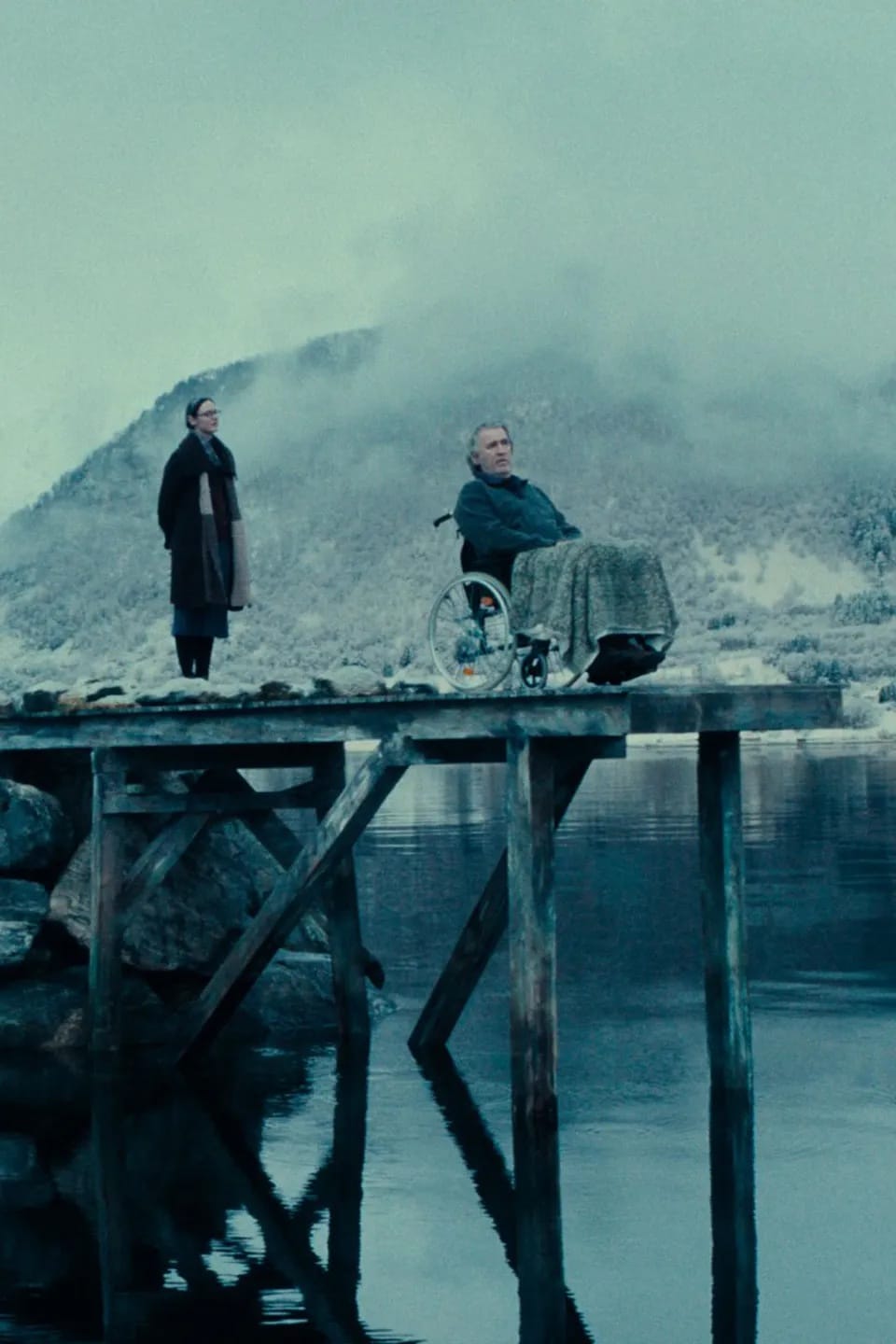
Visually, Mungiu is at his most disciplined. His famous long takes appear less often here, and the film grows more formally restrained as it moves toward the shape of a courtroom drama. The frame is full of windows, glass, and insulation, so that the characters often appear sealed inside their own conclusions, observed from a cool distance.
The Norwegian landscape is breathtaking, though I will confess some of that beauty belongs to nature more than to the cinematography, which stays resolutely sober. The contrast between the majestic scenery and the nightmare unfolding inside it is one of the film's quiet ironies, and the coldness of the staging mirrors the climate in every sense.
I do have reservations, and they are worth naming. The restraint that makes the film so controlled can also keep it from reaching its full potential. There were moments when I wanted Mungiu to push harder, to let the contradictions between secular liberalism, religious conservatism, and state authority ignite rather than simmer. A touch too subdued, I thought, particularly in the middle stretch. There is also a slight imbalance in how the antagonists are drawn. The film is at its strongest when the Norwegian officials seem ignorant rather than malicious, because ignorance is more frightening and more true. When they tip toward coldness for its own sake, the balance wobbles, and I found myself wishing for a little more ambiguity on that side of the ledger.
Still, those quibbles feel small against what the film accomplishes. I do not share the Gheorghius' faith, and I would hesitate over some of their methods, which makes the film's central question land harder for me. How do we separate moral authority from the simple belief that we are righteous? It is a question the film turns on every character in it, religious and secular alike, and it refuses to let either camp settle into comfort.
The most effective forms of control, Mungiu suggests, never look like oppression. They look like order, like necessity, like progress. They arrive carrying casseroles and clipboards.
Then there is the ending, which I will not describe beyond saying it is one of the most beautiful and devastating final scenes I have seen in recent cinema. It does not resolve anything, and it does not need to. It leaves you standing in the cold with everything you thought you believed, and I mean that as the highest compliment I can pay a film. I left the theater with more questions than answers, which has become a rarer experience than it should be.
Fjord will frustrate viewers who want a clear side to cheer for. It is more interesting to discuss than to simply enjoy, and it asks for patience in exchange for an experience that lingers long after the credits. But in an era of polarized takes and instant verdicts, a film that dares to say that no one in the room is entirely right feels almost radical.
Mungiu has made a chilly, challenging, and deeply humane drama, and I expect I will be arguing about it with myself for a long time.
*Feature image: Fjord (NEON)