
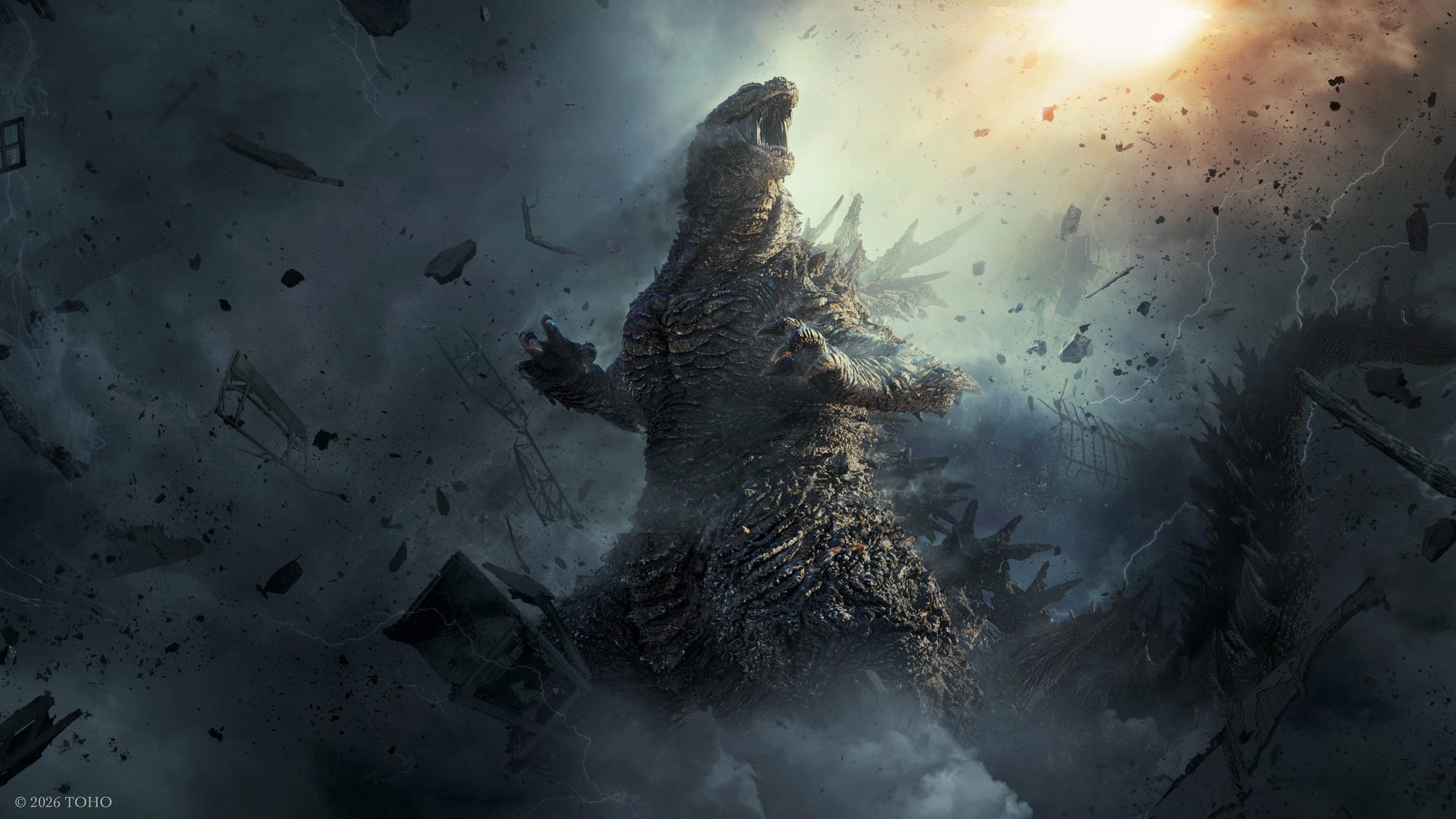
'Godzilla Minus Zero': The King Returns Bigger, Louder, and More Devastating Than Ever
Let me set the scene for you. You are standing in line at Alice Tully Hall at the New York Film Festival, surrounded by what can only be described as the most magnificently dedicated fan base in cinema. Entire families in Godzilla regalia. Action figures of every vintage. A woman who has arrived in full Godzilla costume and labeled herself, with complete sincerity, as the wife of Godzilla. A kid with blue not-so-radioactive hair. And when Godzilla finally emerges from the ocean depths in that screening, the entire hall loses their collective minds in a way that I will not forget for a very long time.
I mention all of this not as colorful preamble but as genuine critical context, because the experience of watching Godzilla Minus Zero with that crowd elevated the film in ways that are inseparable from what the film itself is trying to do. Every glimpse of Godzilla was treated like a superhero entrance, nothing less than a Captain America reveal.
That communal energy is part of what this film was built for.
Takashi Yamazaki's direct sequel to the Oscar-winning Godzilla Minus One picks up two years after the events of that film, finding the Shikishima family and Japan itself in the fragile, hard-won business of recovery. The premise, as the film's own title suggests with a kind of mathematical absurdity, is about what happens when a people who have rebuilt from zero are plunged into negative territory again.
Yes, the title is ridiculous on its face. It is also, if you follow Yamazaki's logic, a genuinely coherent statement about a film concerned with how you balance grief with growth, vengeance with peace, and self-sacrifice with self-preservation. These are not small questions, and the fact that they are being asked inside a blockbuster featuring two enormous monsters destroying large portions of Japan is precisely what makes this franchise so distinctive.
The film wastes no time introducing its new threat.
King Ghidorah arrives with an opening sequence of genuine, jaw-dropping scale, and Yamazaki frames the creature with the kind of mythic weight that the franchise's most iconic monsters deserve. Where Godzilla Minus One built its tension through prolonged dread and restraint, this sequel has a larger appetite for spectacle from the outset, and the shift in register feels intentional rather than gratuitous.
This is a film that knows its audience has come to see the kaiju action and delivers it without apology, while still attempting to keep its human characters at the emotional center.
Ryunosuke Kamiki returns as Kōichi Shikishima, and the film draws real dramatic weight from the fact that we already care about him and understand what he has survived. The ensemble around him brings commitment and warmth to their roles, and when the set pieces put them in genuine peril, the investment pays off in a way that purely spectacle-driven blockbusters rarely achieve.
The themes of guilt, sacrifice, and perseverance that gave the first film its unexpected emotional resonance are present here, too, though the human drama does occasionally tip into melodrama in ways that the predecessor handled with more restraint. The newer characters are defined more by their singular tragedies than by fully developed interiority, which is the sequel's most noticeable weakness.
But when this film works, it works with a force that is almost physically felt. The aerial sequence midway through is a masterclass in tension and spatial choreography, and the final kaiju confrontation delivers on every piece of scale and emotional architecture the film has been building toward.
Yamazaki understands something that many blockbuster directors lose sight of: the monsters are only terrifying when the people around them matter, and the destruction only devastates when you have been given something to lose.
The violence here is harsher and more graphic than the previous film, and the darker register gives the film a genuine sense of danger that keeps you from ever fully relaxing.
Naoki Satō's score is, and I cannot stress this enough, absolutely insane in the best possible way. There were moments in that screening where the music alone was generating physiological responses that I usually associate with live performance rather than cinema. Close your eyes and the score alone conveys the full scope of what is happening on screen. If this film receives the awards recognition it deserves, and I believe the visual effects Oscar is essentially already decided, I would argue the score is equally deserving of a conversation.
Yamazaki and his VFX team, following their Oscar win for the first film, have delivered work here that sets a new benchmark. I am not sure what Dunesday or any other effects-heavy 2026 release is bringing to the table, but this is the film to beat.
The political dimension of the story is also more explicit than the first film, which confined its anxieties largely to national trauma and personal guilt. Here, the presence of American military forces adds layers of tension around authority, outside intervention, and the question of who bears the cost when strategic decisions are made by the powerful and absorbed by the vulnerable.
The film does not resolve these tensions neatly, which is the correct choice. It asks uncomfortable questions about the endless cycle of building bigger weapons, the seduction of technological escalation, and the ways that innovation in the name of safety can create new forms of inescapable danger.
At two hours and fifteen minutes, the film earns most of its runtime while occasionally feeling the weight of its own ambition in the middle stretch. The emotional scenes that bookend the action are genuinely affecting, but there are passages where the pacing slackens in ways the first film largely avoided. These are not deal-breakers, but they do mean that Godzilla Minus Zero, for all its considerable achievements, does not quite surpass its predecessor.
It is a worthy and frequently spectacular extension of one of the great recent franchise reinventions, a sequel that gives fans more of what they love while expanding the canvas in meaningful ways. It is also, and I say this as someone standing in line behind the wife of Godzilla, exactly the kind of film that reminds you why we go to the movies in the first place.
Now, about that inevitable sequel title: Yamazaki stayed characteristically quiet during the Q&A. But I think we all know it is coming. And I am already in line.
*Feature image Godzilla Minus Zero (Toho)