
James Gunn Was Fired—No Surprise Here
*EDITOR'S NOTE: this is obviously an opinion piece, our staff is torn as most of us loved the new Superman, tyvm ...
“We must preserve the myth.”—Marlon Brando on making Superman: The Movie in 1978
The firing of DC co-chairs and CEOs James Gunn and Peter Safran was announced on November 9th. Despite the usual excuses of creative differences and the challenges of being a CEO, the oil-and-water mix that failed didn’t surprise me in the least. In fact, it was really just a question of when. If you had seen Gunn’s reboot of both Superman and Supergirl, it didn’t take X-ray vision to see what would come sooner rather than later.
Gunn is not entirely to blame for his failure at the helm of such properties, as the DC Universe had suffered at Warner Bros./Discovery for some time. For starters, they’ve spent the better part of the last decade playing catch-up to the vastly more successful big screen adventures put forth by the Marvel Cinematic Universe since 2008, when the film version of Iron Man (starring Robert Downey, Jr.) took the world by storm. Since then, the DCU has been trying to copy the MCU, even bringing in Guardians of the Galaxy veteran James Gunn to helm the aforementioned films and to run the whole enterprise with his producing partner, Peter Safran.
DC/Warner Bros. were so impatient in aping the MCU’s success that they rushed a superhero team-up movie (Batman v. Superman: Dawn of Justice) after only a single outing to set up their new universe (Man of Steel). What followed was a series of standalone films, sequels, and two versions of another team-up movie (Justice League)—as well as studio shake-ups, high-profile departures, and emergency edits to salvage release dates.
Into this desperate game of “Follow the Leader” came James Gunn, whose brief tenure as co-head of the DCU began, ironically, just as the MCU had begun to grapple with its own diminishing returns. Marvel’s obsession with linking experimental, ever-expanding narratives across streaming shows and movies had worn audiences out. It felt more and more as if no one was at the helm. Today, even the MCU’s most loyal fans are holding their collective breath to see whether December’s Avengers: Doomsday (featuring players from virtually every franchise) can restore the Avengers to their former glory. And it’s safe to say that James Gunn’s attempt to put his own quirky stamp on this formula was both misguided and ill-timed.
Warner Bros. (now Warner Bros./Discovery) is hardly new to mergers and has repeatedly switched up DC leadership since 2018. But they’ve really got egg on their face this time: hiring Gunn was supposed to turn around their fortunes with the Guardians of the Galaxy wunderkind, but those aspirations stalled just a few films in. It’s not just that both Superman and Supergirl underperformed with critics and audiences; there were deeper problems that both WB management and Gunn should have been far more savvy about recognizing.
As a movie critic, lifelong film fan, and DC Comics enthusiast, I see the primary reason for the sudden, swift ouster of the Gunn/Safran creative leadership as a misreading of the Superman property—and of Gunn’s unabashed, cynical take on the hero, his backstory, and the cultural phenomenon it’s been since Jerry Siegel and Joe Shuster sent the Kryptonian to Earth in 1938. Gunn’s sensibilities were snarky, mean, and far too nasty for such earnest characters as Superman and Supergirl, and his on-screen results weren’t merely a bad fit; they felt tin-eared.
Not to mention … unseemly.
A strong word, I grant you, but much of Gunn’s superhero work over the years was just that, and in the DC Universe, it was nothing if not wholly unbecoming.
For a long time, it worked for Gunn. In his 2010 film Super, starring Rainn Wilson and Ellen Page (now Elliot Page), Gunn made a pitch-black comedy about misfits tackling society’s ills by dressing as costumed superheroes. The delusional ‘dynamic duo’ of Frank Darbo/The Crimson Bolt (Wilson) and his sidekick Libby/Boltie (Page) chose to fight crime mostly to rescue Darbo’s ex-girlfriend (Liv Tyler) from the clutches of a smarmy drug lord (Kevin Bacon). Darbo’s “hero’s journey” began when he dressed up in his red costume to crush the skull of a line-jumper outside a bijou with a wrench, and Gunn showed its gruesomeness in all its bone-crushing and profusely bleeding detail.
Super was vicious, but it made quite an impact by showing the consequences of vigilantism and misguided savior complexes. The film’s climactic showdown showcased even more unseemly visuals as hundreds of bullets, homemade bombs, and buckets of blood filled the frame, culminating in half of Boltie’s face being blown off in horrifying, overly graphic detail. The film earned an R rating rather handily.
As ugly as much of this was, Gunn’s choices worked because his film commented on the blurring of fantasy and reality in a society in which much of the teen population thought they’d become famous via YouTube or reality television. (I worked on kids and teen accounts while in the world of advertising, and the self-delusion came up in study after study, focus group after focus group.) Super nailed these wider, misplaced visions of grandeur, became a cult hit, landed on many critics’ top 10 lists, and announced Gunn as a bold, even brazen new cinematic voice.
Then, in 2014, Gunn hit paydirt with Marvel’s Guardians of the Galaxy, an MCU franchise that would deliver three mammoth critical and financial hits in just nine years. His offbeat antiheroes boldly pushed even beyond the MCU’s existing cynicism, from Tony Stark’s smack-talking Iron Man to Wade Wilson’s motormouth nihilism as Deadpool.
For this critic, the third film went too far with a villain whose experiments tortured, maimed, and killed animals. But most audiences still ate up the franchise. It went on to earn $845.6 million at the box office and cemented the golden reputation Gunn now enjoyed.
Those successes, combined with his improvement on the original Suicide Squad in his sequel, The Suicide Squad, earned Gunn Hollywood’s praise as a filmmaker who could deliver strong, provocative work—even on a salvage job. Of course, he’d be the guy to turn around the DCU’s diminishing fortunes, right?
Well, things started off on the wrong foot with the C-suite’s mutual decision to try to resurrect the granddaddy of all superhero franchises: Superman. Supes on the big screen had struggled for decades since the glory days of Christopher Reeve’s iconic take on the role, beginning in 1978. Bryan Singer’s re-imagining in 2006’s Superman Returns failed rather loudly—particularly because the director seemed lazy, asking star Brandon Routh to do little more than mimic Reeve. Singer also showed his sloth by repurposing John Williams’ iconic theme. It’s one of the greatest film scores ever, but the reboot really called for more something more than a checklist of imitations.
When Zack Snyder was then given the keys to the kingdom, he was considered a visionary by WB executives based on one film—his excellent adaptation of Frank Miller’s graphic novel 300 for the big screen. But Snyder failed in many respects as well, most notably by making his 2013 reboot, Man of Steel, far too violent. British actor Henry Cavill was very good in the role, giving both Superman and Clark Kent presence and likability and steering away from some of Reeve’s comedy, but his superhero seemed almost daft for endangering all of Metropolis in an overlong third act where he battled General Zod and his minions. Superman swore never to use his amazing powers and strength to kill anyone, but by fighting Zod, the two Kryptonians ended up demolishing dozens of skyscrapers and likely killing the people inside. So dumb.
Unfortunately, in Man of Steel, let alone Snyder’s other cracks at the Superman legend in 2016’s Batman v. Superman: Dawn of Justice and 2017’s Justice League, the unseemly violence paired with a superhero who is compared to God in the lore came off as ridiculous. Do you see a pattern here? Surely, Gunn would understand this in his undertaking and veer toward a more earnest, positive presentation, right?
The funny thing is that not only did Gunn have the misfires that went before him to guide him in a better direction, but he also had decades’ worth of TV success that painted Superman and all the other DC superheroes presented in weekly series to, ahem, copy from.
The CW network’s takes on Green Arrow, The Flash, Gotham, Supergirl, and yes, the Superman-themed shows Smallville and Superman & Lois should have been the North Star for anyone attempting to return the Superman franchise to its former glory, regardless of screen size. And if that wasn’t enough, the superior take that WB’s animation department did in creating weekly series for both Batman and Superman in the 90s was just sitting there, waiting to be studied.
But no, wunderkinds have to do their own thing. Screw history. Forget 90 years of formidable storytelling on the printed page. Ignore the brilliant ways superheroes were being brought to life on television for decades. A visionary must do things their own way. And that self-delusion is almost as bad as all those teens thinking they are just one YouTube video or TikTok away from being the next Druski.
Singer thought it was just fine to have a villain shoot a bullet straight into Superman’s eye in Superman Returns. Snyder thought that laying waste to cities by terrorists wouldn’t feel insensitive, even in a post-9/11 environment. And Gunn made many of the same mistakes, both in ignoring much of the nobility and earnestness of his characters and their long, charted histories and by gilding the lily of violence in the on-screen set pieces in his DC efforts.
Gunn cast David Corenswet, a good actor who gave his all to the role of Superman, but he felt small in it. Too human, too down-to-earth, too average-looking in stature. Where was the Herculean figure that Superman cut in both the comics and Reeve’s films? Heck, Gunn couldn’t even dress his lead in a decent suit. The Superman costume looked cheap, and the colors felt grayish. Gunn made Lois Lane (played feistily by Rachel Brosnahan) too cranky and mean to Clark/Superman, which diminished the superhero as well.
The character of Lex Luthor was badly essayed, too. Even though he was played by Nicholas Hoult, a fine actor, the slimy interpretation in Gunn’s Superman didn’t gel. In the comics, and particularly the sublime WB animated series, Luthor is the most successful guy on the planet until Superman shows up and that automatically makes him a far second. Luthor should be seething at being displaced and quietly resentful like in the cartoon show, not manic and panicked and strident. But this new Luthor was so insecure, even with all his powers, inventions, and hubris, that he sent goon after goon to beat Superman to a pulp. He even imprisoned him in a Kryptonite cell to slowly start killing him.
Geez, are we having fun yet?
Superman getting pummeled, kicked, tortured, bleeding, dying … my God, even Krypto the dog got the best of him with his love bites—what the hell, James Gunn?
Gunn seemed to forget that Superman is the one superhero who is the character and that he created the regular guy Clark Kent as his cover. Choose as much God symbolism as you want to exploit, but it is a recurring theme in the comics and certainly was a large part of the confidence and strength Superman demonstrated in Richard Donner’s 1978 landmark film. You’ll remember that Jor-El (Marlon Brando) even instructs Kal-El during his long schooling in the Fortress of Solitude that Earthlings “can be a great people … they only lack the light to show the way.”
Where was that sense of genuine purpose in Gunn’s movie? And where was any of that in his reintroduction of Supergirl to the big screen?
Granted, the first attempt at Supergirl in 1984, starring Helen Slater was not great, but at least her Kara was an earnest heroine who, like her cousin Kal-El, understood the superiority of her position and the great responsibility that came with her awesome, Godlike powers. In Gunn’s 2025 Supergirl, the character is ridiculous, played as little more than an embittered, heavy-drinking malcontent, slumming around the universe, unkempt and uninterested. Milly Alcock did what she could with the part, but shame on Gunn for adapting the bitter, antihero version of the character from 2021’s Supergirl: Woman of Tomorrow instead of something we could all get behind more.
Thus, here we are. Another start-over. We’ll never know what Gunn and company might’ve done with other DC properties.
I personally liked what the new regime did with Lanterns on HBO, and the various ways Batman has been portrayed over the decades show there is some wiggle room in how that darkest of superheroes is presented. DC/Warner Bros. has also done very well with Batman’s famous Rogues Gallery: a series devoted to The Penguin’s backstory won Emmys for HBO, and Clayface recently did surprisingly well at the box office. But Superman on the big screen is the sore spot, and it needed to be done right.
There’s an old saying about not trying to fix something that ain’t broke. In the case of Superman, I’d suggest to whomever is next to tackle the venerable franchise that they pay closer attention to the decades of material to draw upon—which, by and large, consistently portrays the Man of Steel as decent, strong, and earnest.
Christopher Reeve and Melissa Benoist, in her outing as Supergirl on TV, proved that such qualities don’t make for a boring hero. Quite the opposite; they make for a character we want to follow, applaud, and maybe even learn a little from. That’s what they need to do (as well as leaving out excessive violence, cynicism, and flagrant contradictions to the lore).
Preserve the myth, as Brando said. And for God’s sake, avoid being unseemly.
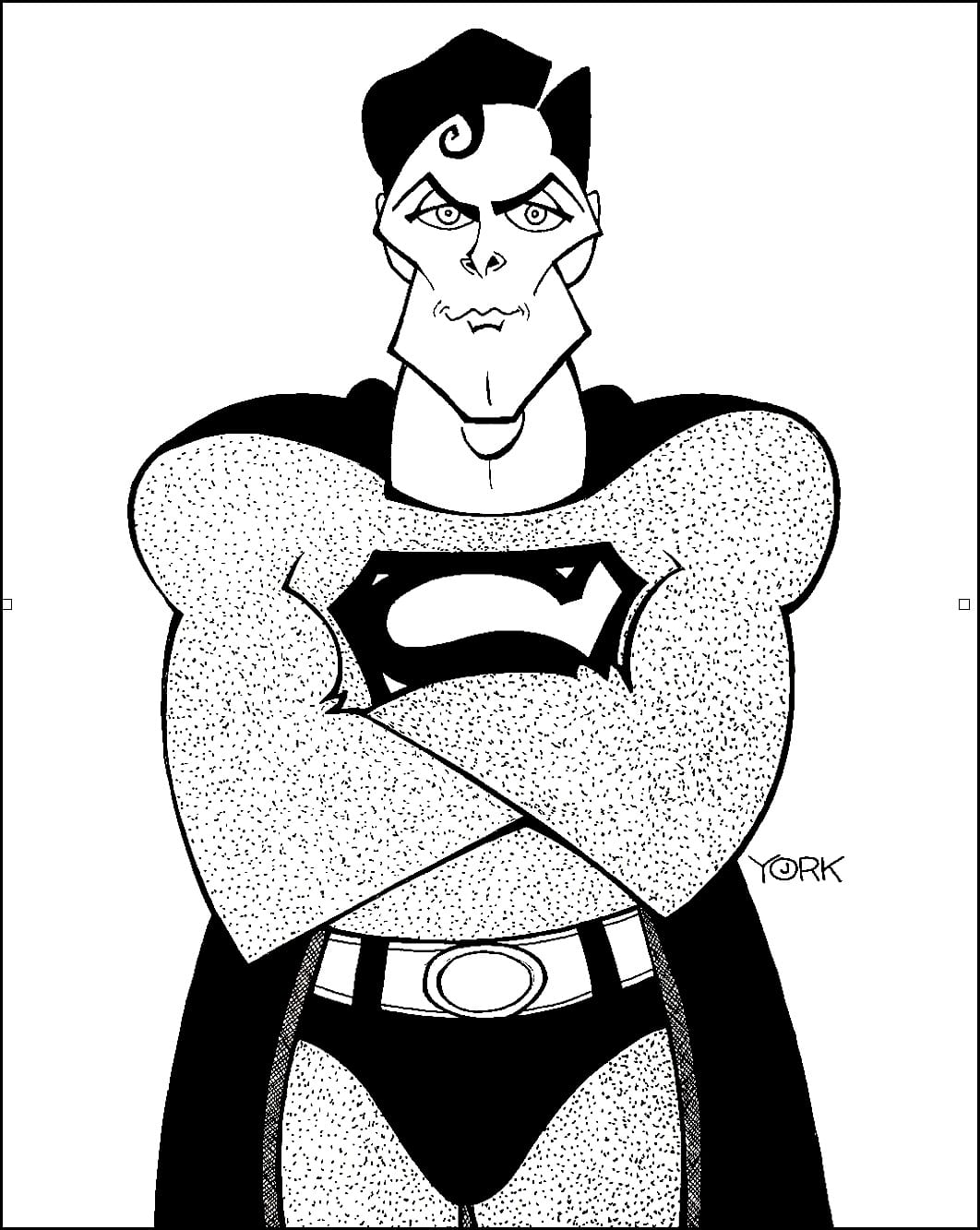
*Featured image created by Jeffrey York