
'Wicker': A Wickedly Funny, Wildly Tender Fable About What Love Is Actually Made Of
There is a particular kind of movie I have been missing, the kind that Rob Reiner and Ron Howard once made look easy: a crowd-pleasing fairy tale with real teeth, a strange heart, and enough confidence to trust that audiences will follow it anywhere. Wicker belongs in that tradition. It is the second feature from Eleanor Wilson and Alex Huston Fischer, following their apocalyptic parenthood comedy Save Yourself!, and it is a leap forward in every way. My late-night screening was completely sold out, and watching a full room laugh, gasp, and quietly sniffle at a film about a woman who commissions a husband made of wicker told me everything I needed to know about its appeal.
The setup is gloriously simple. On the edge of a seaside village lives a Fisherwoman, smelly, single, and perpetually ridiculed by her stuffy, small-minded neighbors. Fed up, she asks the village Basketmaker, played with sly warmth by Peter Dinklage, to build her a husband. Adapted from Ursula Wills-Jones’ short story “The Wicker Husband,” the film treats this request with a deadpan sincerity that is the secret of its tone. Nobody in this fable even has a proper name, and that wonderful lack of specificity lets the story move like an old tale told by firelight, familiar and slightly menacing, with a sense that it has always been about us.
Olivia Colman is the reason the whole thing works, and I say that as a lifelong admirer who has never once seen her give a bad performance, even in projects that did not deserve her. Her Fisherwoman is blunt, self-sufficient, and quietly wounded. You can feel how much effort her indifference to the villagers’ cruelty has required, which makes her slow, astonished realization that someone might actually enjoy her company so moving. Colman balances right on the line between comedy and pathos, hilarious one moment and devastating the next. The film’s most touching beats are simply scenes of a woman who has always fended for herself experiencing kindness for the first time, and she plays them with a rawness that had me on the edge of tears.
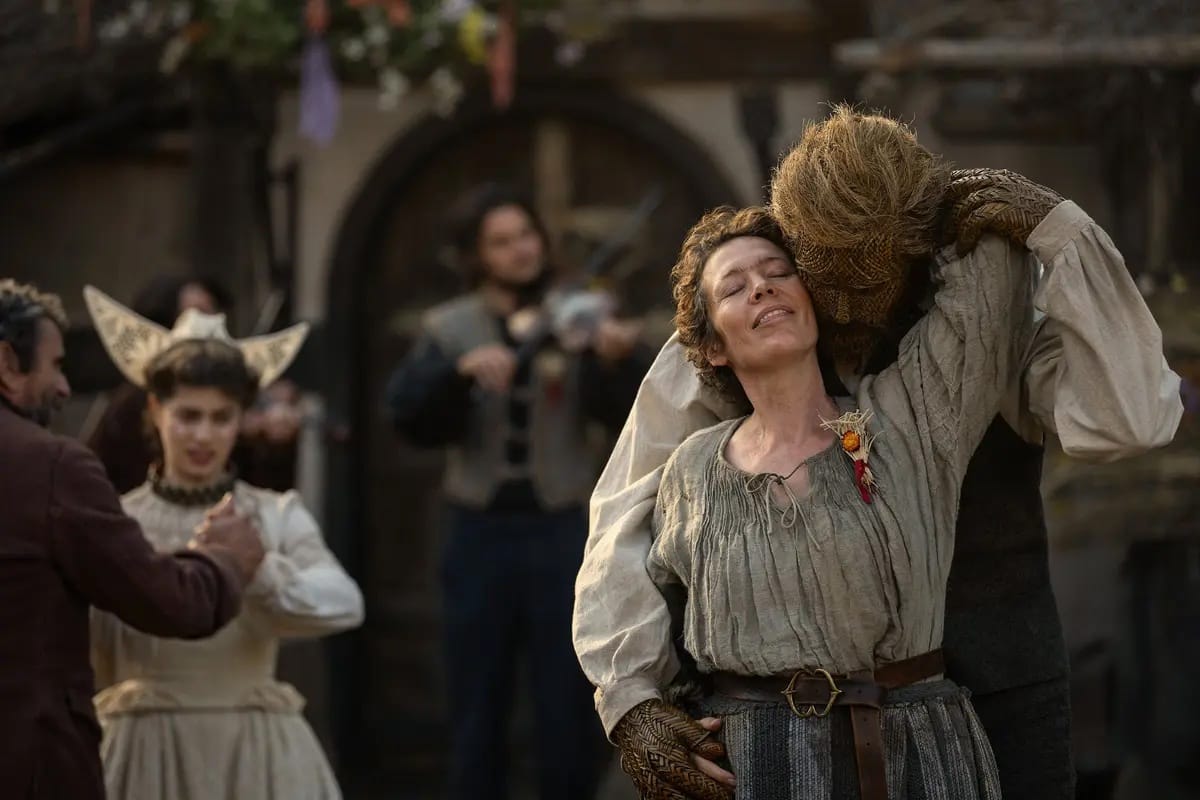
Alexander Skarsgård, buried in prosthetics and wicker, is a delightful surprise. That role could easily have collapsed into a gag, and instead he brings innocence, warmth, and a gentle enigma to the Wicker Husband. By the time he and Colman share a dance, I had stopped wondering how the wicker worked and started simply rooting for them. It is also interesting to watch Skarsgård keep gravitating toward parts that interrogate the effect his looks have on other people. The audible creaks that accompany his every movement, in the bedroom and out of it, are a running joke that never wears thin.
Now, the marketing leaned hard into the surreal sexual novelty of the premise, and yes, readers, it does happen. But the film is not really about carnal passion or a sexual awakening. It is a sweet, surprisingly sincere story about mutual respect, and about how special it is when a relationship becomes a soft place to land.
What makes the villagers so furious is not that this union is strange. It is that it works. The film understands that watching someone else receive genuine affection can force you to confront everything missing from your own life, and that is where its satire sharpens. Elizabeth Debicki is wonderful as the Tailor’s Wife, whose determination to put the Fisherwoman back in her place is fascinating precisely because she gets so little joy from her own marriage.
That satire is the film’s most delicious ingredient. Wilson and Fischer take aim not only at gender norms but at the little social rituals we have practiced for so long that we no longer notice how odd they are: the ceremonial collar, the status that a husband’s job confers on a wife, the idea that marriage means somebody belongs to you. By placing a handmade husband beside the supposedly normal marriages in the village, many of them built on control, obedience, and resentment, the film quietly asks who decided that was the sensible option.
It never lectures. It simply lets the absurdity do the arguing, and the ideas land all the harder for being funny first.
Visually, Wicker is a feast. The production design is crazy good, with a handmade storybook quality that makes the faux medieval world feel lived in, a little ragged, and a little magical. The costumes and makeup deserve real praise, and the wicker husband himself is a marvel of craft, tactile and expressive. The seaside setting has a salt crusted, claustrophobic atmosphere, with cottages that feel more like emotional traps than cozy shelters, and the score understands the assignment completely.
It delivers whimsy with a spine, which is exactly the kind of crowd-pleasing cinema we rarely get anymore.
It is not without flaws, and they are worth naming with affection. Some plot points near the end feel slightly rushed, a few side characters are not fully tidied up, and I wish the film had not sidelined Colman at moments to skewer the town. The Basketmaker’s motivations are not always crystal clear, and the direction, while handsome, can be a little conservative given the strangeness of its material. There is a bolder version of this movie that leans even harder into the danger and bitterness lurking inside its premise. But these are the complaints of a viewer who wanted more, which is the best kind of complaint.
What lingers is the film’s quiet, hard-won idea about love. Real love, Wicker suggests, is not ownership, obedience, or the transaction of "I provide this so you owe me that." It requires the terrifying possibility that someone could leave, and the trust that they will choose to stay. For a woman who has spent her life being ignored and mocked, being genuinely loved can be frightening, and the film honors that fear with real tenderness. It is one of the most unexpectedly emotional love stories I have seen in a while.
Wicker is funny, weird as hell, and wonderfully feminist, a medieval fever dream with more perceptive things to say about relationships than its premise lets on.
Go with a crowd, go with someone you love, and maybe take a few notes. I know I did.
*Feature image: Wicker (Black Bear)