
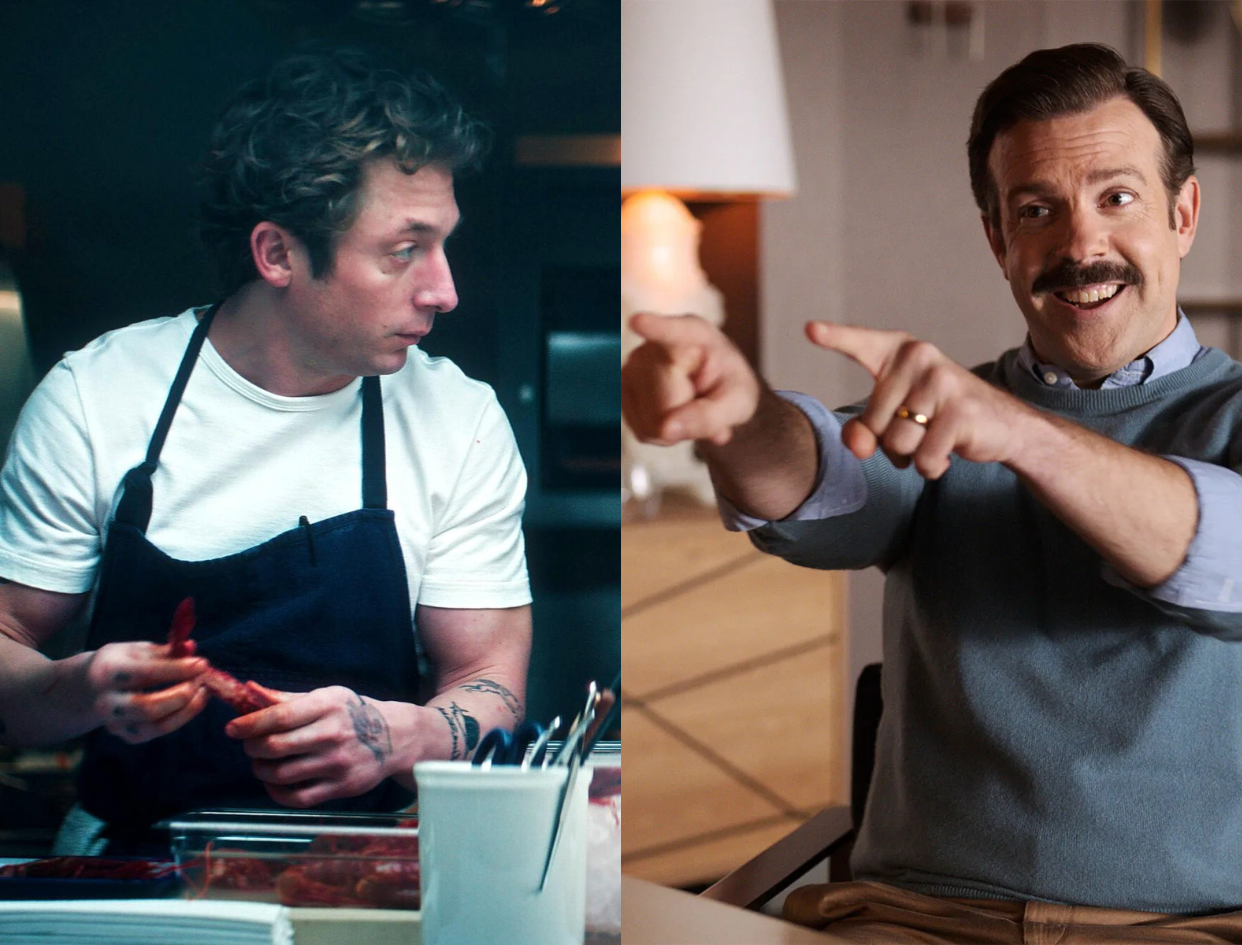
Lassoing the Bear
"Ted Lasso" and "The Bear" are two of the most highly praised and decorated shows in recent years. While they’re technically both listed in the “Comedy” category at the Emmys—mostly because they both started as shows that ran for roughly 30 minutes each, which has traditionally been the realm of Comedy—on the surface, they don’t have very much else in common.
One is very much a jokes-driven, feel-good comedy about a bumbling American football coach, trying to understand the world of a Premier League British soccer team he has been hired to lead, all in the hopes that he’ll destroy the team. The other is about a world-class, high-end chef who returns to his hometown of Chicago to take over the failing, local family restaurant his dead brother willed him.
One was co-created by, amongst others, veteran comedy writer and showrunner Bill Lawrence (more on him later) and Jason Sudeikis, a Saturday Night Live veteran known for making quirky characters and with a voluminous acting career. The other was created by Christopher Storer, a director/producer known for making music videos, stand-up specials, and directing various episodes of comedy TV.
Clearly the shows have very different backgrounds and origins.
Upon closer inspection, however, they share numerous similarities, so much so that I would posit that they are, in essence, the same show told from slightly different points of view. At their heart, both shows are about a broken man dealing with trauma entering into a dysfunctional world and trying to make it, and the people around them, better, all while recovering from their own pain.
Yes, one uses disarming, upbeat comedy while the other uses more moody, directorial flair (season 1 of "The Bear," episode 7, named "Review,” is a spectacularly directed one-shot that only heightens the tension of the the show), but those are only surface-level comparisons. The trauma that informs these men, and thereby the shows around them, are baked into their characters, and only as the shows progress do we as the audience begin to understand the depths of that trauma.
We see the effects of trauma long before we know what the trauma is.
The further you delve into the characters, the clearer the connections become. At the core of both shows are deep explorations of mental health and celebrations of the bonds of friendship. Because of these themes, almost everyone in both shows changes for the better.
Spoilers ahead ...
Character Analysis
Ted uses friendliness and humor to hide the pain of his father’s suicide, so much so that his wife wants a divorce for being “too positive” all the time. There is, in fact, such a thing as “toxic positivity,” (though it is a controversial subject) and Ted is a textbook case. In classic midwestern tradition he can’t deign to see a psychologist to help deal with his issues, instead suffering a series of panic attacks and even lashing out at said psychologist before finally realizing he needs help.
No one would claim that Carmy has the same positive, upbeat traits as Ted, but he’s also avoiding the pain of his past—both his mother’s alcoholism and the effects that had on the family while he was growing up, and his older brother’s substance abuse and suicide. Carmy’s avoidance comes in the form of cigarettes, insomnia, indecision about a menu—he’s constantly striving to make new and better things, which creates chaos for others—lack of clear communication (related to his indecision), and loud yelling, usually at other people, all things he learned in some of the most high-pressure kitchens around the world, which prioritized perfection and brutality over wellness.
As the characters on both shows work through their emotional baggage—Ted via therapy with Doctor Sharon Fieldstone in "Ted Lasso," and Carmy through Al-Anon on "The Bear," a type of group therapy for friends and relatives of people with substance abuse issues—they become better people, helping to inspire those around them to become better, more self-assured, and closer-knit.
In "Ted Lasso," perhaps the person who changes the most is Nate, who goes from a brilliant but insecure kit man to a self-obsessed head coach of a rival club before returning back to the Richmond club where he started, having reflected on his decisions and toxic attitude.
He confronts troubling feelings about self-worth, a fraught relationship with his father—honestly, one of the biggest recurring themes of the show—and a petty, passive-aggressive demeanor to better himself. Arguably the third season redemption arc for Nate could have been shown a bit more on screen. The third season as a whole received much more criticism about some wayward storylines, but that is beyond the scope of this article.
Arguments could be made that Keeley, Jamie, or even Rebecca all changed the most, and I, for one, wouldn’t begrudge that discussion. About the only people who don’t change are Mae, the pub owner and devoted fan (who does eventually become part owner of the club due to Rebecca selling shares) and Rupert, Rebecca’s ex-husband, who begins as a scheming cad and continues as one throughout the entirety of the series, only to finally receive some comeuppance by the season three finale.
Apart from Carmy, the person who changes the most in "The Bear" is Richie. He goes from a selfish, people-hating jerk to a grateful, happy, people-pleaser. Along the way his companions at the restaurant become friends and family, who all see their own positive growth.
Everyone else who works, or who comes to work, at the restaurant also changes due to Carmy’s presence.
Sydney starts as a talented chef who lacks self-confidence to a Michelin-starred cook who runs the high-end restaurant, who also feels more confident around her father. Marcus gains confidence as a pastry chef and rekindles a fraught relationship with his father (there must be something in the air about parents). Sweeps begins as an unhoused man (at least it’s implied he’s unhoused, though perhaps never actually confirmed) who helps clean the original restaurant and ends as a talented sommelier. Even Donna, aka “DD,” Carmy and Sugar’s mother (again with the parents!) changes from narcissistic alcoholic to caring, sober grandmother.
Mental Health In Pop Culture
Mental health and trauma have long been taboo topics, both in television and in American society at large. There have been numerous shows about psychiatrist characters, or people who see psychiatrists, but they were almost always the lead character and played for laughs, never as a core theme to self growth.
In "The Bob Newhart Show," the titular actor plays a psychiatrist whose interactions with his patients, colleagues, friends, and family, made for six seasons of hilarity. Yet it was never a show about dealing with the reasons Newhart’s patients went to see him in the first place.
There was a psychiatrist character in "M*A*S*H*," which did sometimes take the trauma of war more seriously than others of the era, but that was not the core of the show, nor was the psychiatrist character.
Even In the acclaimed "Frasier," the Crane brothers, both psychiatrists, engaged in various hi-jinx related to sibling rivalry, love, and their disabled, retired father and his live-in physical therapist. Rarely, however, did either character, or any on the show, delve into what made them behave the way they did, or how taking their own advice might improve their own mental health.
In the realm of drama television, perhaps no show broke the taboo on therapy more than "The Sopranos." After all, if a mafia boss can see a shrink, then surely it can’t all be bad. Still, a show about overcoming emotional trauma and building a better world, it is not.
Nor would I categorize "In Treatment" as a show that explores grief, trauma, resilience, and community. Each episode focuses on the character of Paul Weston, a charming psychologist who wants a peaceful existence, and one of his patients, sometimes with Weston seeing his own therapist. Still, even in drama, the focus was never on personal growth.
Perhaps no one in modern television has had a greater hand in destigmatizing discussing mental health than Bill Lawrence.
Long renowned for creating such comedies as "Spin City," "Scrubs," and "Cougar Town," his career has reached even higher peaks in the 2020s. In addition to co-creating "Ted Lasso," he’s managed to produce a "Scrubs" reunion series that brought back much of the original cast, helped created a show about a lonely writer who finds community and friendship as a teacher at a small liberal arts college—"Rooster," featuring "Ted Lasso’s" own Jamie Tartt, aka Phil Dunster—and co-created "Shrinking" with another "Ted Lasso" alum, Roy Kent himself, Brett Goldstein.
This latter series combines much of the heart of "Ted Lasso" while also focusing on the therapists themselves attempting to overcome their own grief and trauma, whether it be the death of a wife, a divorce, or a Parkinson's diagnosis.
Therapy is the framing device to explore therapy and its benefits, building friendship, community, and family along the way, just like "Ted Lasso" and "The Bear." While Lawrence may not be the driving force for any of the four most recent shows, his presence can still clearly be felt.
We’ve all got trauma and pain. Seeing it on screen, and the different ways characters react to it, can help us as people navigate life. Watching them struggle, but overcome, can be the beacon of light we need in our darkest hours.
Sometimes we need the lighthearted, Midwestern cheeriness of a mustachioed, friendly coach. Sometimes we need more time to dig into the darkness of our inner demons via an intense, pressure-filled restaurant just trying to feed hungry people.
Either way, the heart and message of the show is the same, that people need other people, and that change for the better is possible, if just given a little support.
*Featured image: "The Bear" and "Ted Lasso"