
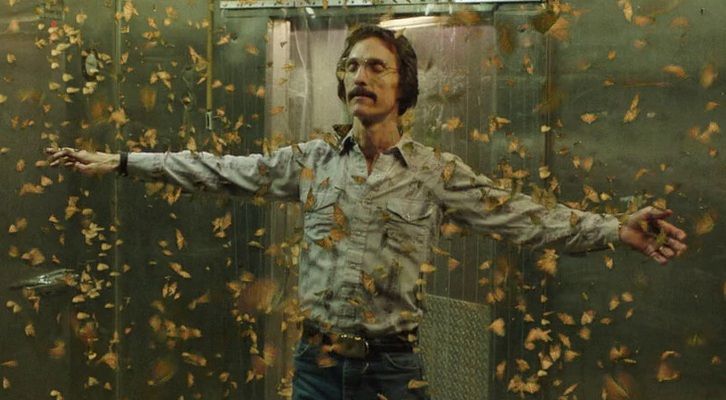
The Brain on Dallas Buyers Club
Every now and then, I invite my parents to go to the movies. We live in a small community, and mostly it’s the big blockbusters that come here. And mostly, we're not all that interested in the big blockbusters. My life would be no different if there were never another Marvel film. I don’t need to see Star Wars, Episode XXXII. Sometimes, though, a film comes that we just have to see. Or, if I'm totally honest, a film comes that I just have to see, and that I hope they will enjoy. When that happens, I invite the folks, and they always say yes, because they are good people and good sports. Always, these outings conclude at the local brewpub, where, over glorious wood-fired pizza and a large pitcher of microbrew, we dissect the film we've just seen and have a grand old time.
Over the years, we've seen Oppenheimer and The Blind Side, Zero Dark Thirty and American Horse, The Boys in the Boat and Philomena, Air and Argo and American Sniper. We saw the Hunger Games trilogy together, and Skyfall, and every single Harry Potter film, but not before my father re-read the book. He’s been retired for many years, but he’s still a scientist at heart, and he does his research.
In 2013, we took a film field trip to see Dallas Buyers Club. Afterward, like always, we repaired to the local brewpub to debrief. Dallas Buyers Club is a powerful film, and was well worth seeing on a big screen. There was much to notice about it, much to discuss, much to debate. We sat for hours, nursing our pints, eventually moving from pizza to a gigantic eclair shared three ways. Great film, great night, great indigestion.
I didn’t know it then, but that outing marked the beginning of a set of obsessions that have only grown over time. Those obsessions have to do with how stories can move people and change them, with how, in particular, stories can unite people across differences in ways no other medium can. Today, more than a decade later, these obsessions have shaped themselves into concentrated, mission-driven work: They underwrite not only our Substack, but also the Story Incubator Writing Lab, the nonprofit Maurice and I founded with the goal of supporting storytelling that moves us, individually and collectively, past our rigid partisan divisions and into a flourishing, expansive post-partisan era.
I. Obligatory Plot Summary, Without Which this Piece Won’t Make Much Sense
I used to teach English. Which means I used to teach writing. Not creative writing, but analytical writing: critical essays about literature. I taught for years at the University of Pennsylvania. Before that, I taught as a grad student at the University of Michigan. At one point, Maurice and I spent a year teaching high school English in a boarding school — itself a wild story for another day. Always, when speaking to students about what constitutes good analytical writing, I harped and harped and harped some more about Rule Number One: Do not write a plot summary. Plot summary is not literary criticism. It is storytelling that is trying to pass as literary criticism. I lectured at length about the difference between the two, and warned students that turning in a plot summary in lieu of an actual work of analysis would not be a good move for their grade.
Years and years of preaching about the evils of plot summary — and yet: here I am, breaking Rule Number One. Reader, if you’ve never seen the film, or if you saw it long ago and your memory of it isn’t all that fresh, this plot summary is for you. If you know the film well, please do skip ahead!
Starring Matthew McConaughey, Jared Leto, and Jennifer Garner, Dallas Buyers Club tells the true story of Ron Woodroof, a Texas cowboy who is diagnosed with advanced HIV/AIDS in 1985. The doctors give Ron 30 days to live — and refuse to give him the then-experimental drug AZT. Instead, they tell him to join a support group and wish him luck.
But Ron isn’t ready to die ...
Continue reading the full article by Erin O'Connor on "The Story Rules Project."
*Feature image Dallas Buyers Club (Truth Entertainment / Voltage Pictures)