
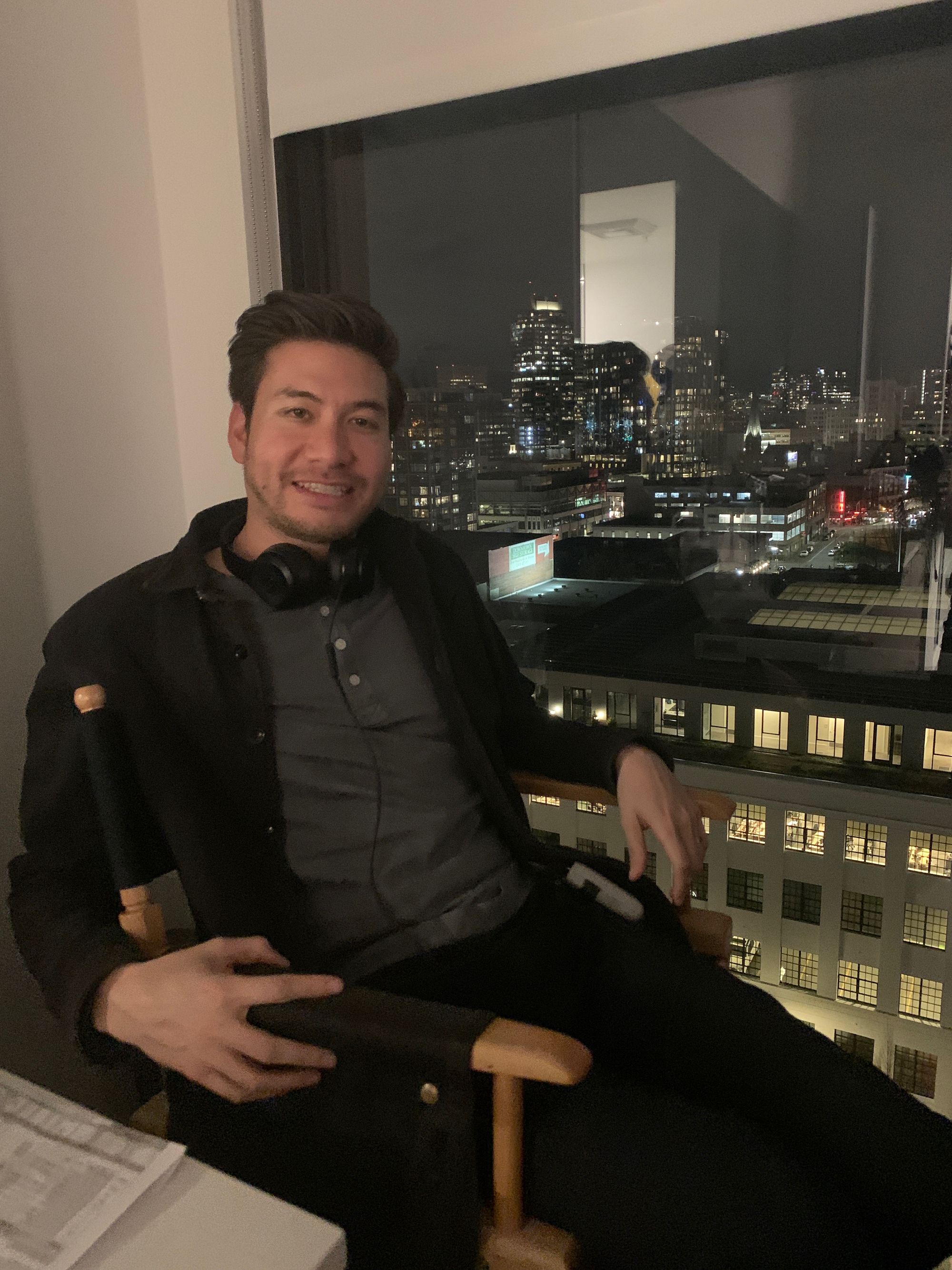
Interview: Toby Louie—A Producer's Perspective
Toby Louie has built a career out of forward motion.
He’s produced commercials, features, television, and documentaries. He’s also one of the founders and producing partners at Fairvale Entertainment, a director-driven production company focused on prestige genre entertainment.
Professionally, he’s a dynamo. Personally, he’s a grade-A mensch. He’s a get-it-done guy in a business full of I’ll-get-back-to-you people.
I met Toby about ten years ago, when I was trying to get my dream project off the ground: the kind of script every filmmaker has, the deep-down-in-your-soul one that speaks to the reason you started writing in the first place. I had seed funding, strong actors attached, and a big EP signed on.
What I didn’t have was momentum. I was working with other collaborators for the longest time and nothing happened. It was like watching paint dry in slow motion, except paint was better at returning phone calls.
I reached out to my friend Jordana Mollick for help, and she told me she knew exactly how to get the ball rolling. That’s when she put me in touch with Toby.
We clicked immediately. Within a month, he helped pull together a top-notch crew and an amazing cast for the proof of concept, which later earned a Best Short nomination at Tribeca.
We got within weeks of making the feature, too. While the project ultimately stalled for all the familiar reasons independent films stall, the fact that we got so close is a testament to Toby’s inimitable hustle.
That hustle is exactly why I wanted to talk to him now, at a time when our industry feels so wildly in flux that getting anything made feels less like a logical process and more a magic trick where no one—not even the magician—has the faintest clue how the trick is done.

As our Zoom begins, Toby tells me his origin story. His family owned a building in San Francisco. The top floor was his father’s photography studio. The middle floor was a clothing store. And on the bottom floor … a fortune cookie factory.
His grandfather, he recounts proudly, invented the machinery that mass-produced the cookies. As a child, he watched “a machine squirt batter onto a little disc, cook it, then fold the cookie around the fortune at exactly the right moment.”
Which is funny, because Toby now works in film, an industry built almost entirely on people confidently predicting things they cannot possibly know.
Will my script sell? Will that actor say yes? Will that financier close? Will that exec return my “just following up” email before the heat death of the universe?
(The answer to that last one is no.)
Toby grew up around the arts. His dad was a photographer. His sister acted in theater and commercials from a young age. He was shown Taxi Driver and The Shining far too early, which is either a formative cinematic experience or a mild act of questionable parenting. Probably both.
But even then, he says, “I wasn’t one of those kids that knew right away, ‘Oh, I want to get into the movie business.’ I always enjoyed them, but I didn’t have an eight-millimeter camera. I wasn’t running around making shorts with my friends.”
Instead, he wrote for his high school paper, studied journalism in college, and assumed that was his path. Then came the pivot. “What about documentary film?” he remembers thinking. “With journalism and my love of visual arts … It bridged those two skill sets.” That led to a producing job at National Geographic TV, where, he says, “You had to wear a ton of hats because we had tiny crews. It allowed me to see all parts of that world.”
When he moved to Los Angeles, he fell into commercials. They were fast, collaborative, and hands-on—a crash course in how production works. “For me, it was about making stuff,” he says. “I really love the creative process. I like how the sausage is made.”
Commercials, for him, were “... a great thing. You’re working on such a tight timetable, and there’s so much turnover. You could be working on one commercial for two weeks, then you’re on another for the next two weeks.” Better still, they were “... an amazing way to meet people in the industry.”
That, for Toby, is the real lesson. Not make commercials forever, unless, of course, you love making commercials, in which case, congratulations on finding one of the few corners of the business that occasionally pays on time. The bigger point, as he said, is: “If you can’t be in the job that you want, be adjacent to that job, as close to that job as possible.”
Toby’s advice is simple: don’t wait to be discovered. Get close to the industry, meet people, learn how things get made, and make yourself useful.
Eventually, a chance meeting on a commercial set led to Night Owls, the indie feature he produced for around $200,000 in a rented Airbnb in Topanga Canyon. “It turned out to be one of the best experiences I still have had in the film industry,” he says. “Small crew, one location, short shoot.” The film went to South by Southwest and sold to MGM/Orion. “Meeting collaborators while working in commercials, the short-form world—got me into the long-form world.”
“You never know what door is going to open,” Toby continues, “and so you just have to follow whatever path you find yourself on, and look for openings.”
He encourages young creatives to “... just say yes. Meet as many people as you possibly can, and don’t say no to a meeting just because you think it’s not going to be worth your time.”
“Go PA on a set, see how it’s done. And you never know the random conversation that you have … in crafty or in the bathroom line … all of a sudden you’re pitching your next film and someone’s like, ‘Well, that sounds cool, send it to me.’”
There is something wonderfully unromantic about that. Forget the fantasy of your Sundance short launching a directing career. Forget the mythology of a viral sketch that turns into a TV writing job overnight.
In Toby’s version, your first break might happen while you’re scarfing down 12-hour-old hummus at crafty or waiting in line for a bathroom when you really have to go. It’s about getting close to the industry, saying yes whenever you can, and sticking around longer than most sane people would.
Which, frankly, feels a lot closer to how this business actually works.

Many younger writers believe the job is to write a great script and then wait for studios to fight over it. Toby sees it differently. A script matters, of course it does. But it has to move through an industry that has a bottom line.
“You need a real strategy for what the movie is and how to communicate it.” Toby says executives often ask for the poster or a pitch deck because “... they want to be able to sell it very specifically to either their higher up or to an audience. Most of the time, they’re looking for a fresh take on a familiar story.”
That can sound reductive to writers, especially writers who would rather discuss theme, tone, character, structure, and the exact childhood wound that inspired the third-act monologue. But now you have to be more than just a writer. You’ve got to learn how to market your work.
Toby isn’t saying art doesn’t matter, of course. But you need to know what your movie is, who it’s for, and why someone else should spend time, money, credibility, and years of their life trying to make it.
“Every step of the way,” Toby says, “you must be selling.” A writer sells the script to a producer. The producer sells it to actors. Actors sell it to financiers. The package sells it to buyers. The finished film sells itself to an audience.
Toby now reads scripts with these kinds of questions in mind: “What is the release strategy of this film? Who is this for? What will the marketing look like?” he asks. “That’s the first thing that a distributor is going to look at.”
But that doesn’t mean chasing some abstract idea of what’s “sellable.” “Don’t follow trends,” he says. “It takes two, three years to get a movie made at the minimum. Don’t write something that’s popular now because you think it’s going to be popular forever. Only write it if you really feel passionate about it. If it’s a story that you want to sustain and tell because it’s got to stick with you forever.”
For all his talk of marketing, Toby is still looking for the same old mysterious thing every producer is looking for: a script that hits him hard enough to make him care.
“Does it really move me?” he says. “That’s a huge box that has to be checked for me to get involved.” He remembers one project that made him physically react. “I kid you not, I actually dropped my iPad halfway through the script because I could not believe the twist.” What impressed him wasn’t just the shock value. “It wasn’t gimmicky. It was very integral to the story, part of the DNA of the characters.” That script, he says, has been hard to get made, but he continues to advocate for it because it felt “undeniable.”

For writers and directors trying to get something made, independent producers like Toby are key.
“Partly, it’s to legitimize a project,” he says, “because if someone else has been going to bat for it, then that means that there’s something there.” But more than that, producers are often the ones with the longest emotional commitment to the film. “We’re the ones that have the most passion for the project and have to sustain that passion … through production, post, and release.”
“You need independent producers in your corner because they’re the ones that are gonna get the movie made down the road, not the agent or manager.” Agents and managers, he says, are “more transactional.” A producer’s job is different. “My job is not to promote your career as much as I hope that happens. My job is to make the best movie. My job is in service of the film.”
Many writers and directors treat producers like subordinates, as if they’re working for them rather than the film. But it’s not a hierarchy, it’s a partnership. And partnerships only work when both sides are willing to meet in the middle.
“I look for a writer who’s willing to do the work,” Toby says. “Willing to maybe do a change without a fee.” It’s not ideal, and it shouldn’t be abused, but in the early stages of getting an independent film off the ground, that kind of collaboration is often part of the reality. “Work with me. Collaborate with me, so that if we can both get it there together, then the likelihood of it getting made … is much, much higher.”
“Being a good collaborator is a big piece of making it happen,” he continues. “It takes a village. And the script is the base of the village.”
Yes, the script is the foundation. But for it to become a film, other people have to build on it. And the writer can’t yank out that foundation every time the village expands.
Toby has seen that happen. He mentions “two or three projects” that fell apart because the writer “decided they wanted to pull the rug out from the project when we had momentum.”
Which is why one of his most practical suggestions is simple: “Wear your producer hat.”
“Think about: who should read this? What is the strongest version of the pitch? What could make it easier to say yes? What other form could give the material more traction?”
Sometimes that means thinking beyond the script. Toby points to a younger writer with a project everyone liked but knew would be difficult to make. “He decided to make a graphic novel out of it,” Toby says, “on his own dime and his own time.” That, he says, is “thinking outside the box.”
Because the truth in our industry is that even success doesn’t guarantee stability.
“There could still be instances where you make a movie and then three years go by before you make another one, and you can’t really live off of that,” Toby says. “You need to have a ton of balls in the air.”
Toby’s produced commercials, documentaries, scripted, unscripted, and also runs a production company. This is what a producing career looks like. You can’t put everything on one project. They fall apart for reasons that have nothing to do with quality: actors pass, financing collapses, executives leave, companies change direction. It’s honestly shocking that anything gets made.
Which is why, for Toby, survival is not only about perseverance. It’s about people. “Find your collaborators,” he says. “The people who see the world the way you do, but can still challenge you. Those who you want to live in the darkest trenches with. That includes your support system at home and your partners in business. And once you find them, hold on for dear life.”
And even if you get a project together, Toby says, “... that doesn’t mean you’re going to find that success again. You have to continuously reinvent yourself creatively. Think about ways that you can put a unique spin on … the familiar but different.”
A creative career can be fun. It can be truly beautiful. You can make something vaguely resembling your dreams come true.
But it’s not easy. Nothing fulfilling is.
“If all you want is the finish line—‘I made a movie, and my name’s on it, and it’s in the theater’—then this is not for you,” Toby says. “What keeps me going? I love the process. The little wins, the stories I believe in, and the butterflies you get when you read a great script.”
For all his talk of strategy, Toby is, at heart, a romantic.
And maybe that’s what a producer’s job really is: to hold both ideas at once. To think practically, but feel deeply. To understand the business, but still be in awe of the work the business creates.
To believe, even after knowing how brutal this industry can be, that you can still make something powerful enough to make someone else drop their iPad.

As we wrap up our conversation, I ask Toby if he has his own nugget of wisdom to impart to young creatives trying to climb the Hollywood ladder.
“You’ve got to be a cockroach. Outlast everyone.”
It is not glamorous advice, but trust me—Hollywood ain't glamorous. Careers are built through proximity, stamina, luck, taste, timing, collaboration, and an exhausting number of afternoons “just catching up” with acquaintances at various Coffee Beans.
Unlike most careers, there’s almost no “climbing the ladder.” For Toby, it’s about being on the right rung, at the right time, with the right script in your hand.
Not exactly the kind of fortune you’d find in a cookie, but a heck of a lot more useful.
*Feature photo: Toby Louie (Credit: Bobby Lam)