
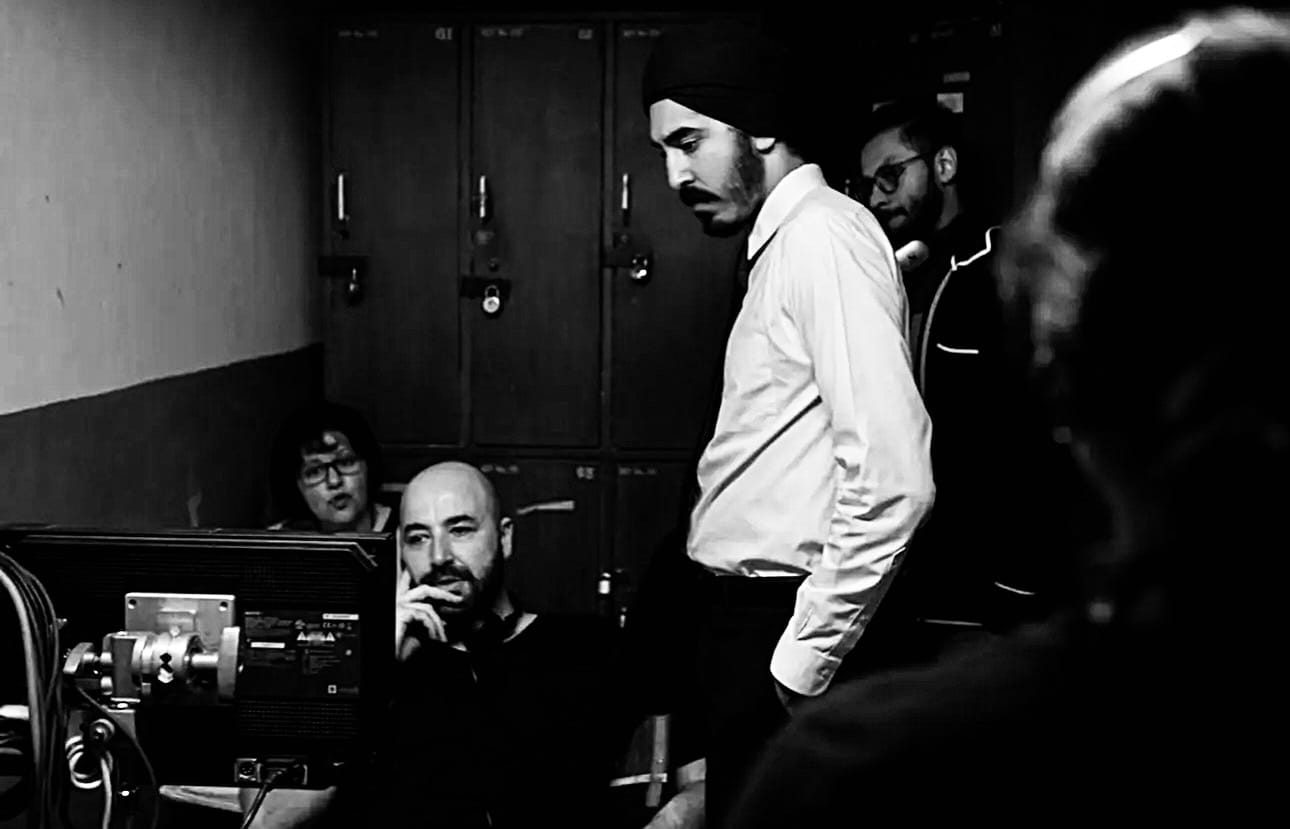
Let the Clouds Part: A Conversation with ‘Pressure’ Co-Writer & Director Anthony Maras
Finding the human story inside history, the art of invisible tension, and why a meteorologist became the most important person in World War II.

A film about a meteorologist making weather forecasts in the 72 hours before D-Day does not, on paper, announce itself as edge-of-your-seat cinema. And yet Pressure, writer-director Anthony Maras's second feature, is exactly that: a taut, claustrophobic chamber drama that turns forecast charts into instruments of dread and conference room arguments into something approaching psychological warfare. The film trusts that tension does not always require bullets or explosions. Sometimes it requires a room full of exhausted people staring at maps and waiting for certainty that may never arrive.
At the center of it is Andrew Scott as James Stagg, the chief meteorologist tasked with telling General Eisenhower and the Allied high command something they desperately do not want to hear: the weather window they had planned for does not exist, and a postponement may cost thousands of lives either way. Scott plays him with a restraint that is almost frightening in its precision, revealing the man beneath the professional exterior only in small, carefully rationed moments, tiny cracks in a surface working very hard to hold. It is the kind of performance that makes you understand why certain actors only need to exist in a frame for the whole room to reorganize around them.
Maras knows exactly what he is working with. His previous film, Hotel Mumbai, made with the same discipline and the same instinct for finding the human story inside historical catastrophe, established him as a filmmaker of genuine consequence. What connects the two films is not subject matter but philosophy: a belief that the most powerful storytelling happens not in the spectacle but in the interior, in what people carry and conceal and how they hold themselves together when everything is breaking down around them.
Maras grew up in Adelaide, Australia, the child of Greek migrants, surrounded by people whose stories felt almost mythic to him as a boy. He made short films for years, winning multiple Australian Academy Awards, before Hotel Mumbai announced him to international audiences. Pressure, co-written with David Haig from Haig's acclaimed stage play, continues that work. Maras also edited the film himself, and there is a score by Academy Award-winner Volker Bertelmann that understands exactly when to press and when to hold back.
I spoke with Anthony about the path from Adelaide to the D-Day war room, the challenge of adapting theater to cinema, what Andrew Scott does that most actors simply cannot, and why a meteorologist standing his ground against unimaginable pressure is exactly the story this moment in history needs.
This interview has been edited for flow and clarity.

Rahul Menon: Before Hotel Mumbai, before the Australian Academy Awards, there was a filmmaker making short films, finding his voice, building the instincts that would eventually carry him into some of the most intense and morally complex true-life stories in recent cinema. Where did it all begin for you, and what was the film or the moment that made you understand what kind of filmmaker you actually wanted to be?
Anthony Maras: It is hard to ever really pin these things down, but I think growing up in a migrant household in 1980s and 1990s Australia had something to do with it. Just being surrounded by the stories and larger-than-life characters of my own and other immigrant families, fellow Greeks, but also Italians, Serbians, Persians, Vietnamese, Maltese, and many others. To a kid growing up in the suburbs of Adelaide, their tales of lives abroad seemed almost mythic. These were stories of heartbreak and longing, of war and struggle, but also of adventure and triumph, and they were as exciting to my young mind as any movie or television show. They left a lasting impression, and from very early on drew me toward stories exploring the intersection of people from different cultures and worlds.
Then in my early twenties, I was volunteering at a local film festival and was utterly blown away by a short film called The Shot, made by Puven Pather, an Indian-Australian filmmaker. The sheer ambition of this little Australian production telling such a monumental story completely reframed what I thought was possible in the short film format. It gave me the courage to try something on a similarly large canvas.
RM: Your short films, including The Palace, Spike Up, and Azadi, won multiple Australian Academy Awards and played at festivals around the world. The short film is where most filmmakers learn the fundamentals, but for you it seems to have been something more, a body of work rather than a stepping stone. What did those years in short form teach you about storytelling that you could not have learned any other way?
AM: Filmmaking is something you can only learn by doing. Trying, failing, experimenting, and trying it all over again. That opportunity is what making short films really afforded me. There is all the usual stuff you would expect: coming up with a story, scrounging for resources, managing a production, working with actors. But more than anything, it is problem solving. It is getting used to the idea that somehow, you have got to find a way to get this idea on the page, and then finally onto the screen.
It took me a little while to understand short film as a form. I made my first short films before ever having watched any, and so instinctively I tried to cram a feature-length story into the format. This does not work. As I developed, I came to see that the power of a singular idea, beautifully realized, is what makes for a truly great short film. Some of these principles, of narrative economy, of the importance of exploring a central theme, of working collaboratively with cast and crew, have carried through to my feature film work, and I think for the better.

What strikes me across these first answers is how organically Maras's sensibility was formed, not through formal training or deliberate ambition, but through immersion: in the stories of the people around him growing up, in the hard practical lessons of making short films before he had really watched any. That kind of formation leaves a particular mark. It produces filmmakers who trust feeling and instinct over theory, and who tend to find the human interior of a story before they find its architecture.

RM: Hotel Mumbai arrived and immediately announced you as a filmmaker of real consequence. For me personally, the 2008 Mumbai attacks are a tragedy I remember vividly, a moment that carried a particular weight for anyone with Indian roots or connections. How did you approach the responsibility of telling that story, and how did you ensure that the film honored the people who lived through it while still serving the demands of cinema?
AM: We began writing Hotel Mumbai less than a decade after the terror attacks on which it is based occurred. The wounds were very raw, the key organizers of the attacks were still at large, and the political environment was highly volatile. In these circumstances, I felt an immense responsibility to tell the story as truthfully as possible, to honor the stories of the survivors and the fallen, and to approach the wider geopolitical conversation around terror, extremism, class, and religion with utmost respect and sensitivity.
On a practical level, this started with listening.
Allowing the time to meet with many survivors and other participants in the attacks, and to just hear them out. My co-writer John Collee and I went to extreme lengths in sourcing as much firsthand material as possible, trawling through thousands of pages of court case records. Some of our interviewees were reluctant to have their actual names and biographical details used in the film, which meant changing their identifying details to honor their wishes whilst keeping the heart of their story intact.
RM: You wrote, directed, and edited both Hotel Mumbai and Pressure, which gave you an unusual degree of control over the final films. How does wearing all three hats simultaneously shape your approach to each role, and do you ever find that the editor in you begins influencing decisions that belong to the writer or director?
AM: With both Hotel Mumbai and Pressure, I was interested in the immediacy of the moment. Instinctively this meant giving as much space as possible for the actors to run with the scene and capture it organically, rather than orchestrating things too much for camera. In both instances this made the editing process central to my work as a director, as we took an almost documentary-like approach to production, which meant that much of the film was found in the editing room. This meant I was never making definitive calls on set as to which was the best take, but just moving forward when we had gotten what we needed, knowing there was much more to discover in the cutting room.
When you are on the tools across all three phases it can allow for a kind of harmony which I think both films needed. And in both cases I had exceptionally talented collaborators in my fellow co-writers and editing team who were instrumental in shepherding the project with me, providing fresh insight, and just constantly refining the work until someone finally rips it from your hands because the deadline is up!
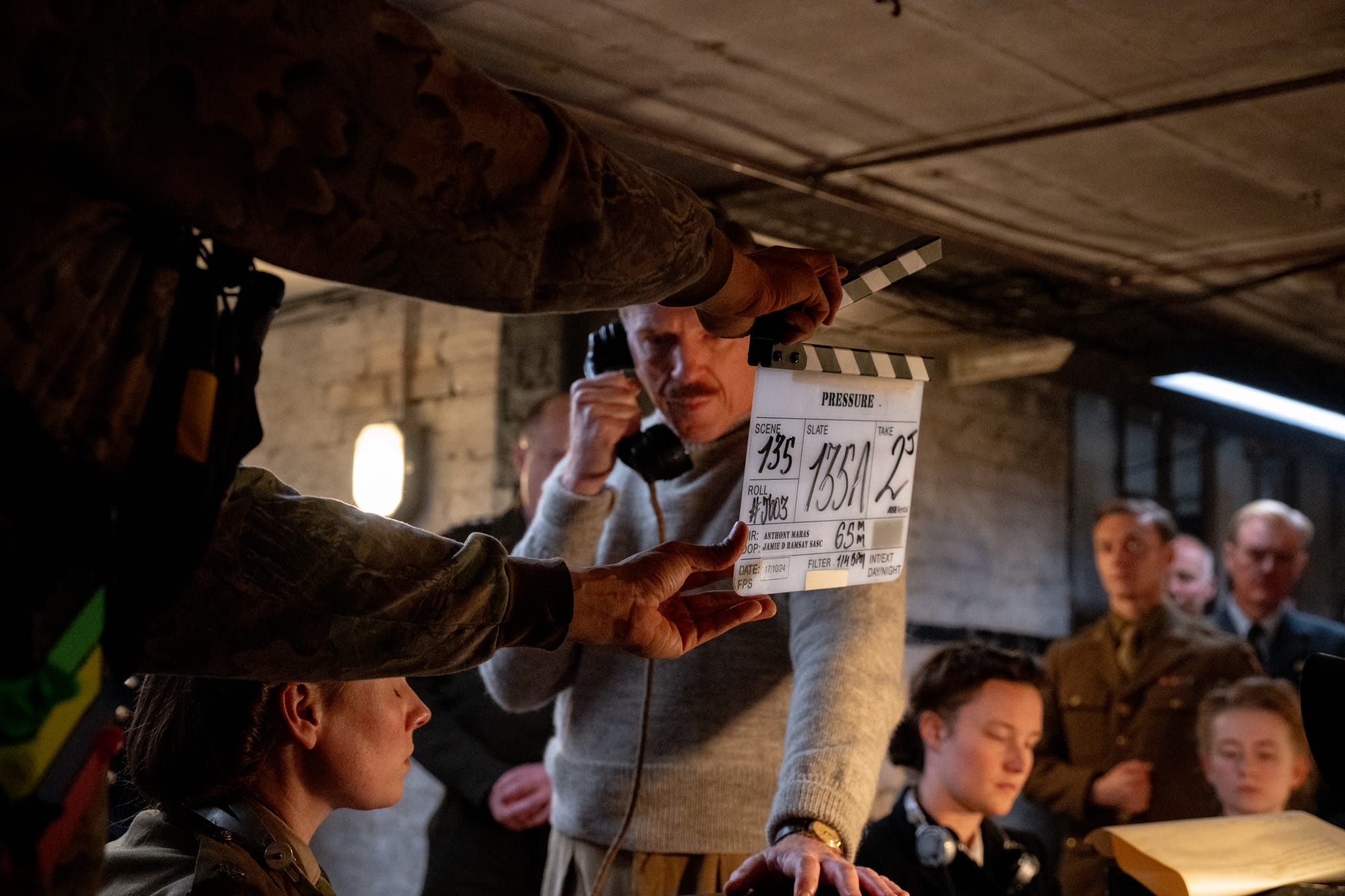
RM: For readers of Pipeline Artists encountering your thoughts on preservation for the first time, can you say a little more about how the research process for Pressure changed your own relationship to archival cinema and the urgency of protecting it?
AM: Archival cinema is vital to recording and shaping our collective memory, and in making Pressure, the use of archival footage was vital in capturing both the sheer scale of the D-Day operation, as well as these small, candid moments that offer a type of authenticity that is impossible to manufacture. Protecting the legacy archival footage offers us is of paramount importance, because it is a big part of how we and future generations will come to understand ourselves, our society, and our history.
It is also worth mentioning the extraordinary coincidence that occurred when reviewing our archival material. We had so much footage and so little time to go through it all that we had to hire more archive editors in the months leading up to production. One of these editors, completely by chance, was one James Stagg, the grandson and namesake of the protagonist of our film. Some eighty years after the actual events took place, he just walked into our London production offices to begin work on a job he had heard of the day before, only to discover the unbelievable coincidence that had unfolded.

That detail, James Stagg's grandson walking into the London production offices and finding himself working on a film about his own grandfather, perfectly captures something about why Maras is drawn to this kind of storytelling. History is not an abstract record. It is a living thing, still connected to the people whose lives shaped it. That young man sitting down to work through eighty-year-old footage and finding his own family's story is exactly the kind of human surprise that Pressure, at its best, manages to make you feel.

RM: Pressure began as a stage play by David Haig, who also co-wrote the screenplay with you. Adapting theater to film involves a fundamental change of grammar: the stage thrives on language and presence, while cinema thrives on space, time, and the cut. How did you and David Haig negotiate that transition, and were there moments where the theatrical origins of the material pushed back against what you needed the film to do?
AM: The process of adapting the play was entirely organic and instinctual. Having written the stage play and having performed the role of Stagg over three hundred times, David knew the material inside out, and I just approached it like any other source material.
A lot of dialogue was trimmed or removed entirely where an image could say the same with less. Themes of dealing with uncertainty came to the forefront, as did the idea of Stagg being one man against the world, speaking truth to power. There was also an inherent wit and sardonic humor buried deep within the DNA of the stage play, that we took great care to really build on for the screenplay.
I was also very conscious of imbuing the film with an increasingly suffocating sense of dread as D-Day drew closer. Opening with the catastrophic D-Day training rehearsal, Exercise Tiger, was vital here, as it underscored that any small mistake could result in countless fatalities. It meant that throughout the rest of the film, every calculation in the operations room and every argument in the war room carried the weight of hundreds of thousands of lives.
RM: At the center of Pressure is a genuinely fascinating dynamic: a meteorologist telling the most powerful military commanders in the world something they desperately do not want to hear, and holding his ground. That tension between expertise and authority, between truth and the pressure to conform, feels remarkably contemporary. Was that resonance something you were conscious of while making the film, and did it shape the way you approached Stagg as a character?
AM: The tension between truth and political expediency lay at the heart of the film, and was absolutely central to my eagerness to come onto the project. Pressure might be set eighty years ago, but its themes are just as relevant, if not more so, today. It is a story that explores what leadership, at its very best, looks like: having the humility and wisdom to acknowledge when you are out of your depth, the necessity of rational thought, and the courage to stand one's ground against unimaginable pressure.
I first read the stage play as my home country of Australia was being incinerated by the biggest wildfires in its history, and I had just left Los Angeles, which was also engulfed in wildfires. After this, Covid followed, as did countless other ecological catastrophes, and through it all I was struck by how much misinformation was being peddled on all these fronts, and by the hostility toward the scientific method. To find, then, a story of a singular moment in history where a meteorologist was central to winning one of the greatest military victories of all time and helping defeat fascism in Europe: that was a story worth telling.

That passage, connecting wildfires in Australia and Los Angeles to a story about a meteorologist in World War II, illuminates exactly why Pressure lands with the weight it does. It is a film about the past that is quietly insisting on the present. Every scene in which Stagg defends his calculations against skepticism, against impatience, against the desire for a more comfortable answer, resonates in a way that has nothing to do with historical distance and everything to do with where we are right now.

RM: Andrew Scott's performance as James Stagg is extraordinary, and what struck me most about it is the restraint. He never reaches for grand theatricality. The performance works through hesitation, glance, and tiny emotional cracks. As both the director and editor of the film, how did you draw that quality out of him on set, and how did you protect and amplify it in the edit?
AM: A director must try and create an environment where his or her actors are free to explore their impulses, and in the case of Stagg, it meant having the confidence to reveal very little at times. To not play a man under pressure, but counter-intuitively, to play a man actively trying to suppress the pressure and tension he feels. To embrace restraint almost throughout, and then at very specific moments to let the clouds part, revealing an inner life, a humanity that Stagg is suppressing just to try and get through the day.
Really, it just comes down to casting well, trusting your actors, and letting them run with their instincts. Then sculpting it all in the cutting room in a manner that does justice to the performance and the story. With someone as unspeakably talented as Andrew Scott, one of the finest actors working today, that becomes a lot easier!
RM: You have now made two films grounded in real historical events that carry enormous emotional and political weight: the 2008 Mumbai attacks and the hours before D-Day. Both films find the human story inside the historical record rather than the spectacle. Is that a conscious artistic philosophy, or does it come from something more instinctive, a particular way you see the world and the stories worth telling?
AM: Making Pressure after Hotel Mumbai was certainly not part of any overarching artistic philosophy. If anything, I was reluctant to do another true story after Hotel Mumbai, and I certainly was not looking to do anything war or terror-related again. However, upon reading the stage play for Pressure, I became really intrigued by the prospect of working with tension and suspense in an almost diametrically opposite way.
In Hotel Mumbai there are armed gunmen roaming the corridors, creating a visceral sense of fear that taps directly into our reptilian brain. With Pressure you have an invisible, amorphous weather system that will never directly affect the lives of the characters we follow. It is not a disaster film. The tension must be extracted entirely from the hopes, fears, and anxieties of the central characters and the actors portraying them.
I was very keen on making something as dry as a series of meteorological arguments into a thrilling, cinematic experience. I also feel that many of the greatest threats we collectively face, like climate or economic collapse, are systemic, complex problems that we are not evolutionarily designed to fear. I was interested in telling a story that made such threats thrilling and terrifying, without sensationalizing them.
RM: Pressure arrives at a moment when audiences are genuinely hungry for intelligent, character-driven historical drama, but also at a moment when the theatrical landscape for that kind of film is increasingly uncertain. What does making this film at this particular time mean to you, and looking forward, what kind of story are you searching for next?
AM: I am optimistic about the future of storytelling generally, because it is an inherent part of the human experience, and I do not know of any society that has ever existed without it in one form or another. Whether cinema as an art form continues to flourish amidst the monumental changes in technology and in the world generally is an open question. I am still a believer that a good story, well told, will always have an audience, and that is what I am searching for in my next film, whatever that looks like.

Anthony Maras ends this conversation with something that sounds almost deceptively simple: a good story, well told, will always have an audience. It is the kind of thing that sounds like a platitude until you spend an hour and a half inside Pressure and realize that he genuinely means it, and genuinely knows how to deliver it. The film is, in many ways, the proof of its own argument.
What I keep returning to in this conversation is how consistently Maras describes his own creative process in terms of listening and restraint. The years spent hearing the stories of migrant families in Adelaide. The short films made before he had watched any short films, and the hard lesson that followed. The set where the instruction to Andrew Scott was not to play pressure but to suppress it, and then let the clouds part only at the precisely right moment.
That phrase, let the clouds part, is perhaps the most precise description of what makes the film work as well as it does. Scott's Stagg does not erupt. He does not break in the conventional dramatic sense. He is a man holding himself together under conditions that would collapse most people, and when something finally surfaces, it surfaces in the most economical, most controlled, most devastating way possible.
Maras as editor understood that the job was not to amplify those moments but to protect them. To clear space around them and let them breathe.
The resonance Pressure carries beyond its historical setting is not accidental. Maras was reading the stage play during Australian wildfires, during Covid, during a sustained global assault on scientific expertise and the idea that expertise matters at all. He found in this story of a meteorologist standing his ground against Eisenhower a model for something he believed the moment needed: a demonstration that rational thought under pressure, delivered with courage and without performance, can actually change the course of history.
Whether or not Maras intended Pressure as a film about the present, it functions as one. And that is perhaps the most useful definition of the kind of historical drama worth making: not a film that explains the past, but a film that illuminates the present through it. Maras has now done that twice, with Hotel Mumbai and with Pressure, and the consistency of that instinct, finding the human story inside the record, trusting the interior over the spectacle, is starting to look less like sensibility and more like a genuine artistic signature.
I am looking forward to whatever he finds to do next.
*Featured photo Anthony Maras