
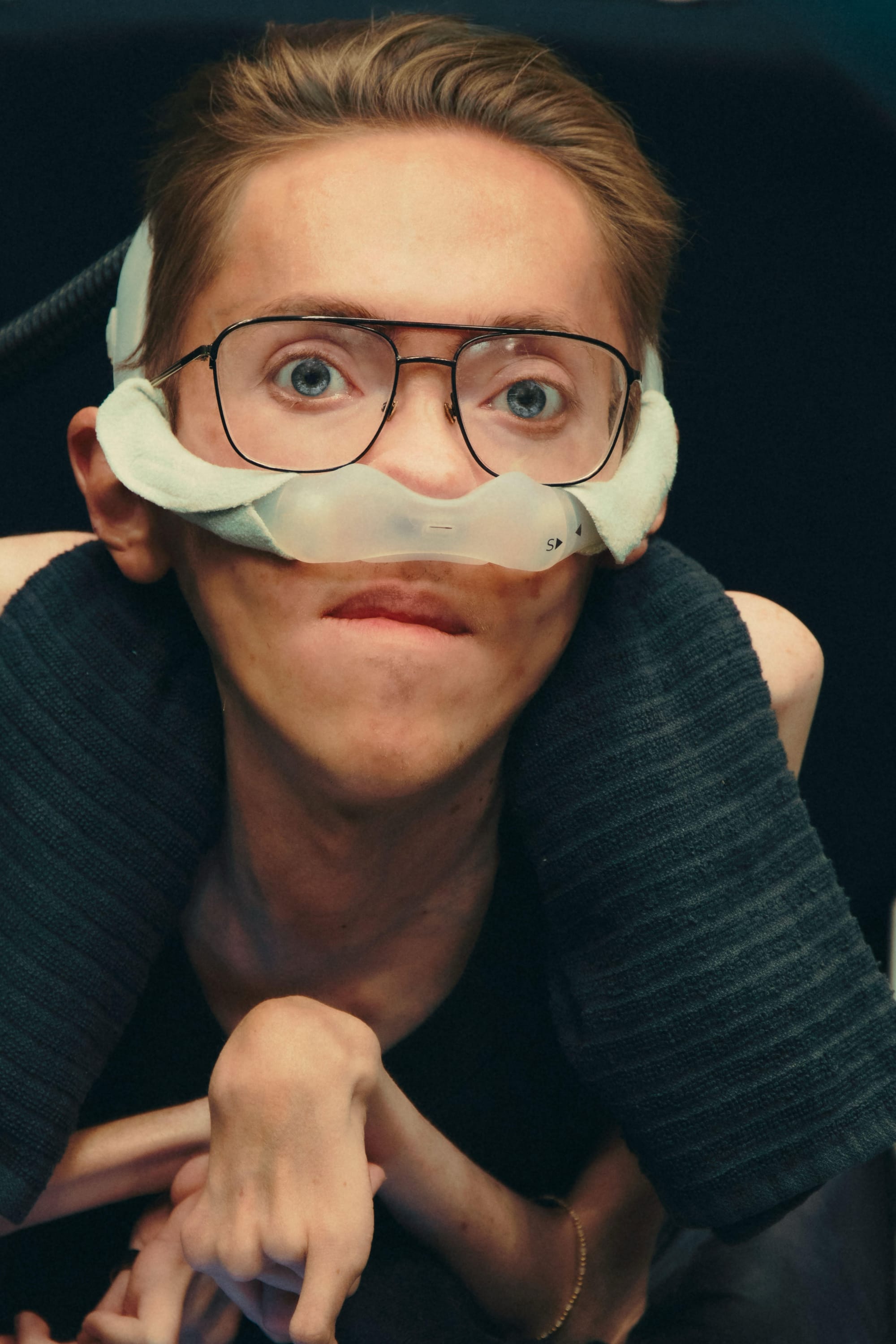
SEEN: At 25, Steve Way Learned He Had a Future. He Decided to Become an Actor.
For most of his life, Steve Way didn't plan for a future.
Growing up with muscular dystrophy, severe scoliosis and compromised lung function, the New Jersey native had survived major back surgery that almost killed him, along with serious health complications. Acting and comedy were passions, but he never imagined he'd have enough time to turn them into a career.
Then, at 25, his doctors told him something he hadn't expected: he was healthy. He was going to live. And not just for another year or so but “for a long time.”
Suddenly, Way had a problem he'd never anticipated: He needed to figure out what to do with the rest of his life.
“I thought, well, I guess I should get a job,” Way said.
His answer? Acting. Stand-up. Writing. Performing. Public speaking.
“That’s all I’m good at,” he laughed. “I just never thought I would live long enough to make a career out of it,” Way said.
A decade later, at 35, Way isn't merely making a career out of it. He's helping challenge an industry that still too often struggles to imagine disabled performers as anything beyond their disabilities.
The Beginning
Way began “unofficially acting,” as he puts it, after high school. His interest in performing started in a TV production class and soon, he and his friends were acting in and creating their own videos for YouTube and Vine.
But at 25, his acting went from a hobby to professional, thanks to his longtime childhood friend, Ramy Youssef.
Youssef, who is also a comedian and an actor, created the show "Ramy," which premiered on Hulu in 2019. And Way said Youssef was determined to include him in the show. But according to Way, getting him onto the series required something disabled performers know all too well: advocacy.
“There was push back about hiring me,” he said. “He fought for me a lot.”
Way recalled Youssef having to push for him when questions arose about his health and around accessibility and the logistics of accommodating a wheelchair user on set. The solutions, like ramps, were hardly extraordinary.
Ultimately, Youssef and Way won out and Way was included in all three seasons of the show.
But for Way, the initial resistance illustrated an industry problem he has continued to encounter throughout his career: accommodations are too often treated as burdens rather than ordinary components of production. It’s a frustration made more glaring by the excess that routinely exists elsewhere on sets.
Way pointed to the absurdity of productions being willing to provide actors with enormous trailers “the size of a city block,” while balking at something as basic as a ramp.
And ramps, he noted, don’t only benefit wheelchair users. They make sets easier to navigate for crew members transporting equipment, costumes and countless other materials.
That distinction gets at something Hollywood still struggles to understand about accessibility: designing a set to include disabled people often makes the environment work better for everyone.
Beyond “Disability Stories”
After "Ramy," however, Way found meaningful acting opportunities harder to come by. Rather than waiting around for Hollywood to call, he stayed busy, traveling the country performing stand-up comedy and speaking publicly about disability representation and advocacy, as well as the shortcomings of the American healthcare system.
But acting remained the goal.
Eventually, Way found himself on a caregiving panel where he met writer Elizabeth Meriwether.
“I talked about how I was unemployed,” Way said. “And she got me this role on 'Furious.'”
On "Furious," Hulu’s new police procedural involving a female serial killer (and the author of this article’s favorite show of the year), Way plays Alden, who eventually becomes engaged to Catherine (played by Lola Petticrew) one of the show’s main characters. Alden and Catherine’s relationship explores an unconventional, complex romance and a relationship that relies on interdependence.
Way’s work on "Furious" reflects the kind of representation he wants to see more of: disabled characters who are allowed to be complicated and nuanced human beings.
Way was particularly excited by the range his character afforded him. Rather than existing solely to represent disability, the character has relationships, fears and emotional complexity.
There was even the love story, something disabled characters are still too rarely afforded on screen.
For Way, "Furious" also pushed him beyond the comedic work for which he is best known, it required considerably more dramatic territory, giving him an opportunity to explore emotions and experiences he hadn't previously portrayed professionally. He was especially drawn to the fear of losing someone you love and the emotional range the material demanded.
“I love art,” he said. “That can make you feel something, regardless of what that feeling is.”
Elizabeth Meriwether, the show’s creator, told MASHABLE when she met Way on that panel, she knew she needed to write him a role on the show.
“His running bit on the panel was that he needed work, and I was like, he needs work, I need this character, the next day I walked into the writer’s room, and I was like, ‘It’s this guy, Steve Way, we’re building this whole character around him,’” Meriwether said.
Way said Meriwether and the writers' room included him in conversations about how his character's disability would actually appear on screen.
In a shower scene, for example, the production used Way’s own shower chair. Details surrounding his care and physical needs weren't simply invented by writers without his involvement; his lived experience helped inform what audiences ultimately saw.
That collaboration represents something Way believes should be unremarkable.
Disabled people, after all, make up a significant portion of the real world. Their presence on screen shouldn't automatically be regarded as exceptional.
Representation is More Than Being Present
Hollywood has made disability representation increasingly visible, but visibility alone doesn't impress Way.
Too often, disabled performers are given a handful of lines or inserted into a project so a production can claim inclusion without allowing the character to meaningfully affect the story.
Way has little interest in that version of representation.
“I think DEI in Hollywood actually hurts us,” Way said. “It reduces us to a check box or a part of a list that must be completed. We are given roles to fill a hole. We don’t want that. Give us the role because we earned it not because you had a corporate memo you had to fulfill. F*** that.”
Authenticity, to him, means being integral to the plot, not simply appearing long enough for someone to check a box.
That also means allowing disabled characters to exist beyond familiar narratives of suffering, inspiration and dependence.
In other words, they can possess the same contradictions writers routinely grant nondisabled characters.
Way believes other productions should take note of what "Furious" gets right: portraying disabled people as multidimensional human beings rather than defining them solely by their disabilities. They can be caregivers themselves. They can fall in love. They can be funny, selfish, frightened, sexual, ambitious, difficult or dark.
“I’m in five episodes of the number one show in the world,” he said. “My character is integral to the plot, not some throwaway character.”
Way’s role is one of two disability storylines woven into "Furious." In another, Danny, a police officer played by Scoot McNairy, visits his disabled son, who lives in a group home. Together, the storylines offer two distinct perspectives on disability and caregiving, one centered on a disabled adult navigating his own relationships and life, and another exploring the relationship between a disabled person and a parent.
“I want people to expand their views on caregiving,” Way said. “I want people to understand that they are probably recipients of care. Caregiving is not just putting food in the mouth of someone who can’t feed themselves. That is too narrow.”
The Cost of Being Underestimated
Even after establishing himself as a working actor, Way still encounters assumptions about what his body can handle.
He described people questioning his health, wondering whether he could manage production schedules or worrying that he might become sick during a shoot.
The irony is that Way has already done the work.
He has performed long shooting days. He has toured as a stand-up comedian, including opening for Youssef. He has worked across television, comedy, writing and speaking.
Yet the questions persist.
That may be one of the most revealing obstacles disabled artists face. Before they can demonstrate whether they're right for a character, they sometimes have to convince people that employing them is feasible in the first place.
Way acknowledges that conditions have improved during his career, even if the industry remains far from perfect.
And despite everything—the ignorance, inaccessible sets, assumptions and uncertainty—he wouldn't trade the career he has chosen.
His ambitions aren't small, either.
He wants consistent acting work. He wants to make a stand-up special. He's writing. And when asked what kind of character he'd still like to play, his answer couldn't have been further from the sanitized roles Hollywood has historically reserved for disabled performers.
A Bond villain.
Or perhaps a serial killer.
Essentially, Way wants what actors have always wanted: the opportunity to play.
Not every disabled character needs to overcome something. Not every storyline needs to educate an audience about disability. Sometimes the disabled guy should get to be funny. Sometimes he should fall in love.
And sometimes, Steve Way would like him to be the villain.
Because authentic representation isn't about portraying disabled people as extraordinary.
It's about finally allowing them to be everything else.
*Featured photo: Steve Way (Credit: Patrick Donovan)