
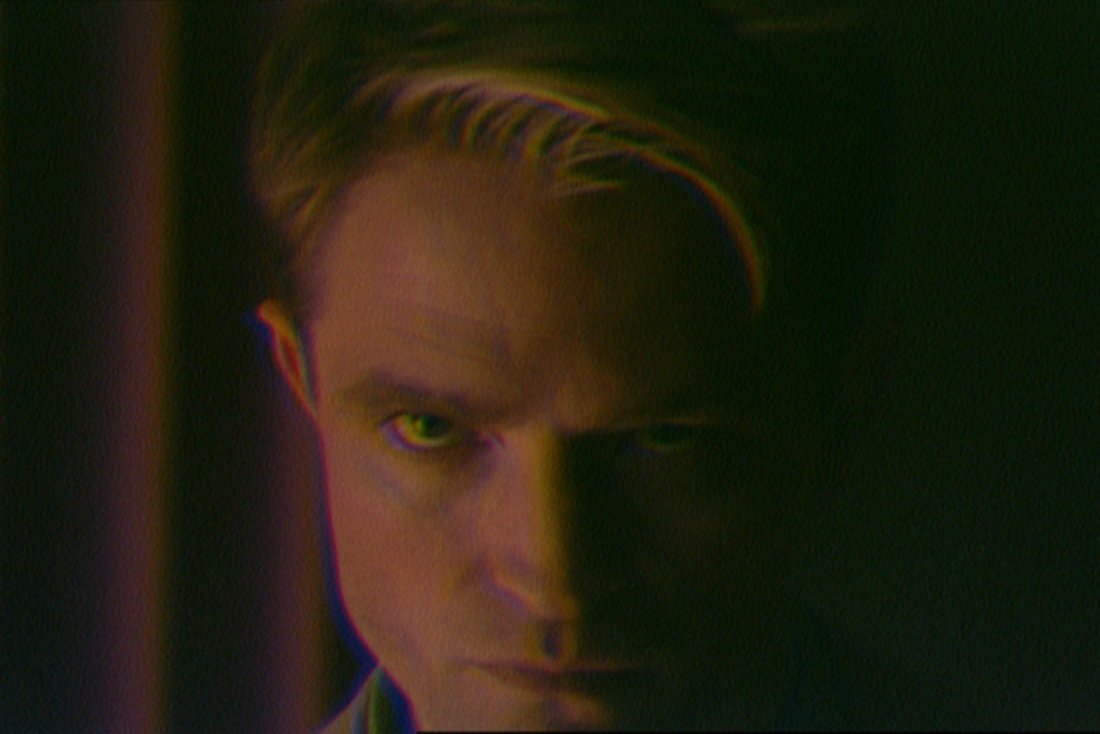
'Primetime': Lance Oppenheim's Fever Dream Is One of the Year's Most Unsettling Experiences
The Camera Never Lies, But Always Performs
There is a moment early in Primetime where Robert Pattinson, as Chris Hansen, descends a staircase with the measured, self-conscious deliberateness of a man who has rehearsed this entrance so many times that the performance has consumed the person entirely. You feel the dread before anything has technically happened.
That is Lance Oppenheim working at full command of his instrument, and it sets the terms for everything that follows: a film that operates in the static between television and reality, between righteousness and narcissism, between a genuine public service and something far more troubling underneath.
I went in knowing this was a Lance Oppenheim film, and I still was not ready for what it actually was. Oppenheim has spent years developing a very specific mode of filmmaking, what you might call docu-fantasia, where the boundary between documentary observation and expressionistic fiction is deliberately blurred to access a psychological truth that straightforward representation cannot reach.
With Primetime, he takes that sensibility into full narrative feature territory, and the result is unlike any biopic you are likely to have seen recently. From its opening frames, the film plays like a surreal, neon-soaked Lynchian horror, and that register is not a stylistic accident. It is the only honest way to approach this material.
Robert Pattinson is simply extraordinary here. This may be his finest screen performance, which is saying something for an actor whose post-Twilight reinvention has produced some of the most interesting work of his generation. He is not doing an impression of Chris Hansen so much as locating the psychological architecture underneath the public persona: the rehearsed authority, the barely concealed ego, the genuine belief in his own messianic purpose, and the fractures that belief opens up over time.
He makes Hansen simultaneously a complete caricature and a mythological figure, someone who reads pedophilic chat logs back to their senders with the gravity of scripture and genuinely believes he is performing a divine cleansing. The comparison that keeps surfacing in my mind is Gyllenhaal in Nightcrawler or even Jack Nicholson in The Shining, that same quality of watching someone whose mask has become so integrated with their face that the distinction barely exists anymore.
Skyler Gisondo and Merritt Wever leave impressions that linger long after the film ends. Gisondo, playing the decoy actor who wanted a career and instead found himself at the center of a reality show catching real predators, carries the film's most quietly devastating arc. There is a scene where he shifts between his teenager voice and Hansen's cadences in a single beat that is genuinely chilling, one of those pure acting moments that makes you put down whatever you are mentally carrying and just watch. Wever embodies the more casually ruthless business machinery of the whole operation, the producer who knows something is probably wrong but is just as hooked on the chase as everyone else.
Ajon Singh's screenplay is doing real structural work beneath the surface spectacle. The film uses Rent as a recurring motif, a musical about a self-absorbed filmmaker who exploits the suffering of others for his art, and the choice is so precisely right that it made me genuinely laugh in recognition.
The script takes the "based on a true story" framework and pushes it to extremes of genre, oscillating between horror and surreal anxiety with a tightness that keeps you constantly sensing the strings are about to snap. The film's central argument, that the morality of the show was never seriously questioned until it caught someone rich and powerful, lands with the quiet devastation of a fact you already knew but had not fully reckoned with.
David Bolen's cinematography deserves extended discussion, because it is genuinely extraordinary. I have followed his work across Delhi Crime, Soni, and Thelma for years, and this is him operating at a new level of expressive confidence. The visual language combines the harsh grain of aughts DV and hidden camera aesthetics with a lurid, kaleidoscopic expressionism that feels simultaneously period-specific and nightmarishly modern.
I was not surprised to learn he used a colonoscopy camera for at least one shot. That is exactly the kind of inspired, slightly insane choice that makes his work so distinctive.
The color grading by Damien Vandercruyssen is so integral to the film's emotional texture that he received an end credits billing, which is rare and completely deserved. Daniel Garber's editing and Ari Balouzian's score work in genuine partnership, maintaining momentum and keeping you on edge even when you already know how the real story ends.
The film's sharpest and most uncomfortable observation is not really about Chris Hansen at all. It is about the audience: the people who watched, who cheered, who wanted the predators to suffer publicly and televised because the suffering felt like justice. Primetime draws a direct line between the pillory in the town square and the television in every home, and it does not let you sit comfortably on the side of the righteous.
The machine built to catch predators was also a machine built to generate ratings, and the film dwells in the tension between those two purposes without pretending they can be cleanly separated.
What troubles you most, by the end, is not Hansen. It is the question of what we collectively asked for, and got.
Primetime is not a scathing masterpiece without qualification. There are moments where the satire's self-awareness tips slightly into smugness, where the formal intensity overshadows the human specificity underneath, and where the media critique, while pointed, does not always reach beyond what sharper predecessors have already mapped. But as a formally dazzling, deeply unsettling, and impeccably performed piece of filmmaking, it is one of the most distinctive and genuinely disturbing experiences of the year.
You will leave feeling like you need a shower. That is precisely the correct response. The camera was always performing. So were we.
*Feature photo, Patterson in Primetime (A24)