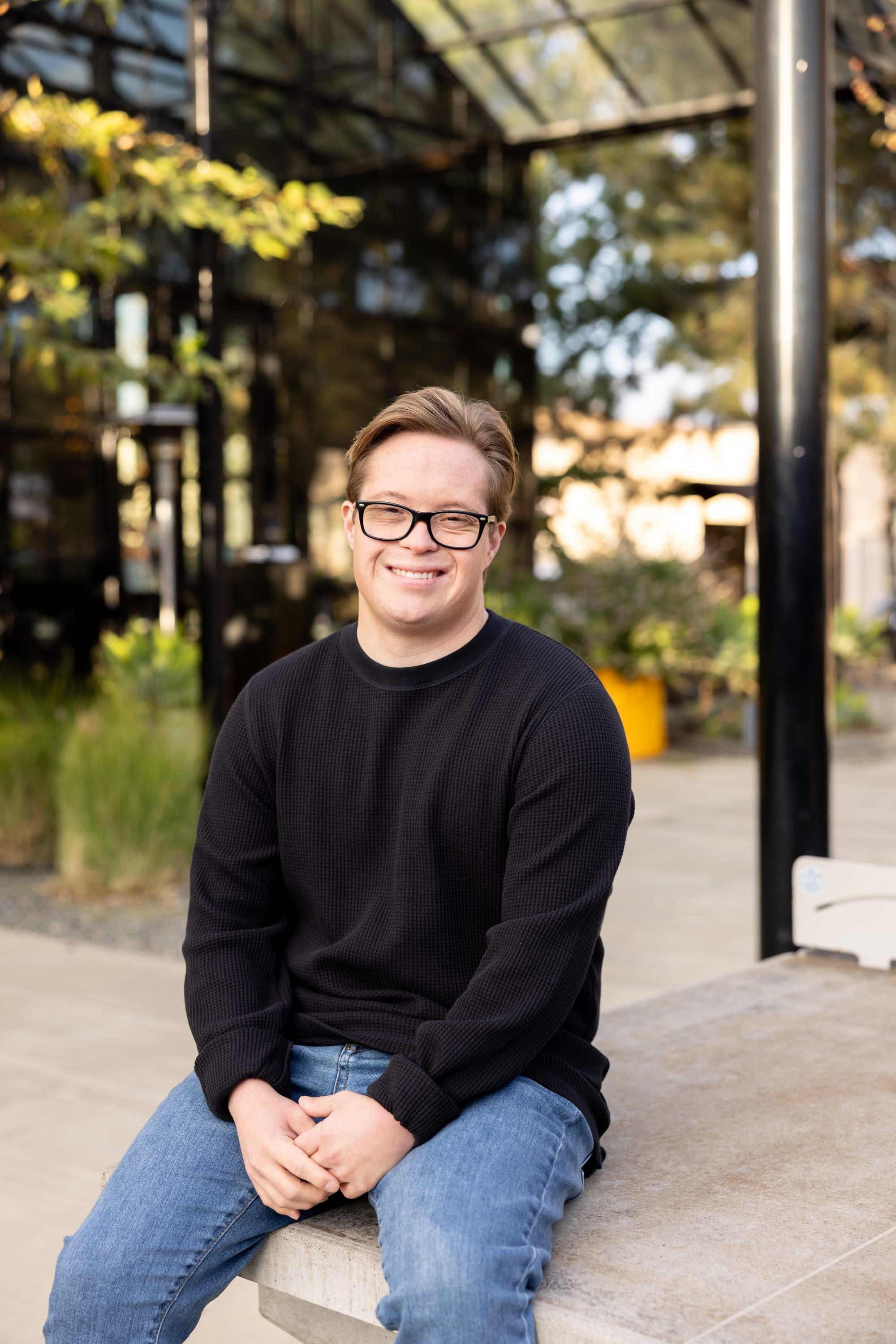
SEEN: Cole Sibus on Down Syndrome, Hollywood, and the Power of Belonging
To Cole Sibus, Hollywood is magical. And it has little to do with the fact that he gets to perform in front of the camera. (Okay—maybe that helps a little!) For Cole, the real magic lies in the people he meets, the friendships he builds, and the sense of belonging he feels every time he steps onto a film or television set.
"We’re like one big family," Cole said.
From ABC's Stumptown to the miniseries A Thousand Tomorrows and the film Spare Room, Cole's journey as an actor has been filled with excitement, challenges, and meaningful connections. Each project has given him opportunities not only to grow as a performer but also to forge lasting bonds with the people around him.
For Cole, who has Down syndrome, those experiences speak to something bigger than the magic of filmmaking. They demonstrate the power of human connection and what becomes possible when inclusion isn't just an aspiration, but a reality.
As we recognize October as Down Syndrome Awareness Month, Cole's story offers an important reminder: People with disabilities deserve the opportunity to build careers in Hollywood, to pursue their passions, and to be part of telling stories that reflect the full complexity of the human experience.
And Cole isn't just proving that it's possible. He's living it.
From Home Movies to Hollywood
Cole's love of performing began as a child, after his older sister turned the family’s video camera onto him.
"Me and my sister did home videos. And that's how I first started," Cole recalls.
His mother, Kristi, remembers those early productions fondly. Cole's sister was the filmmaker of the family, often giving him smaller parts in her home movies, including a memorable part as a hotel bellhop.
Cole also remembers watching movies with his father, captivated by the actors on screen and imagining what it might be like to do the same.
Those childhood experiences planted a seed—he was going to become an actor.
That childhood dream eventually led to real-world opportunities in the entertainment industry, including his first television appearance at 18 years old, on the reality series "Born This Way." The show was a documentary series, which highlighted several young adults with Down syndrome. This experience led him to an agent who eventually helped him land future roles on scripted television shows and films.
After one audition, Kristi remembered an interesting ride home.
“We were driving home and he goes, ‘Look mom,’ and I look at him and he's literally crying. And I go, ‘Why are you crying?’ and he says, ‘Oh, these are fake. I just wanted to show you I could do it!’”
His journey hasn't been without challenges. Like countless other actors, Cole has faced auditions, rejection, demanding schedules, and the pressure to prove himself—especially because he’s an actor with a disability.
“Having a disability doesn’t define us … I know I can do it,” he said.
But he never allowed any challenge to determine how far he could go.
Kristi recalls one of his earliest film experiences, when Cole worked long days on Spare Room, waking up before dawn, working with an acting coach, and spending hours on set before returning home late at night.
Despite the grueling schedule, Cole never complained.
“I love this,” he said.
For Kristi, it was a defining moment. Her son wasn't simply enjoying the novelty of acting. He was demonstrating the dedication required to pursue it professionally.
And his favorite part of acting might be surprising.
"I love memorizing my lines,” he said.
For many actors, memorization is one of the most demanding parts of the job. For Cole, it is one of the most rewarding.
That doesn't mean the process is always easy.
"I know it's hard, but I know I got it," he laughed.
Cole acknowledges that learning dialogue and delivering certain words can take additional time and practice. Sometimes adjustments to the wording of a script can help.
But the need for a different approach does not diminish his ability to perform.
In fact, his mother describes how repetition, coaching, and experience helped him develop stronger memorization skills throughout his work on "Stumptown."
It's an important distinction that the entertainment industry must continue to recognize.
Accessibility is not about lowering expectations. It's about removing unnecessary barriers so that talent has the opportunity to thrive.
And Cole is thriving.
“I’m very proud of him, very, very proud of him,” Kristi said.
A New Chapter: Interdependence
Cole's newest creative journey brings him to Interdependence, an upcoming short film in which he plays Leo, one of the two leads, a disabled adult whose relationship with his older sister is transformed when she becomes his primary caregiver.
(Note: The author of this article is also the screenwriter and co-director for Interdependence. She won a grant from the inaugural USC Annenberg Inclusion Initiative’s Mental Health Accelerator to fund the project, with leadership from Dr. Stacy Smith and actress Kristen Bell.)
The story follows a burned-out night shift nurse (Zoe) who unexpectedly finds herself responsible for caring for her adult sibling with Down syndrome (Leo) after their mother passes. As the two navigate the emotional realities of caregiving, family responsibility, and personal independence, they begin to discover that care is not simply something one person gives and another receives.
And for Cole, the story feels deeply personal.
"Me and my sister have a business, and I felt connected to Leo because he loves his sister, and they take care of each other like me and my sister," he explains.
That connection is particularly meaningful. Outside of acting, Cole and his older sister collaborate on Happy Mail, a monthly mail club designed to encourage creativity, reading, and connection away from social media, and to spread joy.
Their sibling relationship reflects something at the very heart of Interdependence: the understanding that relationships involving people with disabilities are not inherently one-sided. People with disabilities are not simply recipients of care. They are also caregivers, collaborators, supporters, and sources of strength within their families and communities.
Changing The Narrative: The Mental Health Accelerator
The themes of Interdependence extend beyond disability representation, touching on broader conversations about mental health, caregiver burnout, identity, and the emotional complexities of family relationships.
For caregivers, the expectation to remain strong often leaves little room for vulnerability. For people with disabilities, assumptions about dependence can overshadow their individuality, autonomy, and capacity to care for others.
These are stories that deserve more space on screen. And they're precisely the kinds of narratives the Mental Health Accelerator at USC's Annenberg Inclusion Initiative was created to champion.
According to Katherine Pieper, Program Director at the Annenberg Inclusion Initiative, the accelerator grew out of years of research examining representation in Hollywood—and a growing recognition that identifying the industry's shortcomings wasn't enough.
Dr. Stacy L. Smith, founder of the Annenberg Inclusion Initiative, recognized that one of the greatest barriers to changing who gets represented on screen, and who gets opportunities behind the camera, was access to funding.
That realization sparked the creation of accelerator programs designed to help turn underrepresented stories into films. After launching initiatives focused on reproductive rights and proof-of-concept projects, the team turned its attention to another area where its research revealed a troubling lack of progress: mental health.
The findings were stark.
According to the Initiative's latest mental health study, just 1.7% of the 4,425 speaking characters across the 100 top-grossing films of 2024 were depicted as having a mental health condition, a figure that has remained virtually unchanged since 2016.
But the problem extends beyond the lack of representation.
The research also revealed that Hollywood continues to perpetuate harmful stereotypes, frequently associating mental health conditions with violence while offering few portrayals that encourage acceptance, compassion, or seeking help.
The Mental Health Accelerator was designed to help change that narrative.
"We want creative content that destigmatizes and breaks the mold of what we see in our research, which is underrepresented, heavily stigmatized, not focused on the outcomes that matter around treatment or therapeutic opportunities," Pieper explained.
She said Smith approached actress and mental health advocate Kristen Bell about bringing the initiative to life.
"Kristen signed on right away and said we want this to be about capacity building and resilience, and that is how it was born."
The accelerator also builds on the Initiative's longstanding research into disability representation.
Pieper said the organization began examining the prevalence of characters with disabilities in film and television around 2015. What researchers discovered was another significant disparity: While people with disabilities make up roughly a quarter of the population, they account for only about 2% to 3% of characters on screen.
It's a striking disconnect between the world Hollywood portrays and the world we actually live in.
And it's one of the reasons Pieper believes Interdependence is such an important story to tell.
"I think that's why Interdependence is so exciting," she said. "It really focuses on mental health and resilience around caregiving, which is such an invisible way that so many people live. And at the same time tells a really important story about disability and how adults with disabilities are living, working and realizing their own hopes and dreams and we just don't see that."
At its heart, Interdependence challenges two deeply ingrained narratives: that caregivers must always be the strong ones, and that people with disabilities are defined by their need for care.
Instead, the film explores what happens when those assumptions are turned upside down, and two siblings discover that vulnerability, strength, and the ability to care for one another are not determined by disability.
Dreaming Beyond the Roles Hollywood Expects
Cole's ambitions extend far beyond any one role or genre.
He hopes to continue building his acting career, land another television series or film, and perhaps one day trade dramatic scenes for action-packed adventures alongside stars like Dwayne "The Rock" Johnson, whom he greatly admires.
But Cole's dreams aren't limited to Hollywood.
Like many young adults, he hopes to find love, get married, and build a life of his own.
And when he's not in front of the camera, Cole leads a full and active life. He works as a restaurant host, enjoys surfing and golfing, and has a passion for fitness. A quick scroll through his Instagram reveals his dedication to working out, boxing, and pushing himself to reach new goals.
Whether he's learning lines, hitting the gym, catching waves, or dreaming about his next big role, Cole approaches life with enthusiasm, determination, and an eagerness to keep growing.
And if there's one thing that's clear, it's that Cole isn't slowing down anytime soon.
He's just getting started.
*Feature photo credit: Shelly McKeever