
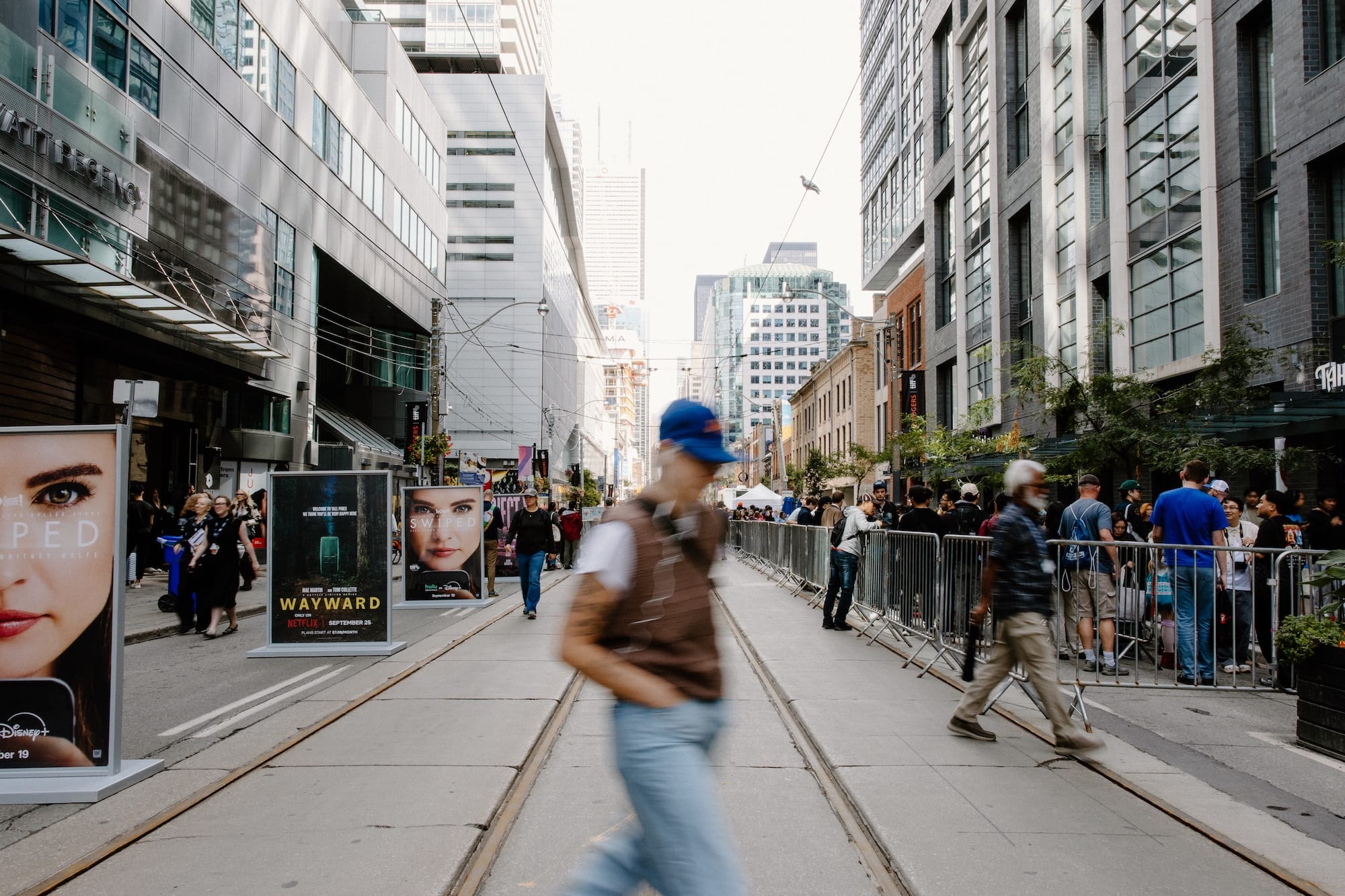
TIFF: First Time in Toronto, and the Films That Made it Unforgettable
There are few experiences in cinema quite like attending a major international film festival for the first time. The Toronto International Film Festival has long been one of the most important gatherings in the film world, a place where awards seasons ignite, where international cinema finds its North American foothold, and where the sheer density of great filmmaking in a single week can leave you genuinely altered.
This was my first time covering TIFF officially, and I arrived with a list longer than any reasonable person could get through in the time available. I did not get to everything I wanted to see, and there are films I will spend the rest of the year catching up on. But what I did see left a mark, and a handful of films in particular are going to stay with me for a long time.
Here are the ones I loved most.

Club Kid (2026)
Directed, Written and Starring Jordan Firstman
There is a specific kind of film that arrives at a festival, generates the kind of word-of-mouth that makes you rearrange your schedule to see it, and then actually delivers on every whispered promise.
Club Kid is that film.
Jordan Firstman's feature directorial debut is funny, tender, specific, and moving in ways that accumulate so quietly and so precisely that by the time the final twenty minutes arrive you are not quite sure when the tears started, only that they are very much happening.
Firstman writes, directs, and stars, a combination that makes a certain kind of critic nervous and which here turns out to be one of the film's greatest assets. He plays Peter, a hard-partying New York City club promoter who has spent a decade avoiding adulthood, with a disarming openness. When a ten-year-old son he never knew he had arrives at his door, the film that follows is not the one the premise promises. This is not a film about a man who needs to abandon his community to grow up. It is a film about a man whose community has real value, and whose growth does not require abandoning it. That distinction matters enormously right now.
Reggie Absolom as Arlo is wonderful, and his chemistry with Firstman is the film's emotional core. Diego Calva brings his considerable charisma to the social worker role, and Kirby Howell-Baptiste arrives in a single extended scene and delivers what is essentially a masterclass in controlled comic chaos. The music supervision is exceptional throughout, the 35mm cinematography puts the film in conversation with a tradition of New York filmmaking from Cassavetes to Scorsese, and the needle drops are deployed with the precision of someone who genuinely understands what a song at the right moment can do to an audience.
Coming-of-age does not happen on a schedule. Club Kid loves everyone who missed the conventional windows, and it made me love them, too. What a debut.
Josephine (2026)
Written and Directed by Beth de Araújo
I first encountered Josephine at Sundance earlier this year, where it won both the Audience Award and the Grand Jury Prize for US Dramatic, and seeing it again at TIFF confirmed what I felt in Park City: this is one of the most difficult and most necessary films of 2026.
Written and directed by Beth de Araújo, the film centers on eight-year-old Josephine, who accidentally witnesses a violent crime in Golden Gate Park. What follows is not a procedural but an intimate portrait of aftermath: what happens to a child, and to the family around her, when violence enters a life that was not ready for it.
De Araújo plays like a filmmaker who is constitutionally incapable of offering comfort where there is none, and the film is relentless in that commitment.
Mason Reeves delivers a debut performance that is genuinely staggering. She does not perform trauma. She inhabits it, pulling focus without effort in every scene, including those opposite seasoned professionals. Channing Tatum, and I say this as someone who has been tracking his increasingly interesting script choices for years, gives one of the best performances of his career here. His work is quiet, restrained, and devastating in a final scene I am still thinking about. Gemma Chan matches him completely.
The film has frustrations. Some parental decisions feel engineered to escalate conflict rather than arrived at organically, and the ending did not fully land for me. But de Araújo's filmmaking is undeniably powerful, and cinematographer Greta Zozula crafts a visual language that mirrors the characters' internal states with striking consistency.
This is a film that hits hard in the theater and even harder after you leave. That gap between the two experiences is where the best films live.
Carrie (2026 – TV Show)
Created, Written and Showrun by Mike Flanagan
I will admit I had a moment of genuine skepticism when this was announced. Brian De Palma's 1976 Carrie does not merely stand the test of time. It actively grows in stature with each passing decade. Why would anyone touch a seminal text after a masterpiece like that?
Having now seen Mike Flanagan's reimagining in full, I will never doubt Mike Flanagan again.
What Flanagan understands, more deeply than either previous adaptation managed to articulate, is that Carrie is not fundamentally a horror story. It is a tragedy rooted in a specific failure of love. The supernatural elements are the metaphor.
The real horror is the loneliness of a girl denied the tools to survive ordinary human interaction, and then thrown into an environment where the cruelest ordinary human behavior flourishes. In 2026, that environment extends far beyond school walls, and Flanagan knows it. The cyberbullying at the center of this adaptation is deeply disturbing precisely because it is so recognizable.
Summer H. Howell is extraordinary as Carrie, not replicating Spacek but finding her own specific tragedy in wanting, in reaching, in almost getting there before the world takes it away. It is a star-making performance.
Samantha Sloyan, a Flanagan regular who deserves every flower she is not yet receiving, gives what may be the most compelling Margaret White ever put on screen. This Margaret leads with love, which makes her far more complicated and far more devastating than the one-dimensional villain of previous iterations.
Alison Thornton as Chris Hargensen completes a triumvirate of powerhouse performances, and Matthew Lillard, in the midst of a remarkable career resurgence, delivers his most layered and moving work as Principal Grayle.
The prom sequence is handled with a formal intelligence that honors De Palma while finding something genuinely new. Flanagan's decision to interrogate the sequence through a Rashomon structure gives the familiar beats an analytical clarity no previous adaptation had fully realized.
Fifty years after De Palma, the story has not dated. It has only become more urgent.
The Only Living Pickpocket in New York (2026)
Written and Directed by Noah Segan
The film opens with LCD Soundsystem's "New York, I Love You but You're Bringing Me Down," and if you know that song, you already understand the emotional register Noah Segan is operating in. It is a song about devotion and exhaustion in the same breath, about loving something so completely that its transformation feels like a personal wound. It is the perfect overture for Harry Lehman, an aging pickpocket who has been working the streets and subways of New York since the 1980s, and who now finds himself in a city that has moved on without him in every direction.
John Turturro was born to play this role. This is a performance so warm and funny and quietly devastating that it is difficult to imagine the film existing without him.
Harry is not a tragic figure in the operatic sense. He is something more affecting: a man who chose a life, stuck to it, developed a code around it, and now watches that code become a relic. The Gene Hackman comparison circulating since the premiere is apt, that same quality of weathered, unglamorous, utterly convincing masculine specificity in every gesture.
Steve Buscemi is exactly as wonderful as you would hope. Tatiana Maslany gets the film's most emotionally concentrated scene, a father-daughter conversation that briefly transforms the whole film. The craft surrounding the story is genuinely beautiful: Sam Levy's cool autumnal cinematography, Gary Lionelli's jazz score that functions less as accompaniment and more as a second character.
The film closes the same way it opens, with that LCD Soundsystem song carrying Harry back into the streets that made him. If you have a father who loves New York and remembers when it was different, take him. It might make him cry. That is meant as a recommendation.

TIFF 2026 was everything I hoped a first official festival coverage experience could be. There were films I did not get to, and conversations I missed. But what I did see reminded me, with some force, why the festival circuit matters: not just as a market or a launchpad, but as a place where the experience of watching films together, in rooms full of people who genuinely care, still does something no algorithm can replicate.
I cannot wait to come back next year.
*Feature image: TIFF (Spring Morris)