
'Untitled In-Depth Interview Dramedy' with Screenwriters Joshua Paul Johnson and Jamie Napoli
Don't let the title fool you, that's the actual headline.
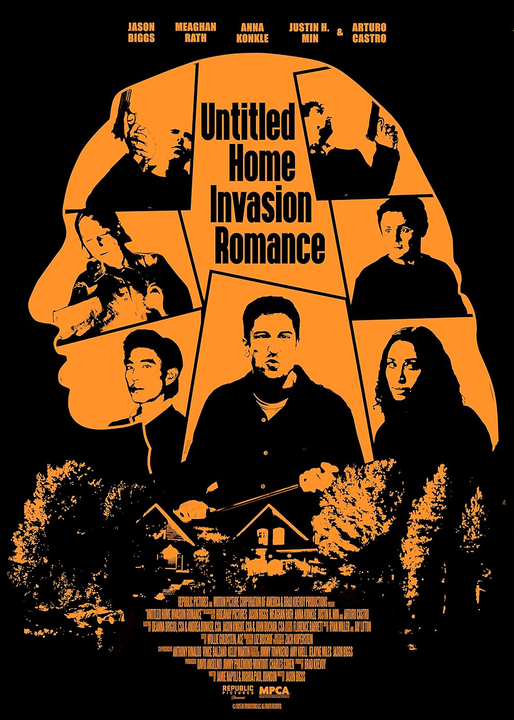
A clarification Joshua and Jamie will similarly have to make in every conversation about their first produced feature, Untitled Home Invasion Romance (and yes, the title makes sense once you're a few minutes into the movie ...).
The crime/comedy is the directorial debut of actor Jason Biggs and features a top-notch cast. It's a Script Pipeline winner, so sure, we're biased, but it's legitimately a super fun watch. Go stream it.

You two won Script Pipeline with this screenplay (then titled Getaway) in August, 2017. So, a mere nine years from script to streaming … I kid, but honestly, filmmaking, as I’ve always said, is a wondrous miracle, and somehow that timeline isn’t too crazy. Give us the lowdown—how did it finally happen?
Josh Johnson: Yeah, nine years is definitely a long time! But sometimes movies take decades because they need the stars to align in a very specific way to get made. Although we had partnered with different producers over the years who were excited about the script, it ultimately took one with a clear vision for how the pieces fit together.
That was Jimmy Philémond-Montout, who we owe a lot to. He reached out to us about getting it to Jason’s agent at CAA, Brad Schenck. Jimmy knew Jason wanted to direct something wildly different than the comedies he’s known for and thought he’d be perfect. He was absolutely right.
That kicked off a chain reaction. Because Jason had recently done a movie with producer Brad Krevoy, he got it to him, who then took it to Paramount.
I personally really love how it turned out. Different from the original script, sure, as most films end up being, but to me it earned every ridiculous beat. How involved were you in the rewriting? Did [director/co-writer] Jason Biggs spearhead that? What was it like seeing a slightly altered version of your story on screen? Or was it more like, “Holy smokes, this is a real thing now,” and none of that really mattered from a creative standpoint?
Jamie Napoli: Thankfully, we were involved every step of the way, which is often not the case.
During the 2023 WGA strike, Josh and I decided on our own to do an overhaul of the script. We added the police chief character, brought to life by the ridiculously talented Anna Konkle, and created the “Mr. Softie” ED commercial (we may be nine years older than when we started, but we haven’t gotten any more mature).
Then Jason came onboard and brought a whole new bunch of brilliant ideas to the table. We lucked out in that Jason is an incredibly collaborative partner, and we were able to work with him through production and post to make the script producible and aligned with his vision. We couldn’t be happier with how it all turned out.
So, it’s very much, “Holy smokes, this is real now,” but also, “Holy smokes, this is good!”
Tell me about the set visit. Seeing your script coming to life before your little eyes.
JN: It was wild. By the time our tiny prop plane landed in Sudbury, Ontario (which stood in for upstate New York in the film), this story had lived in our heads for seven years. So, stepping on set felt like we were walking into some shared, recurring dream. The locations, particularly the main cabin, were stunning. The cast that Jason had assembled was basically our dream cast (I was already a big fan of Anna Konkle, Arturo Castro, and Justin Min, and then Meaghan Rath blew our freaking minds as Suzie). Same goes for the crew (Zach Kuperstein, who shot our favorite recent horror film, Barbarian, was our DP). So, it was reassuring to us that such talented people had come together to bring this story to life.
My usual anxiety with spending time on set as a writer is feeling like I have nothing to do. Fortunately, Jason created an incredibly collaborative experience where, for the weeks that we were there, Josh and I felt like we had a vital role to play and our ideas were listened to.
And our eyes are perfectly average-sized, thank you very much.
Between 2017 and now, you’ve had some near misses with other scripts, wrote on other projects, including a scripted podcast starring Jon Hamm …
What can other writers glean from your experience in playing this usually-very-exhausting waiting game? At some point you need to set a script aside and move on, wait for the right window?
JN: The only advice I can offer is to not play the waiting game. We do everything we can to get all of our scripts produced (and our reps at Bellevue Productions give us a fighting chance), but at the end of the day there are so many forces outside of our control that it would be counterproductive to pin all our hopes on one project or another.
We’ve found the best thing we can do for ourselves is to just keep working—writing new specs, producing Audible Originals and podcasts. We’ve had a few situations where a newer project opened the door to renewed interest in an older, shelved spec. At the very least, keeping multiple irons in the fire has allowed us to make a living doing what we love.
You’ve also written romp-y (is that a word, let’s make it a word) adventure scripts, a horror/thriller … what made you branch off into other genres? Or has it always been concept first, or character first, and you figure out what tone and genre it takes after the fact? Having read or helped develop, at least to a small extent, some of your other scripts, it always felt to me like, oh, this premise is good, it could have gone in several tonal directions.
JJ: Yep, you’ve got it exactly right. For us, it always starts with some combination of a great premise and exciting characters. If we’re both hooked by that, then it’s a good indication that something’s there. We never start with, “Let’s write a horror script” or put genre first, so that’s how we end up inevitably branching out. But one thing that remains consistent is that we gravitate towards stories where the main character is driven, and the story moves fast. That naturally favors certain genres over others, and lends itself to us always infusing some level of humor, giving each its own unique tone. Whether it’s thriller, horror, adventure, etc., we can’t stop ourselves from pitching each other elements that make us laugh.
I have to ask every writing team this: how do you make that work, and for as long as you have? The sheer idea of writing with someone else gives me an arrhythmia.
JN: A big challenge of writing together is communication. Unlike a lot of solo writers, Josh and I have to plan and outline extensively to make sure we both know and are on board with the journey we’re about to go on together. Before we ever open Final Draft, we spend weeks talking through every aspect of the story and its characters, and also how we want the audience to experience them.
And then it helps that Josh has a very calming presence, which probably does more to lower my heart rate than cause an arrhythmia.
It’s dicey to get a film financed, to find a champion for it with the influence and drive to actually move it forward. But for every manager or exec telling me indie film is “dead,” there’s an indie filmmaker saying, “I have financing now, we’re shooting next month.”
From your perspective, as writers who have crossed into different mediums with film and TV and podcasts, what’s the state of the industry? Where do you think the flaws are, and what are some things filmmakers and execs are doing the right way?
JJ: We live in a strange era of filmmaking where it’s never been easier to make a movie (grab your iPhone), but it’s never been harder to make a living making movies. There are so many different things competing for your attention now, which wasn’t the case 30 years ago. As video games, social media, and podcasting grow, the amount of time people spend watching movies and TV shrinks, which means the financing that used to all be concentrated in Hollywood is now dispersed.
It’s hard to say exactly what people are doing right or wrong because there are greater economic and technological forces at play dictating things, and filmmakers and execs are just trying to survive. My dream scenario is that media conglomerates don’t merge, studios take creative/financial risks, and A.I. doesn’t take over the world, but I have a hard time seeing any of that changing. So, we have to adapt.
For us specifically, while our hearts are in traditional theaters, our main goal is to tell stories. We’ve had a great time pursuing TV, as well as narrative and documentary podcasts. Maybe a video game is next? No matter what, we’ll continue writing movies, but we’d be lying if we said there are more opportunities than fewer with each passing year. If anyone out there has the secret to save cinema and the well-being of those who make it, let us know.
Touching upon some of the near misses, what lessons did you learn? The good and the bad. What mistakes might you both have made?
JN: A mistake that we’ve made a few times is not trusting our guts when it comes to people who we know don’t have our best interests in mind. I think it’s usually pretty clear from the outset whether a potential producer or collaborator respects you or not, which should be the bare minimum for working with someone. And yet, we’ve ignored our instincts in the past because we thought, “Well, even if this person is kind of a jerk, maybe they can help us get this made.” And pretty much in every instance, it came back to bite us.
On the flip side, we’ve had plenty of wonderful experiences in this industry where our positive feelings from an initial meeting were proven right, and—whether or not the project materialized—we felt lucky to have had that collaborative relationship. The whole UHIR team is an example of that … as are you, Matt. We feel really lucky to have had you in our corner for all these years now.
So, basically, the point is: trust your gut!
Best comedy all-time. Go.
JN: I’m biased because I spent two years working for the Zuckers, but I think Airplane! is in a league of its own.
JJ: For a classic, I’ve gotta agree with Jamie and say Airplane!. But the ones I grew up with that still crack me up are Napoleon Dynamite and Superbad.
And since this is a dual interview, another bonus final question …
Most influential film for each of you (unless it’s the same film, which, okay, but that would take the writing team moniker too far).
JN: This is a little embarrassing, but Garden State (more specifically, the Garden State Making-Of doc) was the movie that made me want to write movies. So when I saw that Jason had included Death Cab and other early-2000s indie rock on the UHIR soundtrack, the moody teenage boy inside my heart did a little jump for joy.
JJ: I had a similar experience. My very first film school was watching and re-watching the behind-the-scenes extras on The Lord of the Rings Extended Edition DVD set, so that’ll always hold a special place for me. I was just a kid in Iowa, as far from Hollywood as you can get, and watching New Zealanders create Middle-Earth convinced me that anything’s possible.
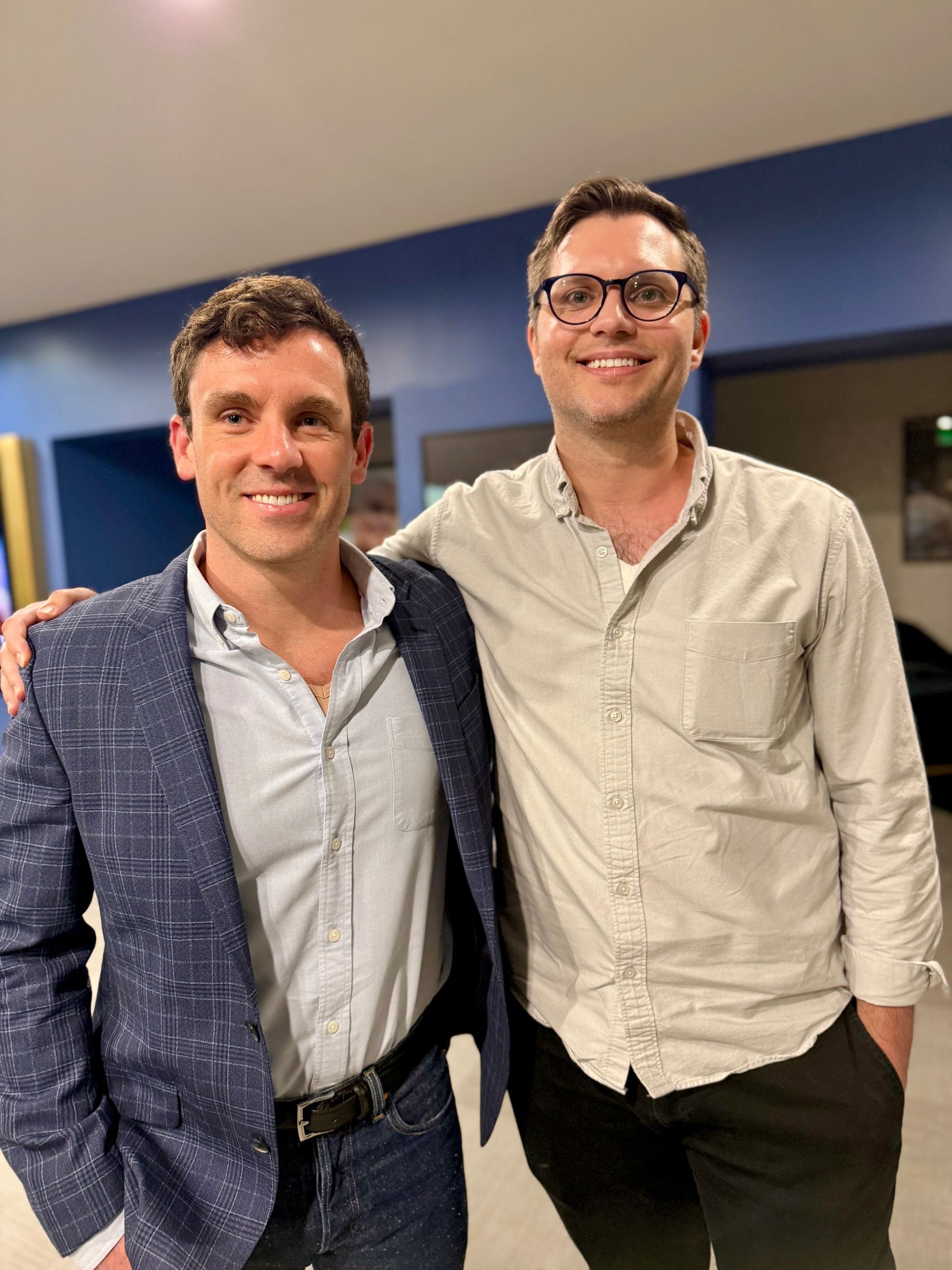
*Feature Photo: Joshua Paul Johnson (r) and Jamie Napoli (l)