
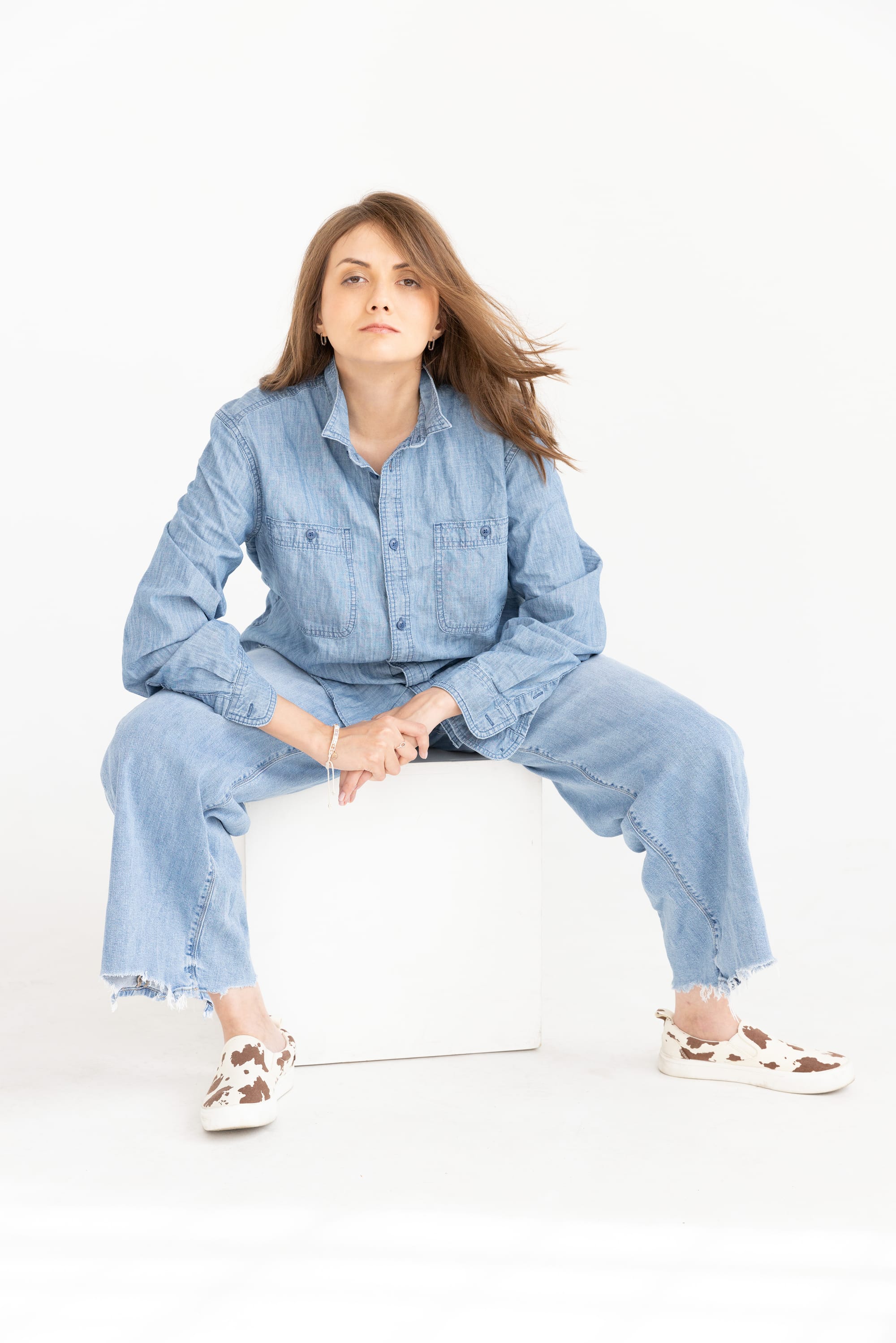
SEEN: Tal Anderson is Changing the Story of Disability in Hollywood
From "Atypical" to "The Pitt," the actor, filmmaker, and editor is proving that authentic representation isn't just about who's on screen—it's about who's telling the story.
This interview is part of our ongoing SEEN series, highlighting disability in the arts.

Tal Anderson has spent a lifetime telling stories.
Long before audiences recognized her from "Atypical" or "The Pitt," the 29-year-old actress and filmmaker was recording homemade audio dramas, writing scripts, staging plays with paper dolls she called her "puppets," and acting out scenes from television shows in her living room. Storytelling wasn't simply a hobby, it was how she understood the world and expressed herself. Anderson realized she wanted to pursue acting professionally in the ninth grade after beginning to work with a private acting coach, and performing in plays and on screen in local productions.
But in many ways, she'd already been rehearsing for the career her entire life.
Born in New Orleans and adopted at birth, Anderson spent a year in Portland, Oregon, before growing up in southwest Florida. But as a child, Hollywood felt inevitable.
"I always knew I was going to move to Los Angeles," Anderson says. "Even as a small child, I knew that I belonged in Hollywood."
Her parents convinced her to attend college before making the leap west—a decision she now appreciates. She earned a bachelor's degree in film from Full Sail University, where she discovered another passion: editing. While acting remained her primary focus, post-production offered a different kind of creative fulfillment, allowing her meticulous attention to detail to shape stories from behind the camera.
That dual identity—as both actor and filmmaker—has become central to Anderson's career.
She's edited dozens of projects, including 54 videos for the Smithsonian Institution's Japanese War Brides: Across the Wide Divide exhibit, and worked on feature documentaries (Note: Anderson was an editor on Meandering Scars, a documentary co-directed by the writer of this article.)
She’s collaborated with other filmmakers, and edited many of her own award-winning short films. Rather than viewing editing as a backup career, she sees it as another tool that makes her a stronger storyteller.
"I consider myself an actor first," she says, "but I'm grateful for my editing skills. I use them every day."
That philosophy of creating your own opportunities has fueled much of Anderson's career. She believes today's entertainment industry rewards artists who are willing to wear multiple hats—not simply because the work demands it, but because making your own projects is often the best way to keep growing.
Nowhere is that more evident than in her long-running involvement with the Easterseals Disability Film Challenge, a weekend-long filmmaking contest that allows filmmakers—with and without disabilities—the opportunity to collaborate and to tell unique stories showcasing disability in its many forms.
Over eight years, Anderson has used the annual competition, to ensure she fulfills a promise she made herself after film school: complete at least one short film every year. Beyond the films themselves, the challenge has introduced her to collaborators, festivals, and professional opportunities that continue to shape her career.
Audiences first discovered Anderson through Netflix's "Atypical." She had only recently arrived in Los Angeles, was finishing a post-production internship, and had just signed with an agent when the audition arrived. Already a fan of the Netflix series, she was thrilled to book the role, and when her character expanded in the second season, she had the opportunity to explore greater emotional depth.
The experience confirmed something she already suspected: acting wasn't just a dream. It would be her life's work.
Today, Anderson is reaching an even broader audience through HBO Max's "The Pitt." Anderson portrays Becca, the twin sister with autism of Dr. Mel King, played by Taylor Dearden.
Rather than defining Becca by her disability, the series presents a deeply layered sibling relationship built on mutual care. Although Mel serves as Becca's primary support, Becca also protects and encourages her sister, creating a relationship Anderson describes as profoundly interdependent. The authenticity of that portrayal, and the overwhelming audience response, has been especially meaningful.
"It's been exciting not just being on a hit show," she says, "but also being part of a series that is touching so many people and making them feel seen."
That impact has resonated far beyond general audiences: Anderson's performance earned her an Emmy nomination for Outstanding Guest Actress in a Drama Series.
But for Anderson, the idea of helping people feel seen extends well beyond a single role.
As an actor with autism, she has become a passionate advocate for authentic disability representation in Hollywood. She believes the industry has made meaningful progress by increasingly casting disabled actors in disabled—and sometimes nondisabled—roles, but she also sees how much work remains.
To her, authentic representation isn't just about who's in front of the camera. It's also about ensuring disabled writers, producers, directors, and creatives are shaping those stories behind the scenes. Hollywood, she argues, still too often tells disability stories from the perspective of caregivers rather than disabled people themselves. She hopes to see a broader range of autistic experiences represented on screen, including people of color, adults with families, non-speaking autistic people, and others whose lives rarely receive attention in mainstream media.
Her advocacy is rooted in a simple belief.
"I wish people would realize that having a disability doesn't define a person," she says. "With accommodations, any qualified and trained actor or filmmaker can do their job and be an asset to a production."
That perspective also informs her advice to young disabled performers.
"Never let anyone tell you that you can't make your dreams come true," she says. "As long as you're following your passion and working hard, even the smallest accomplishments and steps forward should be considered successes."
Off-screen, Anderson continues to develop an impressive slate of creative projects. She is writing a third children's book, rewriting a true-crime limited series she is co-executive producing alongside Kayla Cromer and Scott Stenholm, developing a young adult television series, and collaborating on a feature comedy. Her dream roles? A horror villain tops the list.
"I've been a villain girl since I was little," she says. "The villain in a slasher movie would be perfection."
Whether she's acting, editing, writing, or producing, Anderson approaches every project with the same curiosity that first inspired her as a child recording homemade stories. Nearly three decades later, she is still doing what she's always done: creating worlds, challenging assumptions, and proving that the most powerful stories are often the ones told by the people who have lived them.
*Feature Photo: Tal Anderson (Ronnie Smith)