
Embrace the Uncertainty: A Conversation with ‘Primetime’ Editor Daniel Garber, ACE
Editor Daniel Garber on building a media collage from 14 camera bodies, finding the language of Primetime's fever dream, and why great editing only gets more mysterious with time.

Fourteen camera bodies. That is the number Daniel Garber was handed when he sat down to begin cutting Primetime. Fourteen different cameras with fourteen different looks, from cinematic wide-format imagery to footage designed to feel like it was pulled from the show within the film, to flashes of aughts broadcast television and hidden surveillance aesthetics.
His job, over more than a year in the editing room, was to teach an audience to read all of those visual languages simultaneously, without ever making the lesson feel like a lesson.
I already spoke with Primetime's writer Ajon Singh about the screenplay and the collaboration with director Lance Oppenheim. But the film I encountered in the theater felt different from any description of it, because so much of what makes it work lives in the cutting: the precise rhythm of a Robert Pattinson outburst that should not land and does, the sound design choice that makes an ordinary room feel like the outside world has ceased to exist, the JFK-inflected permission to be formally bold. These are editorial decisions, and they belong to Garber.
Garber previously won the Independent Spirit Award for Best Editing for How to Blow Up a Pipeline, collaborated with Oppenheim on Some Kind of Heaven and Spermworld, and has built a quietly distinctive body of work across films that tend to be formally ambitious, politically engaged, and genuinely difficult to pin down. I spoke with him about all of it.
This interview has been edited for flow and clarity.
Rahul Menon: I have been following your work since How to Blow Up a Pipeline, which remains one of my favorite films of 2022, and a significant part of why that film worked as well as it did was the editing. The tension never relented, and the crosscutting had a propulsive, almost musical logic to it. When you came onto Primetime, a film operating in a completely different register, what drew you to the project, and what did you sense the editing needed to do that was fundamentally different from anything you had tackled before?
Daniel Garber: My collaboration with Lance Oppenheim goes back for many years to our first project together, Some Kind of Heaven. I'd like to think that I would have been along for the ride for whatever Lance's first narrative film could have been, but I'm very glad it came in the form of Primetime.
In addition to Ajon Singh's incredible script, the film appealed to me in part because it presented such a huge editing challenge. I'm always on the lookout for projects that will push me beyond what I've done in the past and ask me to develop a new language in the edit. The film wound up becoming a sort of media collage, made up of cinematic images, footage that feels like it came from the show within the movie, and flashes of other media, like popular TV shows at the time.
The film employed 14 different camera bodies, many of which had wildly different looks and applications. Making all of those sources of footage feel like they belonged to the same world was one of the major editing challenges that went beyond anything I'd encountered before.
The task for an editor in that situation is not just to establish the logic for when different images come into play, but to teach the audience in a subliminal way how to view the film. A lot of that process came down to doing revision after revision of the first act, figuring out just the right balance so that the audience could understand how the different elements play into the film as it unfolds.
RM: In my review I described the film as operating in the static between television and reality, and I think a lot of that quality lives in the editing. The film is simultaneously a biopic, a media satire, a surreal horror, and a period piece about aughts tabloid culture. How did you and Lance Oppenheim arrive at a structural language that could hold all of those registers without any single one swallowing the others?
DG: I love that way of describing the film! Primetime manages to shapeshift, but we never felt the need to build a structural container for it because it's all grounded in character, thanks in large part to Ajon's script. When Dan and his friend Troy are introduced, the film feels like a buddy comedy. Andie's story feels most like a media satire. As Chris' agitation grows and his sense of reality begins to fray, the film goes into increasingly surreal and nightmarish directions.
These tonal shifts are possible only because we invest deeply in each of these characters; when different perspectives are foregrounded, the film's attitude shifts accordingly. The hope is that it never feels like we as filmmakers are putting our fingers on the scale, but rather that the tone emerges naturally from the characters' journeys.
The other major element in building cohesion within variation across the film is Ari Balouzian's score. Recurring themes and instrumentation establish a unified identity for the film even as it moves among multiple tonal registers.
RM: Robert Pattinson's performance as Hansen is one of the most layered things I have seen on screen this year, and part of what makes it work is how the editing deploys him: when to stay close, when to cut away, when to let a moment accumulate versus when to break it. How much of the editing rhythm around Pattinson was discovered in the room with the footage, and how much of it was a conversation between you and Lance about the specific psychology you were building?
DG: Rob's performance was one of the many great gifts we had in putting together this film. He's such an electric performer, sometimes making bold choices we could not have predicted and often deliberately building variation from one take to the next. It left me with a nearly infinite range of choices in the edit. Fine-tuning the character of Chris while doing justice to Rob's inspired performance was one of our biggest tasks. If the performance feels layered, that's partly because of the extremely layered conversations that Lance and I had while toiling away in the edit.
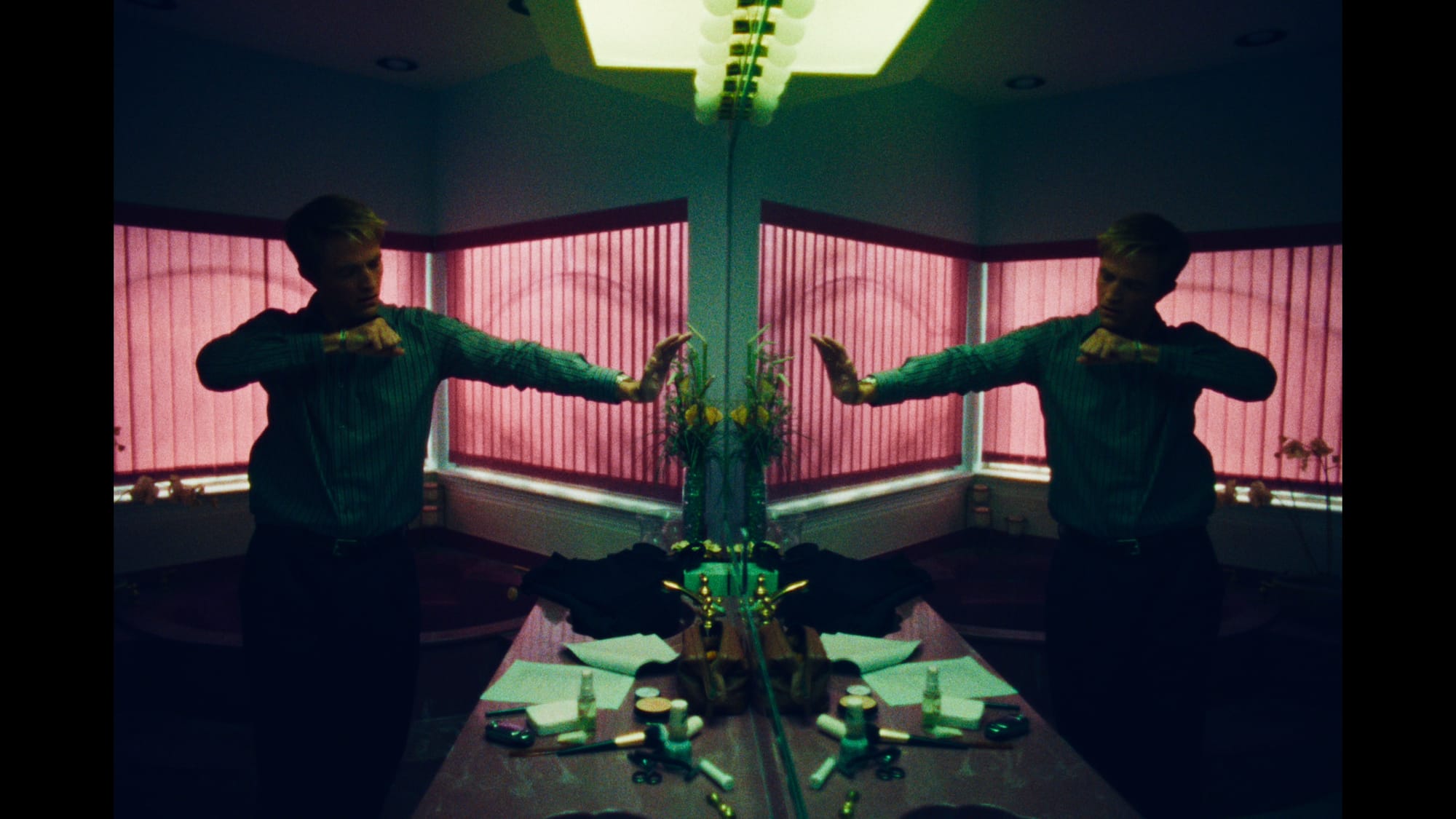
On a micro level, we frequently had to second-guess our decisions because different takes could read so differently depending on context. There's a moment people seem to enjoy, when Chris and Andie are speaking in a decoy house bathroom, and he viciously mocks her when she says they'll be the number one show on TV. That outburst was spontaneous and so extreme that we weren't sure what to do with it at first. It was, in a sense, the wrong performance, but at some point Lance and I just knew it needed to be in the final film. We hadn't quite earned it at first, but we knew that with the right setup, if the audience was aligned with Chris, the moment would really sing.
Instances like that felt like barometers within the film: if they played well to an audience, it meant we had calibrated his performance properly.
What Garber describes here is the editor as emotional calibrator: reading the audience's relationship to a character against the performance on screen, and adjusting the balance until the wildest take lands exactly as it needs to. The bathroom outburst is one of the most disquieting moments in the film, the kind of thing that should break the spell and instead deepens it. That it works is the result of everything the edit had been building in the preceding scenes.
RM: There is a scene involving Skyler Gisondo where he shifts from his teenager voice into Hansen's cadences within a single beat that is genuinely chilling. That moment works as pure cinema, where the cut or the hold around it does as much work as the performance itself. Can you talk about how you found that sequence in the edit, and what editing decisions shaped how it landed?
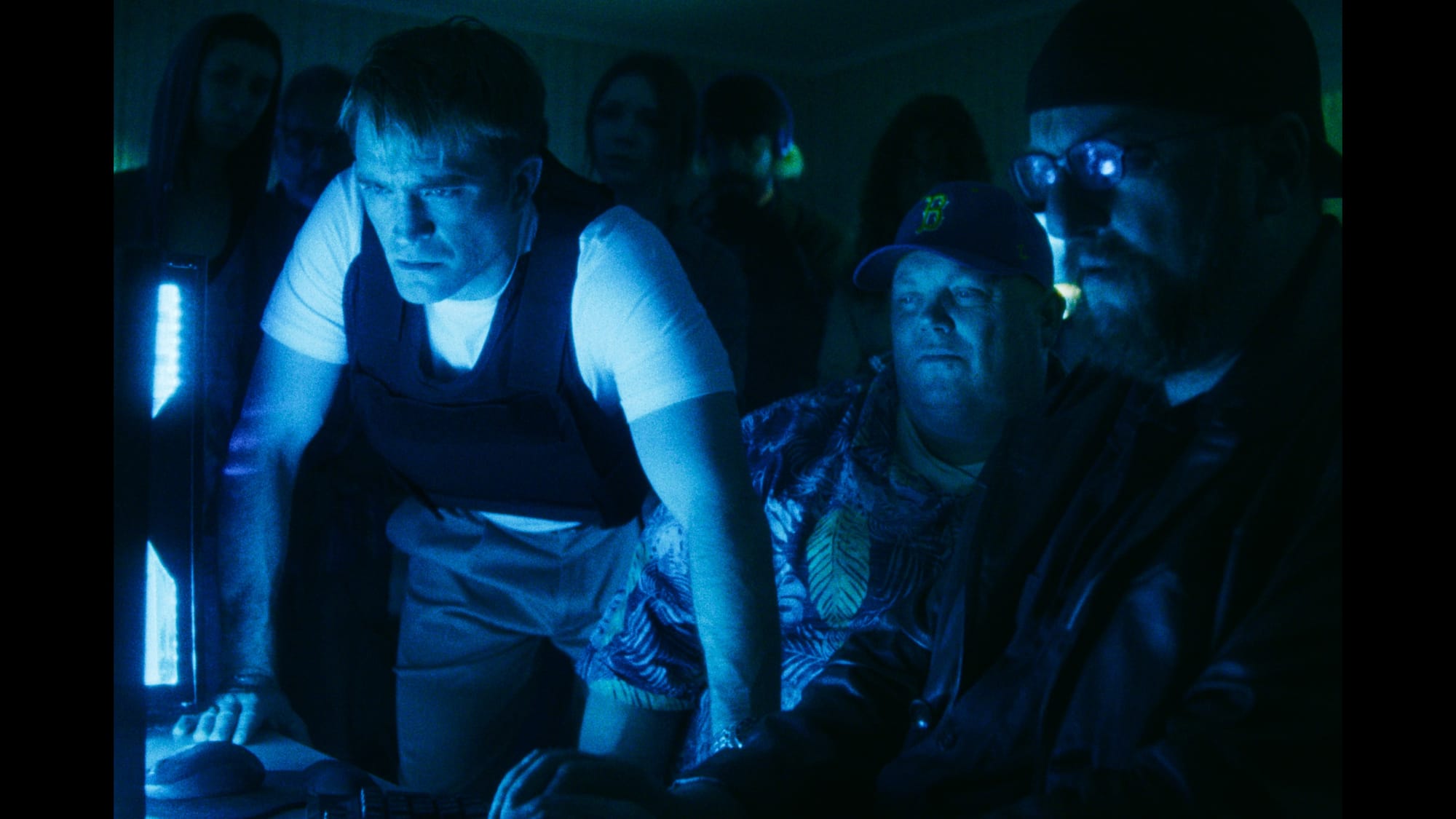
DG: You've hit on one of the moments in the film that most reliably gets a laugh from audiences, and I don't think it's because it's funny. It's just so uncomfortable. The scene starts out much like any other sting, with Dan greeting the potential predator, sitting him down, having a little conversation. There's a stiffness to the way it's constructed, relying on these declarative, locked-off frontal shots of Dan and WrestlingDude facing each other.
In the edit, I really wanted to maintain a deliberate pace. The framing and pacing work in concert to create the sense that Dan is locked into a procedure to set this guy up for a takedown, even as he experiences a twinge of hesitation.
Then comes the turn. DP David Bolen made a brilliant decision to have the camera wrap around from behind Dan to his front while he stands, tilting from the bracelet and transcript up to his face. There's a pause in the performance as he transforms and utters his first line in the Chris persona. I loved the way that slow move signals a huge transition within the scene, both in the form as we go from tripod to steadicam and in the emotional arc.
Sound designer Paul Hsu and I talked about having the sound fade down there; the rain and thunder effects underscore the beginning of the shot but then get eerily quiet, as if the outside world disappears while we're in thrall to Dan's performance as Chris.
RM: You have spoken about the influence of Oliver Stone's JFK on the editing of Primetime, which is a fascinating reference point for a film about the construction of a media spectacle. The way JFK uses archival material, recreation, and fragmentary montage to implicate the audience in the act of assembling a version of events feels directly relevant here. How consciously were you drawing on that tradition, and what does it look like in practice when a specific film influences your approach in the cutting room?
DG: Thematically, I think Oliver Stone's approach felt very relevant to us here. With JFK, he takes a scant or partially concealed historical record and transforms that into a totally immersive audience experience. He's not claiming absolute truth but rather dramatizing history in a way that mixes myth and fact. We're confronting a moment in American media history that we felt deserved to be dramatized, drawing on a public persona, an existing media archive, and fragmentary reporting, and then turning it into a sort of fever dream.
At the very beginning, sometimes even before production begins, Lance and I talk extensively about references. Lance loves Glazer's Sexy Beast, and so I tried to channel that film's kineticism in how I approached early cuts. With JFK, the main feeling I had was total liberation in the edit. The way it mixes formats, the rapidity of the cuts, the way recreated archival footage can be folded into the middle of another scene. What it did for me was give me permission to be bold, for instance, in the scene with Jeff Zucker assigning a primetime slot, where we folded multiple other scenes into a single bombastic montage within that scene. I had that idea at one point and just said, why not?
That phrase, permission to be bold, is worth sitting with. The JFK influence was not stylistic mimicry but something more useful: a demonstration that formal experimentation could serve emotional and thematic purpose without becoming self-indulgent. Garber did not study Stone's editing at the scene level. He absorbed its spirit and then invented his own version of it for a completely different kind of material.
RM: My review described your editing and Ari Balouzian's score as working in genuine partnership rather than one simply serving the other. That kind of collaborative relationship between picture and sound editing is something the best films have and most films miss. How did that partnership develop across the post-production process, and were there sequences where the score changed what you did in the edit, or vice versa?
DG: Working with Ari is always one of the great highlights of my collaboration with Lance. He starts working very early on every project, often composing themes based only on a conversation with Lance about the project at hand. By the time production started on Primetime, Ari had already sent a number of demos that Lance frequently played back on set for the cast and crew, a sort of cinematic metronome.
For me, that meant I had a growing stockpile of score to work with from day one of the edit. Our channels of communication were constantly open. If the music seemed off in a given scene, it often meant that we had not found the right emotional tenor for the scene, and that was steering Ari off course.
In just about every scene, the score and edit were made so closely in tandem that they were constantly changing each other. That tight collaboration is rare and such a luxury.
RM: Primetime is a film where the audience already knows how the real story ends, and yet the editing keeps you genuinely unsettled and on edge throughout. Managing dramatic irony in the cutting room, where you have to sustain tension for an audience that is ahead of the story, is a specific and demanding challenge. How did you think about that problem, and what editorial tools did you reach for to keep the momentum alive?
DG: The best films, in my opinion, can't really be spoiled. Some audience members for this film will already know how it ends going into the theater, but my hope is that viewers will want to return to the film again and still find value in the rewatch. We were always trying to think about the story less from a plot standpoint than a character one: the end of the film really only works if it's serving Chris', Dan's, and Andie's individual story arcs. None of those inner emotional journeys directly relate to the facts audiences might know coming in.
So the question became not what's going to happen with this operation, but how does it affect each character's arc, and how do we carve out space for each of them to have their moment? Then we had to be ruthless in trimming. Anything that did not feel like a key character beat had to serve the unrelenting drive toward the tragic conclusion. And we leaned heavily on Ari's score, which had to underscore all of these subtle emotional beats while also maintaining a sense of propulsion. An incredibly challenging task that he pulled off so skillfully.
RM: You came up through a mix of documentary and narrative work, and Primetime sits right at the intersection of those two modes in a way that feels deliberate rather than incidental. Lance Oppenheim's background is entirely in documentary, and the film has that quality of docu-fantasia, where the boundary between observation and construction is kept deliberately porous. How did your own experience across both forms shape the editorial choices you made, and in what ways did this film ask you to synthesize those two sensibilities in ways you had not quite done before?
DG: Lance's documentary work combines the unpredictability of the real world with a very deliberate style; in a narrative context, the world is all constructed, but he tries to find ways to invite entropy into the production and edit. He loves improvisation, variation in performance, and deviations from the shotlist.
In post, he's keen to experiment, rearrange, rework. That made this edit a particular challenge and joy: even with a strong script as our north star, we treated it very much like a documentary edit, taking little for granted and allowing for deep explorations of our footage. It was also structured very much like a documentary edit, with over a year spent in post and a shooting ratio much more befitting a doc than a scripted film.
One of my other sources of inspiration was my earliest archival documentary work with directors Sierra Pettengill and Pacho Velez. It gave me a deep affection for taking images out of their original contexts and collaging them into something that takes on new meaning. That process taught me how to watch archival footage with two separate questions in mind: what is within the image, and what is the context of its creation? That gave me a lens for dealing with the archival and broadcast camera elements in Primetime, considering both the content of the image and the recording format as separate storytelling tools.
The ruthlessness Garber describes is visible in the final film. Primetime never pauses to admire itself, which is remarkable for something operating in this many visual registers simultaneously. The year-plus in the editing room is nowhere on screen, which is exactly where it should be.
RM: How to Blow Up a Pipeline won you the Spirit Award for Best Editing, Spermworld is a film I return to, and now Primetime is generating the kind of critical conversation that suggests another awards cycle is very much in play. You have built a distinctive body of work at a relatively young age across films that are formally ambitious and politically engaged. Looking at where you are now versus where you started, what has changed most fundamentally about how you think about editing, and what remains the same?
DG: When I started out, I thought editing would get easier over time. I think I believed that there was some secret formula that eventually I would figure out. But over time, it's only gotten more mysterious to me. I used to fear that uncertainty while editing, but I've learned to embrace it as an essential part of the process. Where things are unresolved, there's room to explore and discover, and that's where the true rewards lie.
"It's only gotten more mysterious to me." That sentence keeps returning after this conversation, because it is both the most honest and the most counterintuitive thing an award-winning editor can say about his own craft. There is no secret formula. There is no level of experience that makes the uncertainty go away. There is only the willingness to sit inside that uncertainty and trust that where things are unresolved, there is room to discover.
I think about that in the context of what Primetime actually asks of an editor: fourteen camera bodies, a year in post, a shooting ratio more befitting a documentary, and a director who wants to invite entropy into every stage of the process. You cannot engineer your way through material like this. You have to feel your way through it, revision after revision of the first act, building the subliminal grammar that teaches the audience how to watch before they know they are being taught.
Primetime is a film about a man who confused performance with identity and eventually lost the ability to tell them apart. The editing understands that story so completely that it enacts it in the formal choices, building a visual world that itself hovers between performance and reality, between what was constructed and what was found.
The fact that you can inhabit that world without once thinking about who assembled it is the highest possible compliment to the work that Daniel Garber spent a year making invisible.
*Feature photo by Nasseri (A24)